

Many people are surprised to learn that it is possible to meet diagnostic criteria for both Autism Spectrum Disorder (ASD) and Attention-Deficit/Hyperactivity Disorder (ADHD). In recent years, the informal term “AuDHD” has become increasingly common on social media and within neurodivergent communities to describe individuals who have both conditions.
Although AuDHD is not an official medical or psychological diagnosis, it has become a widely recognized way of referring to the co-occurrence of autism and ADHD. If you have come across the term online, you may be wondering what it means, why autism and ADHD can occur together, and how psychologists determine whether one or both conditions are present.
Understanding the relationship between autism and ADHD can feel confusing because the two conditions share several characteristics while also remaining distinct diagnoses. Some people experience features of both conditions throughout their lives, while others discover later in adulthood that what they believed was one diagnosis may actually reflect the presence of both.
This article explains what people mean when they use the term “AuDHD,” how autism and ADHD overlap, how they differ, and why a comprehensive assessment can be helpful when questions remain.
Can you have both autism and ADHD?
Yes. It is possible to meet diagnostic criteria for both Autism Spectrum Disorder and Attention-Deficit/Hyperactivity Disorder.
Prior to the publication of the DSM-5 in 2013, autism and ADHD could not be diagnosed together under the diagnostic criteria that were in place at the time. As research evolved, clinicians recognized that many individuals clearly demonstrated characteristics of both conditions. Today, both diagnoses can be made when an individual meets the full diagnostic criteria for each condition.
Research continues to demonstrate that autism and ADHD do co-occur. For some individuals, recognizing both conditions provides a more complete understanding of their experiences than considering either diagnosis alone.
In clinical practice, many adults describe spending years feeling that aspects of both autism and ADHD resonated with them, yet neither diagnosis seemed to fully explain their experiences. A comprehensive assessment can help clarify whether one condition, both conditions, or another explanation best accounts for an individual’s presentation.
Distinguishing between autism and ADHD is not always straightforward, particularly because many characteristics overlap. This will be explored in more detail throughout the article.
What does “AuDHD” mean?
“AuDHD” is an informal term used to describe individuals who have both autism and ADHD.
The term has become increasingly common in neurodivergent communities, online discussions, podcasts, books, and social media. Many individuals find it to be a helpful shorthand when describing their lived experience of having both conditions.
Although many people identify with the term, AuDHD is not a formal diagnostic label recognized within the Diagnostic and Statistical Manual of Mental Disorders (DSM-5-TR). Psychologists and other qualified healthcare professionals diagnose Autism Spectrum Disorder and ADHD separately, even when both conditions are present.
Understanding this distinction is important. The term “AuDHD” reflects a lived experience that many individuals find meaningful, while clinical assessment focuses on determining whether diagnostic criteria for Autism Spectrum Disorder, ADHD, both conditions, or another explanation best accounts for an individual’s experiences.
How do autism and ADHD overlap?
Autism and ADHD share several characteristics, which is one reason why it can sometimes be difficult to distinguish between them.
Both conditions may involve differences in:
- executive functioning
- emotional regulation
- attention regulation
- sensory processing
- social experiences
- organization and planning
- adapting to change
- flexibility and rigidity
Although these characteristics can overlap, the underlying reasons they occur may differ considerably between autism and ADHD.
For example, both an autistic individual and someone with ADHD may appear distracted during conversations. However, one person may be struggling to process multiple sources of information at once, while another may have difficulty sustaining attention because their focus has shifted elsewhere.
Similarly, two people may both struggle to complete everyday tasks. For one individual, executive functioning differences associated with ADHD may make it difficult to initiate or organize tasks. For another, difficulties may be related to cognitive overload, sensory demands, or the need for predictability associated with autism.
In clinical practice, psychologists are interested not only in what behaviours are present but also why they occur. Understanding the underlying process is often just as important as recognizing the behaviour itself.
How are autism and ADHD different?
Although autism and ADHD share several characteristics, they remain distinct neurodevelopmental conditions with different underlying features. Understanding these differences is an important part of a comprehensive assessment.
At first glance, autism and ADHD can sometimes appear similar. Both may involve differences in attention, executive functioning, emotional regulation, sensory experiences, and social interactions. However, psychologists are interested not only in what someone is experiencing, but also why those experiences occur.
For example, someone with ADHD may interrupt conversations because they are impulsive or have difficulty regulating when to speak. An autistic individual may interrupt for different reasons, such as difficulty judging conversational timing, sharing an area of intense interest, or interpreting the flow of social interaction differently.
Similarly, both conditions may involve difficulty following conversations. For someone with ADHD, attention may shift away from the discussion or become easily distracted by competing stimuli. For an autistic individual, the challenge may relate more to processing social information, interpreting nonverbal communication, or managing sensory input during the interaction.
Daily routines can also look quite different. Many autistic individuals value predictability and consistency, whereas people with ADHD may genuinely want routines but struggle to establish or maintain them because of executive functioning differences. When both conditions occur together, a person may strongly desire structure while simultaneously finding it difficult to consistently follow it.
In clinical practice, these distinctions are rarely made by looking at one behaviour in isolation. Instead, psychologists consider developmental history, the individual’s own experience of the behaviour, the situations in which it occurs, and the underlying cognitive processes that may be contributing to it. This broader perspective helps determine whether a characteristic is better explained by autism, ADHD, both conditions, or another factor altogether.
Rather than focusing on a checklist of symptoms, a psychologist conducting a comprehensive assessment ensures they understand how the different pieces fit together to form an accurate and meaningful picture of the individual.
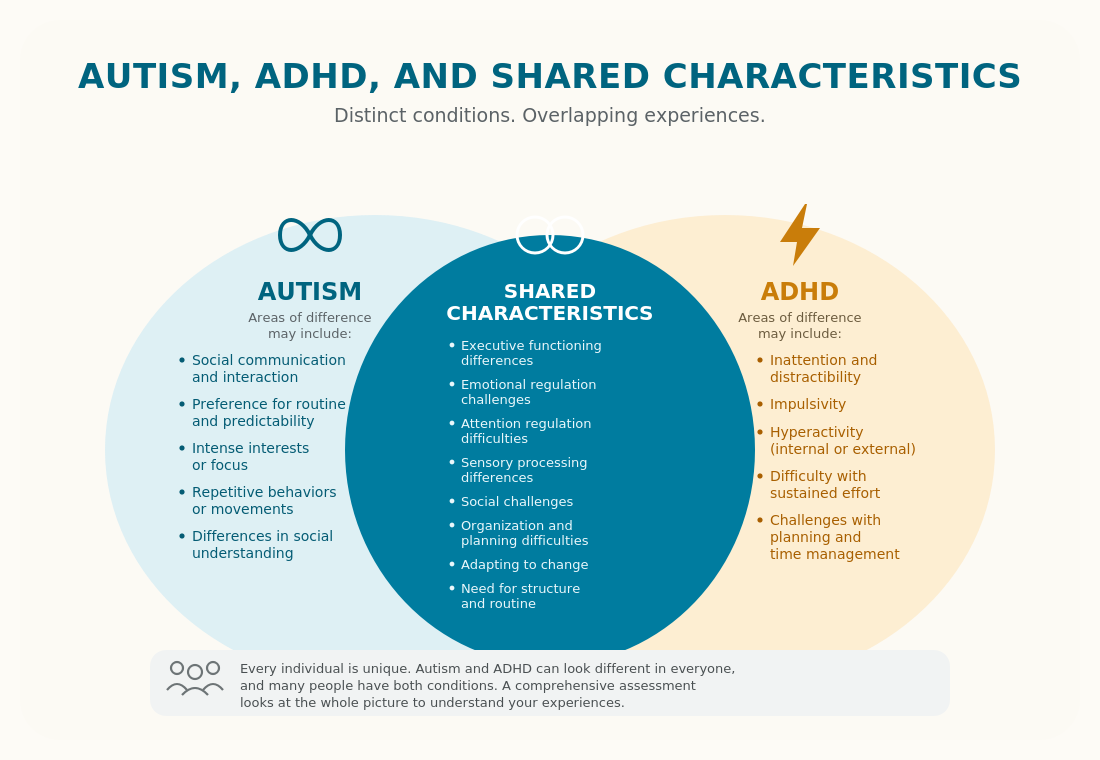
Figure 1. Autism and ADHD are distinct neurodevelopmental conditions that can share some characteristics. Individual presentations vary considerably, and a comprehensive assessment considers much more than symptom overlap.
Why can having both autism and ADHD sometimes feel confusing?
For individuals who meet diagnostic criteria for both autism and ADHD, the interaction between the two conditions can sometimes create experiences that seem contradictory at first glance.
For example, someone may genuinely value routine and predictability while simultaneously struggling to maintain routines because of ADHD-related executive functioning differences. They may become deeply absorbed in areas of interest yet find it difficult to organize everyday responsibilities. They may enjoy spending time with others while also becoming socially or sensory overwhelmed.
These experiences are not necessarily contradictory. Rather, they may reflect the interaction of two neurodevelopmental conditions that influence thinking, attention, behaviour, and daily functioning in different ways.
It is also important to recognize that experiencing some of these patterns does not necessarily mean that someone has both autism and ADHD. Many characteristics associated with autism and ADHD overlap with one another and may also occur in other conditions or simply reflect normal individual differences. This is one reason why comprehensive assessment considers the broader developmental history, the pattern of strengths and challenges, and the underlying reasons for an individual’s experiences rather than focusing on isolated characteristics.
In clinical practice, many individuals who ultimately receive both diagnoses describe feeling that neither autism nor ADHD alone fully explains their experiences. For others, a comprehensive assessment may determine that one condition better accounts for their presentation, or that another explanation is more appropriate. The purpose of assessment is not to fit someone into a particular label, but to develop the most accurate understanding of their individual strengths, challenges, and support needs.
Why are more people talking about “AuDHD” now?
There are several reasons why the term “AuDHD” has become much more common in recent years.
One important reason is that our understanding of autism and ADHD has evolved. Prior to the publication of the DSM-5, clinicians could not diagnose both conditions together. As research has demonstrated that autism and ADHD may co-occur, the diagnostic criteria now allow clinicians to diagnose both presentations when appropriate.
Greater awareness has encouraged more adults to seek assessment after recognizing lifelong patterns that had previously been attributed to personality, anxiety, or simply “coping differently.” For some individuals, a comprehensive assessment confirms both autism and ADHD. For others, it identifies one condition, another explanation, or no diagnosis at all.
In some individuals, characteristics associated with autism and ADHD may also influence or mask one another, making the overall presentation more difficult to recognize. This is one reason why a comprehensive assessment considers the pattern of strengths, challenges, and developmental history rather than focusing on individual characteristics in isolation.
Over the past decade, there has been growing public understanding of autism and ADHD across the lifespan, particularly among adults, women, and individuals whose presentations may not fit outdated ideas about what autism “looks like”. For example, autism is now understood as a broad-spectrum disorder with varying presentations and levels of support needs. This has been an important evolution in our understanding of what it means to be autistic and how these traits may appear and interfere with day-to-day functioning.
Social media has also played a role. Many people first encounter the term “AuDHD” through personal stories shared online. While these experiences can help people feel less alone and encourage them to seek further information, they should not replace a comprehensive clinical assessment. Online content may increase awareness, but it cannot determine whether someone meets diagnostic criteria for autism, ADHD, both conditions, or another explanation.
Social media can also contribute to misunderstandings about mental health by encouraging people to interpret common experiences as signs of a neurodevelopmental or mental health condition. In doing so, individuals might begin to think that common everyday experiences are signs of a mental health or neurodevelopmental condition. It is always important to speak to a healthcare professional when you have questions about your own mental health functioning.
What does a comprehensive autism and ADHD assessment involve?
A comprehensive psychological assessment explores much more than whether someone appears to have characteristics of autism or ADHD.
Rather than simply counting symptoms, psychologists conducting a comprehensive assessment will consider developmental history, current functioning, strengths, challenges, and the underlying reasons for an individual’s experiences. Information is gathered from multiple sources to understand how characteristics have developed over time and how they affect everyday life.
A comprehensive assessment may include:
- a detailed clinical interview
- developmental history
- standardized questionnaires and rating scales
- review of educational, occupational, and medical history when appropriate
- consideration of strengths alongside areas of difficulty
- assessment of functional impact across different settings
- careful consideration of alternative or co-occurring explanations
In clinical practice, assessment does not only involve determining whether someone has one diagnosis or another. It should also involve integrating information from multiple sources to develop the most accurate understanding of the individual’s presentation. This allows the clinician to develop a well-informed diagnostic formulation and provide individualized recommendations, resources, and treatment planning where appropriate.
Why is developmental history so important?
Autism and ADHD are neurodevelopmental conditions, which means that understanding an individual’s developmental history is an essential part of assessment.
Although adults often seek assessment because of current challenges, psychologists are also interested in understanding how characteristics have been present across childhood, adolescence, and adulthood. This is especially important when assessing for a neurodevelopmental disorder, such as autism or ADHD.
Sometimes people recognize lifelong patterns only after learning more about autism or ADHD later in life. Others discover that experiences they had attributed to personality, anxiety, or stress have been present for much longer than they realized.
Developmental history helps psychologists understand not only what characteristics are present today, but also when they emerged, how they have changed over time, and how they have affected functioning across different stages of life.
Developmental history can also help distinguish lifelong neurodevelopmental characteristics from difficulties that may have emerged later in response to stress, trauma, anxiety, depression, or other life experiences.
Psychologists also will want to consider whether characteristics may be better explained by anxiety, trauma, mood disorders, or other factors before reaching diagnostic conclusions.
Why are screening questionnaires not enough?
Screening questionnaires can provide useful information, but they do not establish a diagnosis on their own.
Many people complete online questionnaires before seeking an assessment. These tools may help identify characteristics that warrant further exploration, but they cannot determine whether someone meets diagnostic criteria for autism, ADHD, both conditions, or another condition that may present similarly.
Screening questionnaires are designed to identify characteristics that may warrant further assessment. They are not designed to distinguish between overlapping neurodevelopmental conditions or determine whether another explanation better accounts for an individual’s experiences.
Psychologists interpret questionnaires within the broader context of the individual’s developmental history, current functioning, clinical interview, and other assessment findings.
In practice, it is possible for two people to obtain similar questionnaire scores while receiving different diagnostic conclusions because the broader clinical picture differs. A psychologist with assessment experience can help individuals to understand this more comprehensive picture of individual functioning.
Common misconceptions about autism, ADHD, and “AuDHD”
Several misconceptions continue to create confusion about autism, ADHD, and the term “AuDHD.”
Myth: You cannot have both autism and ADHD.
Current diagnostic criteria allow both diagnoses when an individual meets the full criteria for each condition.
Myth: If I relate to both autism and ADHD, I must have both.
Not necessarily. Many characteristics overlap, and some experiences may also occur in other conditions or as part of normal individual variation. A comprehensive psychological assessment of this nature considers the overall pattern of strengths, challenges, developmental history, and functional impact before reaching diagnostic conclusions.
This is one reason psychologists are cautious about drawing conclusions based on isolated characteristics. It is the overall pattern of development, functioning, and underlying processes that guides diagnosis.
Myth: Everyone with autism also has ADHD.
Although autism and ADHD frequently co-occur, many individuals have autism without ADHD, and many others have ADHD without autism.
Myth: Online content can diagnose me.
Social media, podcasts, and online articles can increase awareness and encourage self-reflection. However, they cannot replace a comprehensive assessment conducted by a qualified healthcare professional.
Conclusion
Understanding the relationship between autism and ADHD can feel complicated, particularly because the two conditions share several characteristics while also remaining distinct diagnoses.
Although many people now use the term “AuDHD” to describe the co-occurrence of autism and ADHD, the role of a comprehensive psychological assessment is not simply to decide whether someone fits a particular label. Rather, it is to understand the individual’s developmental history, current functioning, strengths, challenges, and the underlying reasons for their experiences. Taken together, this information allows psychologists to develop a thoughtful, well-informed diagnostic formulation that guides individualized recommendations and supports.
For some people, assessment confirms that both autism and ADHD are present. For others, one condition may better explain their presentation, or another explanation may emerge. The goal is always the same: developing the most accurate understanding of the individual in order to guide meaningful recommendations and support.
Ultimately, a comprehensive assessment is not about finding the “right label.” It is about developing the most accurate understanding of an individual’s experiences so that recommendations and supports are based on a thoughtful and well-supported formulation.
At Forward Thinking Psychological Services®, we provide comprehensive adult autism and ADHD assessments across Ontario and several other Canadian provinces through secure virtual care. If you have been wondering whether autism, ADHD, or both may help explain your experiences, we would be happy to discuss our assessment process and whether it may be a good fit for your needs.

FAQs:
DISCLAIMER: This content is meant for informational and educational purposes only. Only a licensed psychologist or psychiatrist can diagnose a mental health disorder. The content of this website is not meant to be a substitute for therapy. Visiting this website should not be considered to be equivalent to a relationship with FTPS. Mental health concerns should only be discussed in the context of providing professional services after the consent process has been completed with a qualified FTPS associate outside of our website.
Make FTPS a Google Preferred Source
If you found our blog helpful, you can ensure our latest evidence-based mental health insights, tools, and recovery strategies always appear at the top of your Google Search and AI Overviews.