


Many people struggling with anxiety have heard some version of the same advice: “Just relax.” While often well-intentioned, this advice can feel confusing or frustrating for those living with and experiencing symptoms of anxiety.
Some individuals find themselves asking, “Why can’t I relax even when nothing is wrong?” or “Why does my body feel on edge all the time?” These questions reflect a common experience: anxiety is not simply a reaction to immediate stress, but a pattern that can persist even in relatively calm situations. Increasing anxiety awareness can help shift how we understand these experiences.
In clinical practice, it is common to meet individuals who feel constantly on edge, even when they recognize that there is no immediate danger. Understanding what anxiety feels like and why it behaves this way can help shift the focus from trying to relax to learning how to respond to anxiety more effectively. We want to be able to navigate our worlds with anxiety in tow and still live a meaningful life. We cannot eliminate anxiety. But we can learn to live with it. In my work with individuals experiencing anxiety, this is often the shift that begins to make the biggest difference.
Read on to learn more about how this can be done and what it is like to experience anxiety from the inside out.
What Anxiety Actually Feels Like From the Inside
Anxiety is often described as a state of heightened alertness or activation. Rather than switching off when a situation is safe, the body remains in a state of readiness. This can be uncomfortable for the person experiencing anxiety. It is neither easy nor enjoyable to be in a state of constant alertness. And that can be exhausting. The environment is safe but it feels like there is danger.
A pattern that often emerges when individuals experience more chronic anxiety is that it feels less like a reaction to a specific situation and more like a constant background state.
Many individuals describe:
- a persistent sense of unease
- difficulty settling both physically and mentally
- ongoing “what if” thinking
- a feeling that something might go wrong, even without clear evidence
- physical tension that might be uncomfortable
When working clinically with individuals living with anxiety, it often becomes clear how difficult this experience can be to communicate to others. From the outside, everything may appear calm, while internally the person feels tense or overwhelmed. It is not always obvious that someone is experiencing these symptoms. They might be able to “push through” and engage in daily activities. Of course, there might also be events that are avoided. But, over time, individuals may do a great job of providing “excuses” that sound realistic to others as well. As others believe them, it can be harder to share what people find difficult.
The Physical Symptoms Nobody Warned You About
One of the most surprising aspects of anxiety for many people is how strongly it shows up in the body. In many ways, this makes sense. Our bodies and thoughts constantly influence each other. Therefore, reactions within our bodies impact our thoughts and emotions and our thoughts can also impact our experience of physical sensations.

What does anxiety feel like physically?
Anxiety can involve a number of different physical sensations:
- muscle tension
- restlessness or difficulty sitting still
- shallow or rapid breathing
- increased heart rate
- gastrointestinal discomfort
- fatigue from ongoing activation
These symptoms are part of the body’s natural stress response. Many individuals are surprised by how uncomfortable physical anxiety can feel, particularly when symptoms appear without a clear external trigger. And this is where people can get stuck.
Why physical symptoms can persist
Over time, the body can become more sensitive to internal cues. A small increase in heart rate or tension may be interpreted as a signal that something is wrong, which can further increase anxiety. As a result, individuals may look to external factors to inform them of what might be happening. However, when anxiety is the primary driver, there may be no clear external cause. Individuals may then turn inwards and try to understand what the “issue” actually is. This can result in ongoing vigilance regarding thoughts, feelings, and body sensations.
In these situations, the environment is actually safe, but the individual’s body remains in a state of alertness. People can become conditioned to this alertness over time.
Common Anxiety Experiences
|
Area |
How It May Show Up |
|---|---|
|
Physical sensations |
Muscle tension, restlessness, increased heart rate |
|
Thoughts |
Persistent worry, “what if” thinking |
|
Behaviour |
Avoidance, reassurance seeking |
|
Attention |
Heightened focus on potential threats; hypervigilance |
|
Energy |
Possible fatigue from ongoing activation |
Why “Just Breathe” or “Just Relax” Can Actually Make It Worse
For many people, being told to relax does not reduce anxiety. In some cases, it can increase frustration or self-criticism. It often feels invalidating, and others may be minimizing what is experienced as extremely impactful and debilitating. This can be distressing for many.
Why “just relax” doesn’t work for anxiety
Whether one experiences anxiety or not is not simply a matter of effort or willpower. It reflects patterns in how the brain and body respond to perceived threats.
One of the challenges with anxiety is that effort alone does not override the body’s threat response. This can cause frustration when someone just wants to feel “better”.
When someone is told to relax, they are often already trying to do exactly that. When it does not work, it can lead to thoughts such as:
- “Why can’t I control this?”
- “What’s wrong with me?”
- “Why am I different from everyone else?”
When focusing on relaxation backfires
Focusing too much on trying to relax can increase awareness of physical sensations, which may unintentionally reinforce anxiety.
The more attention is directed toward eliminating anxiety, the more noticeable those sensations can become. This aligns with the idea that when we try not to think about something, we end up thinking about it more than anything else.
Therefore, relaxation is typically not something that we can just force our bodies to do successfully.
What to Say Instead of “Calm Down”
Supporting someone with anxiety often involves shifting how we respond.
Instead of saying:
A more helpful response may include:
In situations like this, validation does not mean agreeing that something is dangerous or not. It means recognizing that the experience feels real and significant.
How to Support Someone With Anxiety (Without Enabling Avoidance)
This is often one of the most challenging aspects of supporting someone with anxiety. Of course, we want to help individuals and protect them from feelings of discomfort. But when it comes to anxiety, that can also lead to supporting individuals in their avoidance behaviour. And that, unfortunately, can reinforce the anxiety in the long run.
The balance between support and avoidance
Avoidance can provide short-term relief, but over time, it tends to reinforce anxiety. Although many of us are aware of this, it can sometimes be hard to resist the urge to engage in avoidance behaviours. When we avoid it, the behaviour is reinforced.
This is a typical pattern that can often emerge:
Anxiety → Avoidance → Temporary Relief → Increased Anxiety
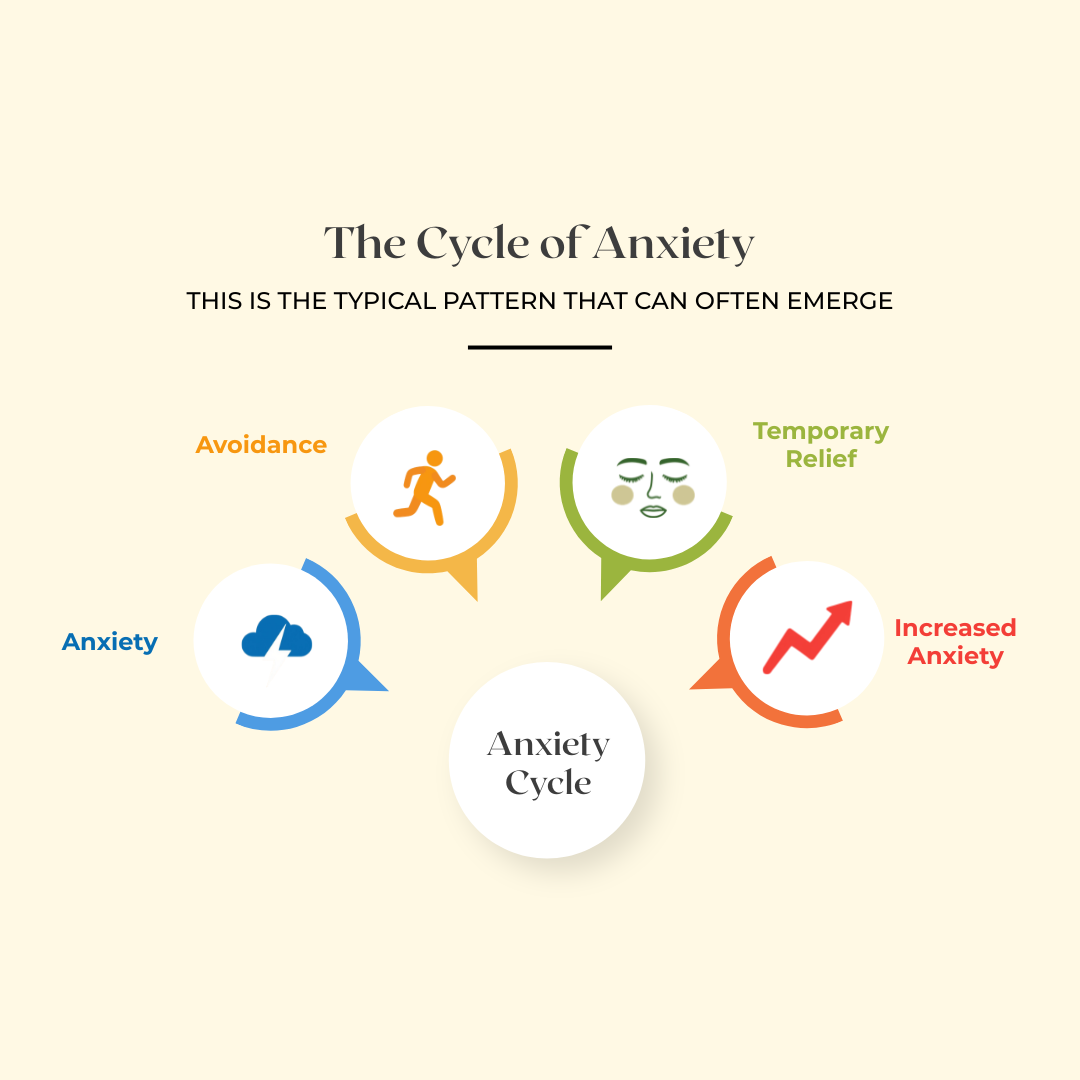
When we fall into this pattern/trap, we might continue to engage in avoidance because the temporary relief is very reinforcing. However, in the long run, it can really impact how much anxiety is experienced.
What supportive responses look like
Let’s shift our focus and really think about what a more helpful and supportive response to anxiety can include:
- encouraging gradual steps rather than complete avoidance
- focusing on what feels manageable, even when those tasks might feel small
- bringing down the overwhelm by supporting all the progress that is being made
- maintaining a calm and steady presence
- avoiding repeated reassurance that reinforces uncertainty
When working clinically with individuals and families, it is common to see how well-intentioned reassurance can unintentionally maintain anxiety over time. It is important to break that connection in order for progress to begin.
What Good Anxiety Treatment Looks Like
Understanding what actually helps anxiety is an important part of addressing common misconceptions. Below, we will review what evidence-based treatment for anxiety actually looks like. It can be difficult to carry these strategies out on your own, at times. Therefore, it can often be helpful to begin to look into working with a professional who has the training and expertise to help with the anxiety.
Moving beyond symptom elimination
Effective treatment focuses on changing how someone responds to anxiety rather than trying to eliminate it completely. We want to help individuals learn to navigate their lives with a different relationship to their anxiety. In the same way, we cannot eliminate positive emotions; we also cannot eliminate those that feel more uncomfortable to experience (i.e., such as anxiety or anger).
Evidence-based approaches
Approaches such as cognitive behavioural therapy (CBT) and exposure-based strategies are evidence-based treatment strategies for individuals experiencing symptoms of anxiety.
These approaches help individuals in a variety of ways, including:
- responding differently to anxious thoughts
- reducing patterns of avoidance
- building tolerance for distress and discomfort
- increasing confidence over time
In clinical practice, treatment is tailored to the individual, taking into account the specific patterns that maintain anxiety.

When It’s Time to Get Professional Help
We know that deciding when to seek support can feel unclear and, sometimes, even scary. It can be unclear what therapy might involve. When individuals reach out to us, they often will say that it can be difficult to discuss what has been concerning them, which is very understandable. As professionals, we want to make the experience of reaching out for help as smooth and supportive as possible.
Although not reviewed in detail in this post, you want to find a therapist who will meet you where you are and help support you to decrease the avoidance. We wrote about what to expect in your first month of exposure and response prevention therapy for individuals with OCD. Of course, exposure therapy is also something that is used when working with individuals with anxiety disorders. We hope our previous post might help you to begin to understand what happens when reaching out for therapy, even if the presentation is different.
If you are wondering whether it is time to get professional help, there are a few factors you might want to consider.
For many individuals, reaching out for help becomes more relevant when:
- anxiety feels persistent or difficult to manage on a regular and consistent basis
- physical symptoms interfere with daily life
- avoidance begins to limit important activities, such as work, relationships and education
- strategies that once helped are no longer effective
In many cases, people reach this point after trying to manage anxiety on their own for some time. This can be both frustrating and, at times, debilitating.
A helpful way to think about this is not whether anxiety is “severe enough,” but whether having support would make daily life feel more manageable. If your life is being significantly altered and impacted by anxiety, it might be time to reach out for professional help. We are here to help you and hope you will contact us to learn more.
The following imaginary clinical vignettes illustrate how symptoms of anxiety can develop and what individuals and families might experience when this happens. It is based on years of Dr. Taube-Schiff’s clinical experience as a psychologist, but in no way resembles any actual clients seen. It is purely fictional.
Jordan is a 32-year-old professional who describes living with a constant sense of tension and unease. Despite doing well at work, Jordan often feels physically on edge, particularly in the evenings when things are supposed to feel more relaxed.
Jordan reports frequently asking, “Why can’t I relax even when nothing is wrong?” Physical symptoms include muscle tension, restlessness, and difficulty settling at night. Attempts to “just calm down” or distract from the anxiety tend to provide only temporary relief.
Over time, Jordan has begun avoiding certain situations that feel more activating, such as social events or unstructured time, in an effort to reduce discomfort. While this helps in the short term, it has also led to increased anxiety and a growing sense of limitation.
In treatment, the focus shifts from trying to eliminate anxiety to understanding how these patterns are maintained. Through gradual changes in how Jordan responds to both anxious thoughts and physical sensations, anxiety becomes more manageable and less disruptive over time.
Jordan also spoke to his therapist about the difficulty explaining these experiences to family members, who often encourage relaxation without fully understanding how persistent the anxiety feels. In response to this, a family session was conducted and focused on psychoeducation for Jordan’s family members so they could support him without invalidating his experience of anxiety.
A similar pattern can also be seen in adolescents, where anxiety begins to affect school and daily functioning.
Ava is a 16-year-old student who has recently begun missing school more frequently due to anxiety. Her parents describe her as capable and motivated, but increasingly overwhelmed by physical symptoms in the morning, including nausea, restlessness, and a sense of panic about the day ahead.
Ava often says she feels anxious “for no clear reason,” and becomes frustrated when told to “just relax” or “push through it.” While staying home temporarily reduces her anxiety, returning to school has become progressively more difficult over time.
Her parents want to be supportive but are unsure how to respond without making things worse. At times, they offer reassurance or allow Ava to avoid activities that make her anxious in order to reduce immediate distress. However, everyone is noticing that this pattern is becoming harder to interrupt.
In working with Ava and her family, the focus shifts toward understanding how anxiety is being maintained. Treatment involves gradually reintroducing school-related activities, building tolerance for physical symptoms, and helping both Ava and her parents respond to anxiety in ways that support long-term functioning rather than short-term relief. Over time, this helps far more than avoidance behaviour and giving in to the anxiety.
Supporting Yourself or Someone Living With Anxiety
Living with anxiety can be exhausting, particularly when it is not fully understood by others.
Many individuals describe a sense of relief when they begin to understand how anxiety works and recognize that their experience is both common and treatable.
Understanding these patterns can shift the focus away from trying to eliminate anxiety and toward learning how to respond to it more effectively.
Next Steps
If you are living with anxiety or supporting someone who is, speaking with a clinician can help clarify what is happening and identify practical next steps.
At Forward Thinking Psychological Services, our online therapy services focus on helping individuals understand anxiety and develop strategies that are grounded in evidence-based approaches. Our services are offered online across Ontario, British Columbia, Alberta, Nova Scotia, New Brunswick, and Quebec. We work with youth, adults, couples and families who are experiencing a variety of symptoms of anxiety. If you feel ready, reaching out can be a helpful next step.
References
Avoidance Maintains Anxiety | Psychology Today Canada
Treating Anxiety with CBT | Article | Therapist Aid
FAQs: Common Questions About Anxiety
DISCLAIMER: This content is meant for informational and educational purposes only. Only a licensed psychologist or psychiatrist can diagnose a mental health disorder. The content of this website is not meant to be a substitute for therapy. Visiting this website should not be considered to be equivalent to a relationship with FTPS. Mental health concerns should only be discussed in the context of providing professional services after the consent process has been completed with a qualified FTPS associate outside of our website.
Make FTPS a Google Preferred Source
If you found our blog helpful, you can ensure our latest evidence-based mental health insights, tools, and recovery strategies always appear at the top of your Google Search and AI Overviews.