

When a child has obsessive-compulsive disorder (OCD) or significant anxiety, parents naturally want to help. You want to reassure your child that something bad will not happen, help them avoid something that feels overwhelming, change a family routine, or do something for them that they are afraid to do themselves.
Sometimes these responses are simply part of being a supportive parent. At other times, however, families can gradually begin changing their behaviour around a child’s OCD or anxiety. These behaviours are known as family accommodation.
Family accommodation can reduce a child’s distress in the moment, which is one reason it is so understandable and common. The concern is when accommodation becomes part of the ongoing OCD or anxiety cycle, making it harder for the child to tolerate fear and distress, resist their compulsions, approach feared situations or develop greater confidence in their ability to cope.
So how can parents tell the difference between supporting their child and accommodating OCD or anxiety?

What Is Family Accommodation in OCD?
Family accommodation in OCD occurs when parents or other family members change what they do in response to a child’s obsessions, compulsions or OCD-related avoidance.
For example, parents might:
- repeatedly answer reassurance questions
- participate in checking or cleaning rituals
- prepare food according to OCD rules
- avoid touching particular objects because of the child’s contamination fears
- help the child complete something in a very particular way
- change family routines to prevent OCD triggers
- allow OCD rules to determine what siblings or other family members can do
Research on pediatric OCD has found that family accommodation is common and is associated with greater symptom severity and impairment. Importantly, this does not mean that parents cause OCD. Children with more severe symptoms may also require or elicit greater accommodation from the people around them.
Accommodation usually develops because parents are trying to help their child manage genuine distress. However, these behaviours can become part of the OCD cycle and can also affect routine family functioning and the quality of life of other family members.
Parents may find it helpful to learn more about how parents can support a child with OCD without making it worse.
Can Family Accommodation Also Happen With Anxiety?
Yes. Family accommodation is also well established in childhood anxiety, although parents may be accommodating avoidance or anxiety-driven behaviour rather than compulsions.
For example, a parent might:
- speak for a socially anxious child
- repeatedly change plans to prevent separation
- allow a child to avoid activities because they provoke anxiety
- take over tasks the child is afraid to complete independently
- repeatedly check a child’s work because the child is afraid of making a mistake
- alter family routines to prevent the child from encountering feared situations
This distinction matters.
With OCD, accommodation often becomes connected to compulsions, reassurance seeking or avoidance of OCD triggers. With anxiety, accommodation may instead help the child escape or reduce an anxiety-provoking experience.
The broader pattern, however, can be similar: the family increasingly changes its behaviour in response to the child’s fear or distress.
That does not mean every adjustment made for an anxious child is problematic. Understanding the purpose and function of the response is important.
Why Do Parents Accommodate OCD or Anxiety?
Parents usually accommodate because accommodation works in the short term. It can quickly reduce a child’s distress and make a difficult situation easier for the entire family.
Imagine that your child is extremely distressed about whether the front door is locked. You tell them that you checked it. They ask again. You reassure them again. They ask again. You go and check it yourself to let them know it is definitely locked. Eventually they settle enough to go to bed.
Or, perhaps, your child becomes highly anxious about ordering their own meal at a restaurant. You order for them, their anxiety decreases, and the family can enjoy dinner.
These are understandable responses.
The difficulty arises when accommodation becomes the main way the child manages anxiety or OCD.
A child who repeatedly escapes feared situations may have fewer opportunities to discover that anxiety can be tolerated and managed. A child with OCD who relies on family reassurance or participation in rituals may have fewer opportunities to experience distress without completing a compulsion. They also have less of an opportunity to learn that they can cope with the distress and anxiety.
Research consistently finds an association between greater family accommodation and greater OCD or anxiety severity and impairment. However, the relationship is complex. Accommodation may contribute to maintaining difficulties, while more severe symptoms can also lead families to accommodate more.
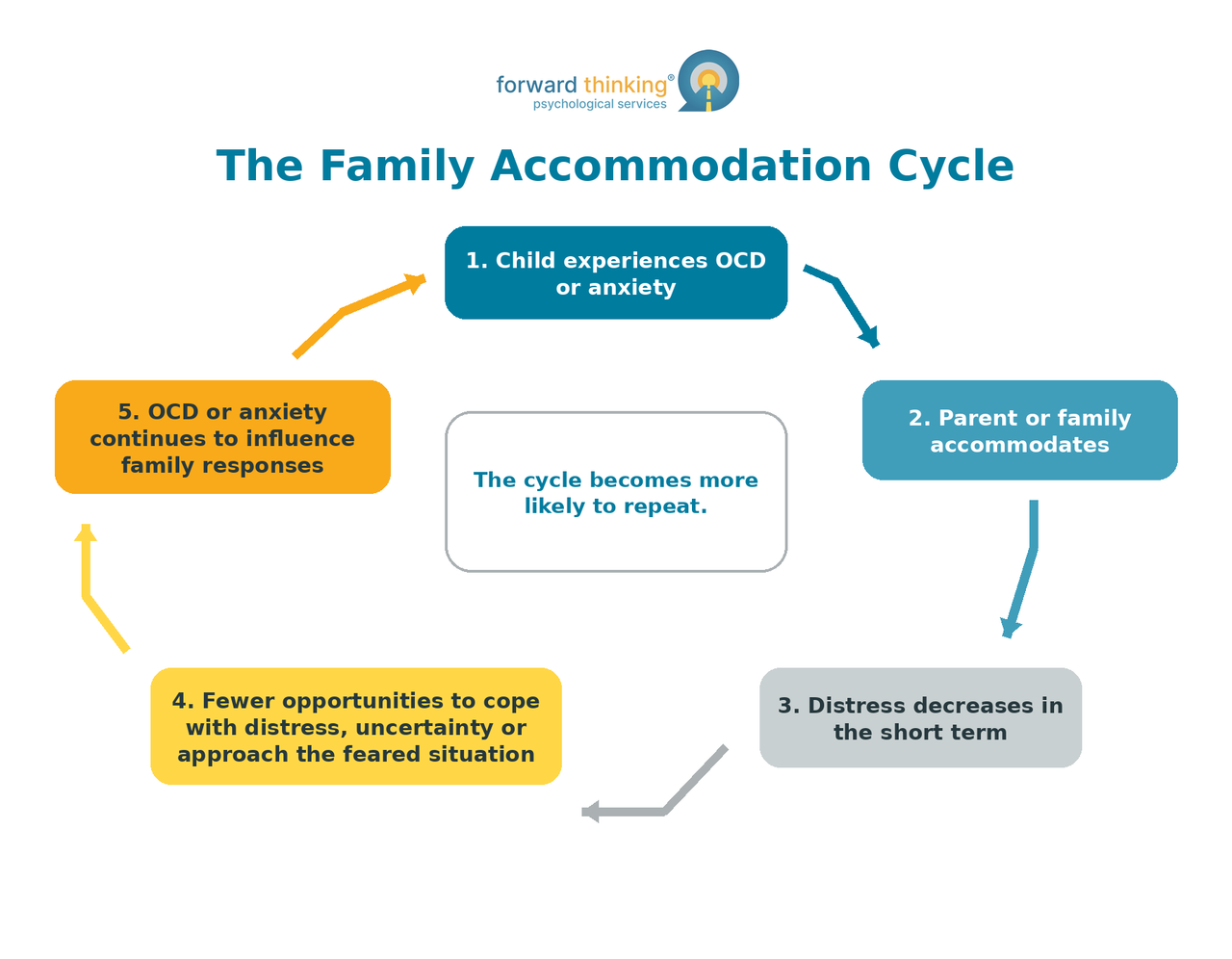
Family accommodation can reduce a child’s distress in the short term while also making it more likely that OCD or anxiety will continue to shape family responses over time.
How Do I Know If I Am Accommodating My Child’s OCD or Anxiety?
The most useful question is often not simply what you are doing, but why you are doing it and what function your response is serving.
Helping your child is not automatically an accommodation. Neither is changing a plan, answering a question or providing reassurance.
Instead, consider questions such as:
- Am I doing this primarily to make my child’s anxiety disappear?
- Is my child becoming increasingly dependent on me doing this?
- What happens when I do not provide reassurance, complete the task or change the plan?
- Has this response increased over time?
- Is OCD or anxiety beginning to determine what other members of the family can do?
- Is my response helping my child approach something difficult, or consistently helping them avoid it?
- Is this response consistent with the goals of my child’s treatment?
Looking at the pattern over time can be more informative than judging a single parental response in isolation.
What Is the Difference Between Supporting and Accommodating a Child?
Support helps a child cope with distress, while accommodation can increasingly help the child avoid distress, eliminate uncertainty or follow the demands of OCD or anxiety.
The distinction is not always black and white, but this comparison can be useful:
|
Support |
Accommodation |
|---|---|
|
Acknowledges that the child’s distress is real |
Repeatedly tries to eliminate the child’s distress |
|
Communicates confidence that the child can cope |
Increasingly communicates through behaviour that the child cannot cope without parental help |
|
Helps the child approach difficult situations when appropriate |
Consistently helps the child avoid feared situations |
|
Encourages age-appropriate independence |
Takes over tasks primarily because anxiety makes them difficult |
|
Supports treatment goals |
Becomes incorporated into compulsions, avoidance or anxiety-driven family routines |
For example, a child might say:
“I can’t go to school. I’m too anxious.”
A supportive response might acknowledge that the anxiety is very real while helping the child follow an appropriately developed plan for returning to school.
Accommodation might involve repeatedly allowing anxiety alone to determine whether the child attends, with family routines increasingly changing to prevent the child from encountering the feared situation.
Even this example requires context. Children can have difficulty attending school for many reasons, and the appropriate response depends on understanding what is driving the difficulty.
Accommodation is best understood by looking at the function of a parent’s response, not simply the behaviour itself.
Helping your child, changing a plan or providing reassurance is not automatic accommodation. It becomes important to look at why the response is happening, whether OCD or anxiety is repeatedly determining what the family does, and whether the child is becoming increasingly dependent on the response in order to manage distress.
Is Reassurance Always Family Accommodation?
No. Reassurance is a normal part of parenting and is not automatically accommodation.
Children flourish when raised by parents who comfort them, help them understand difficult experiences and communicate confidence in their ability to cope.
Reassurance becomes more clinically relevant when it is repetitive, driven by OCD or anxiety, and is relied upon by the child to obtain temporary relief.
For example, a child with OCD might ask:
“Are you sure I didn’t hurt someone?”
A parent answers no.
A few minutes later:
“But are you completely sure?”
Then:
“Would you tell me if you thought I did?”
Each answer may briefly reduce the child’s distress, but the doubt soon returns. In this situation, reassurance may begin functioning similarly to a compulsion by repeatedly providing short-term relief from uncertainty.
That does not mean parents should suddenly refuse to answer every question their child asks. How reassurance is addressed should depend on the child, the clinical problem and, when relevant, the child’s treatment plan.
How Can Parents Support a Child Without Reinforcing Compulsions or Avoidance?
Parents can remain warm and supportive while changing responses that have become part of a child’s OCD or anxiety cycle.
A useful starting point is to communicate two messages:
“I understand that this is really hard.”
and
“I believe you can learn to handle it.”
Those messages allow parents to validate a child’s emotional experience without necessarily agreeing that the feared situation is dangerous, repeatedly resolving uncertainty, participating in a compulsion or automatically removing the anxiety-provoking situation.
In practice, parents can also:
- Validate the feeling without confirming the fear. A parent can acknowledge, “I can see how anxious this situation is making you,” without repeatedly assuring the child that the feared outcome cannot happen.
- Pause before automatically helping. If a child asks a parent to speak for them, check something again or complete an anxiety-provoking task, consider whether the child could do some or all of it themselves.
- Encourage approach rather than avoidance when appropriate. Help the child take a manageable step toward something they fear rather than automatically removing the situation. This might mean supporting the child to execute part of the behaviour they are avoiding, even if not all of it.
- Avoid debating with OCD. Trying to prove that an obsession is unreasonable can turn into another form of reassurance. Parents can acknowledge the distress without trying to resolve the uncertainty.
- Support treatment strategies. If the child is participating in CBT or ERP, family responses can be coordinated with what the child is practising in treatment. This allows for essential opportunities to support in between session work.
- Notice and reinforce coping. Recognize when the child tolerates uncertainty, resists a compulsion, approaches something difficult or manages distress more independently.
- Model confidence without demanding that anxiety disappear. A child does not need to feel completely calm before taking a step forward.
The goal is not to become less supportive. It is to help the child experience parental support without requiring the family to increasingly organize itself around OCD or anxiety.
How Can Parents Begin Reducing Family Accommodation?
The goal is not to eliminate every adjustment a family makes for a child with OCD or anxiety. Families accommodate one another in many healthy ways, and children differ in age, developmental level, abilities, neurodevelopmental needs and current level of functioning.
Instead, it can be useful to identify accommodations that have become closely connected to symptoms or are significantly affecting the child’s or family’s functioning.
Parents might begin by asking:
- Which accommodations are happening most often?
- Which ones interfere most with family life or the child’s independence?
- Which behaviours appear to be directly connected to compulsions or avoidance?
- Which accommodation would be realistic to address first?
- What could we do instead?
- Does the proposed change fit with our child’s treatment plan?
Once a specific accommodation has been identified, reducing it is generally more helpful when the change is planned and communicated rather than introduced suddenly during a moment of high distress.
If a parent has provided reassurance many times every evening for months, abruptly announcing, “I’m never answering you again,” is unlikely to be the most constructive approach.
Depending on the situation, a more thoughtful process may involve:
- identifying one specific accommodation
- understanding how it relates to the child’s OCD or anxiety
- deciding what the parent will do differently
- explaining the change ahead of time
- communicating confidence in the child’s ability to cope
- responding consistently once the change begins
- reviewing whether the plan needs adjustment
For example, a parent might say:
“I know this uncertainty is really hard for you. We’ve been answering this question many times because we want to help you feel better. We’re working on helping you handle the uncertainty instead, so we’re going to respond differently when OCD asks us for that reassurance.”
The exact language, pace and approach should be appropriate to the child’s age, presentation and treatment plan. The aim is not to make family life deliberately difficult for the child. It is to prevent OCD or anxiety from unnecessarily determining how the family functions.
What If My Child Gets More Anxious or Angry When We Reduce Accommodation?
A child may initially become more anxious, frustrated or angry when a family response they have relied on begins to change. This does not automatically mean that the change is wrong.
At the same time, increased distress should not automatically be interpreted as a reason to continue with a plan regardless of what is happening.
A child’s response may provide useful information. The change may be happening too quickly. The child may not understand the plan. The family may be targeting the wrong behaviour. Another clinical or developmental factor may be affecting the situation. Or the child may simply be experiencing the discomfort that comes with responding differently to anxiety or OCD.
When symptoms are severe, family conflict is high, or parents are uncertain about what should change, individualized professional guidance can be particularly useful.
What Does Evidence-Based Family Support for OCD and Anxiety Look Like?
Evidence-based family support generally aims to help parents respond to distress in ways that support treatment and coping without unnecessarily reinforcing compulsions or avoidance.
For children with OCD, cognitive behavioural therapy (CBT) with exposure and response prevention (ERP) is an evidence-based treatment. Depending on the child’s age and circumstances, parents may be involved in treatment and learn how to reduce accommodation while supporting ERP goals.
For childhood anxiety, CBT is also a well-established intervention. Parent-based treatments can additionally target family accommodation.
One example is Supportive Parenting for Anxious Childhood Emotions (SPACE). SPACE works directly with parents and emphasizes reducing accommodation while increasing supportive responses that communicate both acceptance of the child’s distress and confidence in their ability to cope.
In a randomized clinical trial involving children ages 7 to 14 with anxiety disorders, SPACE was found to be noninferior to child-focused CBT for anxiety outcomes and produced greater reductions in family accommodation. More recent reviews have found promising results while also noting that the broader evidence base continues to develop.
This is particularly relevant to the distinction between support and accommodation. Reducing accommodation does not require parents to become less empathic. In fact, supportive communication is an explicit part of parent-based approaches such as SPACE.
When Should Parents Seek Professional Help?
Professional support may be useful when OCD or anxiety is significantly interfering with a child’s functioning or when family accommodation has become difficult to change without guidance.
Consider seeking help when:
- OCD or anxiety is interfering with school, friendships, sleep, activities or independence
- family routines are increasingly organized around the child’s symptoms
- parents or siblings are regularly participating in rituals
- reassurance seeking has become frequent or difficult to interrupt
- the child is avoiding an increasing number of situations
- attempts to change family responses lead to substantial conflict or distress
- parents disagree about how to respond
- you are unsure whether a behaviour reflects OCD, anxiety or something else
Assessment can be especially important when the clinical picture is unclear. Reassurance seeking, avoidance, rigidity and reliance on family members can occur for different reasons. Understanding what is driving the behaviour helps determine the most appropriate intervention. Parents can learn more about teen anxiety and OCD assessment in Ontario.
At Forward Thinking Psychological Services®, we provide evidence-based assessment and treatment for children and teenagers experiencing OCD and anxiety. Treatment may include CBT and ERP when appropriate, along with work with parents and families to understand accommodation, reduce unhelpful patterns and develop supportive ways of responding to anxiety and OCD. Families who would like to learn more can contact Forward Thinking Psychological Services®.
Moving Forward
Parents usually accommodate because they are trying to help their child. Recognizing family accommodation is therefore not about blaming parents or expecting them to stop being responsive.
The goal is to notice when OCD or anxiety has begun to shape family behaviour in ways that provide immediate relief but may make it harder for a child to develop greater confidence and independence in managing distress. Parents can remain warm, validating and involved while gradually changing responses that have become part of the OCD or anxiety cycle.
Sometimes the most supportive response is not the one that makes anxiety disappear immediately. It is the one that communicates, “I know this is hard. I am here with you, and I believe you can learn to cope with it.”

FAQs:
DISCLAIMER: This content is meant for informational and educational purposes only. Only a licensed psychologist or psychiatrist can diagnose a mental health disorder. The content of this website is not meant to be a substitute for therapy. Visiting this website should not be considered to be equivalent to a relationship with FTPS. Mental health concerns should only be discussed in the context of providing professional services after the consent process has been completed with a qualified FTPS associate outside of our website.
Make FTPS a Google Preferred Source
If you found our blog helpful, you can ensure our latest evidence-based mental health insights, tools, and recovery strategies always appear at the top of your Google Search and AI Overviews.