

ADHD can affect romantic relationships in ways that extend well beyond attention and organization. Differences in how partners manage responsibilities, communicate, regulate emotions and follow through on commitments can contribute to recurring misunderstandings and conflict. Over time, both partners may feel frustrated, misunderstood or disconnected from each other.
When ADHD impacts a relationship, couples therapy can help partners understand patterns of behaviour that may interfere and develop more effective ways of responding to them. The goal is not to label one partner as the “problem” or attribute every relationship difficulty to ADHD. Rather, therapy focuses on how ADHD-related challenges interact with relationship dynamics and what both partners can do to improve their relationship.
Couples therapy can help partners improve communication, address imbalances in responsibilities, reduce recurring conflict and rebuild emotional connection. It can also help couples establish realistic expectations and practical strategies that account for ADHD-related difficulties.

How Can ADHD Affect a Romantic Relationship?
When one partner has ADHD, difficulties with attention, working memory, planning, organization, time management and emotional regulation may influence how partners communicate, manage everyday responsibilities and respond to conflict.
For example, one partner may forget an agreed-upon task, struggle to shift attention during a conversation or have difficulty following through on plans. The other partner may interpret these behaviours as a lack of consideration, commitment or interest.
Over time, these experiences can contribute to recurring relationship patterns. One partner may feel criticized or misunderstood, while the other feels increasingly responsible for managing daily life.
ADHD does not affect every person or relationship in the same way. The nature and extent of relationship difficulties depend on each partner’s strengths, coping strategies, emotional experiences and the broader relationship context. Rather than assigning blame, it is helpful to understand how difficulties arise and how both partners respond to them. This understanding creates opportunities for the couple to approach challenges collaboratively, rather than viewing them as individual failures.
What Does Recent Research Tell Us About ADHD and Relationships?
A qualitative study by O’Brien and colleagues (2025) explored how adults with ADHD experience romantic relationships. The findings highlighted themes involving emotional sensitivity, attention and relationship stability, imbalances in responsibilities, and the importance of self-understanding.
Participants described how ADHD-related difficulties could contribute to misunderstandings, feelings of inadequacy and challenges navigating relationship expectations.
These findings illustrate why relationship difficulties associated with ADHD may involve much more than forgetfulness or disorganization. They also highlight the importance of understanding each partner’s experience rather than relying on assumptions about what particular behaviours mean.
Although this research was not a study of couples therapy outcomes, it provides useful insight into the relationship patterns that therapy may help couples address.
What Can Couples Therapy Actually Change When ADHD Is Involved?
Couples therapy can help partners identify recurring patterns, understand what contributes to them and practise different ways of responding.
Interventions within couples therapy address how partners communicate, manage expectations, share responsibilities and respond to difficulties when they arise.
Although ADHD may create significant challenges for individuals, learning skills to manage specific ADHD symptoms is generally a focus of individual treatment. Couples therapy focuses on the relationship itself and how ADHD-related difficulties affect interactions between partners.
Depending on the couple’s needs, therapy may focus on several interconnected areas.
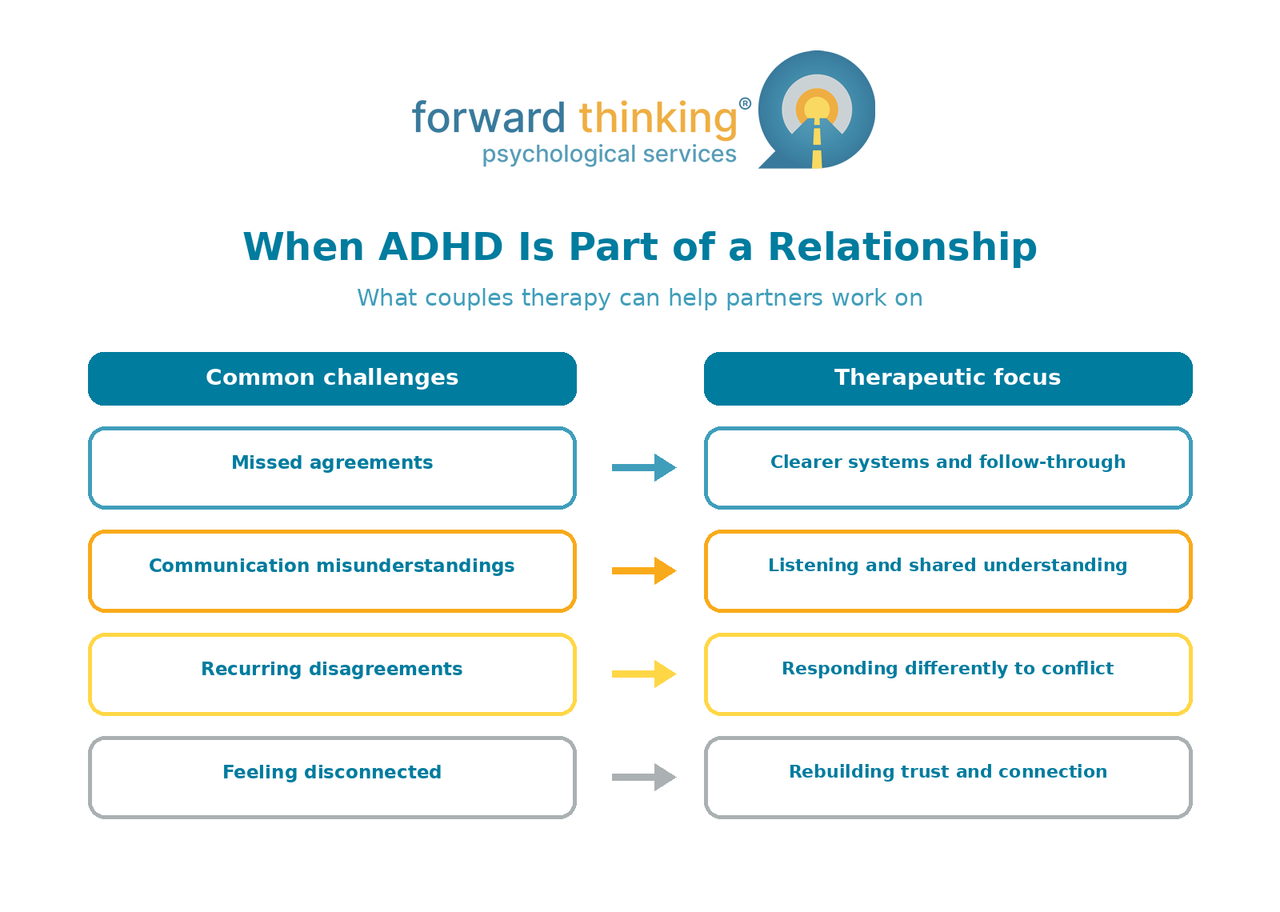
Couples therapy can help partners address both the practical challenges associated with ADHD and the ways these difficulties affect communication, conflict and emotional connection.
1. Improving Communication and Reducing Misunderstandings
Communication difficulties can arise when partners have different expectations about attention, listening, remembering conversations or following through on agreements.
For example, a partner with ADHD may become distracted during a discussion, interrupt unintentionally or struggle to remember details discussed earlier. Their partner may experience these behaviours as dismissive or disrespectful.
Couples therapy can help partners distinguish between the impact of a behaviour and assumptions about the intention behind it.
This does not mean dismissing the impact of behaviours associated with ADHD. Rather, it allows couples to address those behaviours more effectively without automatically interpreting them as evidence of indifference or lack of caring. How a partner responds to ADHD-related behaviours will vary across relationships, and couples therapy explores those experiences to guide appropriate interventions.
Therapy may help couples:
- Establish clearer ways of communicating important information.
- Choose appropriate times for conversations that require sustained attention.
- Practise listening, clarification and checking for understanding.
- Reduce criticism, defensiveness and escalating arguments.
- Develop strategies for remembering and following through on agreements.
For some couples, this may involve relatively straightforward adjustments, such as writing down important decisions or reducing distractions during conversations. For others, more extensive work may be needed to address longstanding patterns of conflict.
2. Addressing Household Responsibilities and the Mental Load
One of the most common sources of conflict in relationships affected by ADHD involves the management of everyday responsibilities.
Difficulties with planning, remembering, prioritizing and completing tasks can create imbalances in household labour, parenting responsibilities or financial management.
A partner without ADHD may gradually take on more of the planning and monitoring required to keep daily life organized. They may feel that they are responsible not only for completing tasks but also for remembering what needs to be done, anticipating problems and reminding their partner.
Meanwhile, the partner with ADHD may feel criticized, controlled or discouraged by repeated reminders and perceived failures.
Over time, these patterns can become entrenched.
Couples therapy can help partners examine how responsibilities are currently managed and develop systems that are more equitable, realistic and sustainable.
This may include clarifying who is responsible for particular tasks, identifying barriers to follow-through, establishing shared organizational systems and agreeing on how partners will communicate when responsibilities cannot be completed as planned.
The goal is not necessarily to divide every task equally, but to develop an arrangement that both partners experience as fair and workable.
It is also important that practical strategies do not inadvertently leave one partner responsible for supervising or managing the other, as this can create an unhelpful dynamic within the relationship.
3. Understanding and Changing Recurring Conflict Patterns
Couples sometimes find themselves having the same argument repeatedly, even when both partners genuinely want things to improve.
Consider the following example:
A common relationship cycle
A task or commitment is forgotten
One partner feels frustrated or unsupported
The other partner feels criticized or inadequate
Defensiveness, withdrawal or conflict follows
The underlying difficulty remains unresolved
This pattern may repeat when the couple has not addressed both the practical difficulty and the emotional responses surrounding it.
In couples therapy, partners can learn to recognize the pattern itself rather than viewing each new disagreement as an isolated incident.
A therapist may help the couple intervene at different points in this cycle. This could involve identifying barriers to completing the original task, exploring how each partner interprets what happened, or practising alternative responses when frustration develops.
For example, rather than allowing an unfinished task to become an argument about whether one partner cares about the relationship, the couple may learn to acknowledge the disappointment, identify what interfered with follow-through and agree on a more workable approach.
Importantly, understanding the contribution of ADHD does not mean that harmful or hurtful behaviour should be excused. Both partners remain responsible for how they treat one another, even when particular behaviours are influenced by neurodevelopmental difficulties.
4. Addressing Emotional Regulation and Sensitivity to Criticism
Emotional regulation difficulties can be particularly relevant when ADHD affects a relationship.
Some adults with ADHD experience strong emotional reactions, frustration or sensitivity to perceived criticism or rejection. These experiences may contribute to rapid escalation during disagreements or difficulty recovering after conflict.
Partners may also develop heightened emotional responses after repeated experiences of disappointment, criticism or feeling unsupported.
Couples therapy can help partners recognize how emotional reactions unfold during difficult interactions and develop strategies to respond differently. For example, one partner may express frustration about an unfinished task, while the other experiences the conversation as criticism and becomes defensive. The resulting argument may become increasingly focused on each partner’s reaction rather than the original concern.
Therapy can help couples identify the point at which these interactions begin to escalate. Partners may practise recognizing early signs of emotional activation, communicating when they need a brief pause and returning to the conversation once they are better able to engage constructively.
Couples may also work on expressing concerns more directly and specifically. Rather than saying, “You never follow through on anything,” a partner might describe the particular difficulty and its impact: “When the bills are not paid on time, I feel anxious because I worry about our finances.” The other partner can practise acknowledging that impact without immediately becoming defensive or assuming that the concern represents a global criticism of their character.
Therapy can also address how couples repair interactions after conflict. This may involve acknowledging hurtful comments, taking responsibility for one’s behaviour, validating the other person’s experience and discussing what could be handled differently in the future.
These strategies do not eliminate emotional reactions, but they can help couples respond to those reactions in ways that are less likely to intensify conflict.
It is important to recognize that emotional sensitivity and difficulties with emotional regulation are not unique to ADHD. Therapy considers the broader relationship context and any additional mental health concerns that may be contributing.
5. Rebuilding Trust, Appreciation and Emotional Connection
When couples experience repeated conflict over responsibilities, communication or unmet expectations, their relationship can begin to feel dominated by problem-solving.
Partners may spend more time discussing what has gone wrong than engaging in activities that strengthen their connection.
Over time, this can contribute to resentment, emotional distance or reduced confidence in one another.
Couples therapy can help partners address the impact of these experiences while identifying opportunities to rebuild trust and emotional connection. This may involve acknowledging past frustrations, improving the reliability of agreements and developing more constructive ways of responding when difficulties arise.
Rebuilding trust generally requires more than understanding why a difficulty occurred. It also involves consistent behavioural changes over time. When partners begin to experience greater reliability, responsiveness and mutual understanding, they may gradually feel more confident in their relationship.
Equally important is helping couples reconnect with the positive aspects of their relationship. When everyday interactions become dominated by reminders, responsibilities and disagreements, opportunities for enjoyment and affection can become less frequent. Therapy may encourage couples to make intentional time for shared activities, express appreciation and reconnect with the qualities that initially brought them together.
The goal is not simply to reduce conflict, but also to help partners experience their relationship as a source of connection, enjoyment and mutual support.
How Is Couples Therapy Different From Simply Learning About ADHD?
Understanding ADHD can be an important part of treatment, but psychoeducation alone is not always sufficient to change longstanding relationship patterns.
Learning that forgetfulness, distractibility or difficulty initiating tasks may be associated with ADHD can help partners develop a more accurate understanding of particular behaviours.
However, understanding why something happens does not automatically resolve its impact.
Couples therapy helps partners move from understanding difficulties to making practical changes in how they interact.
|
Understanding ADHD |
Working on the relationship in couples therapy |
|---|---|
|
Recognizing that working memory difficulties may contribute to forgetfulness |
Establishing reliable systems for agreements and responsibilities |
|
Understanding that emotional regulation difficulties may affect conflict |
Practising strategies to manage escalation and repair disagreements |
|
Recognizing that planning and organization may be challenging |
Developing a fair and sustainable division of responsibilities |
|
Understanding how attention differences affect conversations |
Establishing communication practices that work for both partners |
|
Recognizing patterns of criticism or defensiveness |
Changing how partners respond to recurring difficulties |
Both forms of understanding can be valuable. Couples therapy brings them together within the context of the relationship.
What Does Couples Therapy Involve When One or Both Partners Have ADHD?
Couples therapy typically begins with an assessment of the relationship, including the concerns that have brought the couple to treatment, each partner’s perspective and the patterns contributing to ongoing difficulties.
The therapist may explore how ADHD-related symptoms affect the relationship, but will also consider other factors such as stress, other mental health concerns, parenting demands, previous relationship experiences and differing expectations.
Treatment is then tailored to the couple’s needs.
Depending on the clinical formulation, therapy may incorporate cognitive behavioural strategies, communication skills, emotion regulation approaches, structured problem-solving and interventions designed to improve relationship functioning.
Sessions may involve examining recent disagreements, identifying unhelpful interaction patterns, practising new communication strategies and developing specific plans to try between appointments.
For couples affected by ADHD, practical tools may be particularly helpful. However, therapy should not become solely an exercise in creating schedules, reminders or task lists. This work may also be addressed within individual treatment when appropriate.
The emotional meaning of repeated difficulties, including feelings of rejection, inadequacy, resentment or disconnection, may also need attention.
When ADHD is part of a relationship, couples therapy should consider both the practical impact of ADHD-related difficulties and how each partner experiences and responds to those challenges. For some couples, relatively straightforward changes in communication, organization and shared responsibilities may make a meaningful difference. Others may benefit from additional work on emotional responses, recurring conflict or rebuilding connection. The focus of therapy should be guided by the particular needs and experiences of each couple.
Can Couples Therapy Help If ADHD Is Not the Only Issue?
Yes. ADHD may be one contributing factor in a relationship, but it is important to understand how it interacts with other individual and relationship difficulties.
For example, one partner may have ADHD while the other experiences significant anxiety. Difficulties with planning or follow-through may increase the anxious partner’s need for predictability, leading to more frequent checking or reminders. The partner with ADHD may then experience these reminders as criticism or control. In this situation, the couple’s difficulties cannot be understood solely through the lens of ADHD or anxiety. The interaction between the two becomes an important focus of treatment.
In other relationships, depression, parenting stress, longstanding communication patterns or previous experiences of conflict may contribute to the difficulties couples are experiencing. Both partners may also have ADHD, although their symptoms, strengths and support needs may differ considerably.
A thoughtful clinical assessment helps identify the different factors contributing to relationship difficulties and determine whether couples therapy, individual treatment or a combination of approaches would be most appropriate.
It is equally important not to assume that every relationship difficulty can be explained by ADHD. Persistent disrespect, coercive behaviour or emotional abuse should not be reframed simply as problems with attention or emotional regulation. When there are concerns about safety or coercive control, the appropriateness of conjoint couples therapy requires careful assessment.
What Should Couples Realistically Expect to Change?
Couples therapy can help partners develop a better understanding of their relationship patterns and make meaningful changes in how they interact. However, progress does not necessarily mean that ADHD-related difficulties disappear or that disagreements no longer occur.
Instead, progress may be reflected in how couples respond when familiar difficulties arise.
For example, a forgotten commitment may no longer automatically lead to an escalating argument. One partner may be better able to express their frustration without criticism, while the other can acknowledge the impact and work toward a practical solution without becoming defensive.
Similarly, couples may develop greater confidence in their ability to address disagreements, repair misunderstandings and maintain a sense of connection even when everyday challenges continue.
An important marker of progress is whether both partners feel increasingly understood, supported and able to approach difficulties together. Changes in the quality of these interactions may be just as meaningful as improvements in organization, follow-through or the division of responsibilities.
The pace and extent of change vary depending on the couple’s circumstances, and couples therapy cannot guarantee a particular outcome.
When Might Individual ADHD Treatment Also Be Helpful?
Couples therapy and individual ADHD treatment address overlapping but distinct needs.
Individual treatment may focus more directly on ADHD-related difficulties, such as executive functioning, emotional regulation, time management or associated mental health concerns.
Depending on the person’s needs, treatment may include medication management, cognitive behavioural therapy for adult ADHD, skills-based interventions or other supports.
Couples therapy focuses on how these difficulties affect the relationship and how partners can work together to address them.
For some couples, combining individual ADHD treatment with couples therapy may be helpful, particularly when ADHD symptoms significantly interfere with implementing changes discussed in therapy.
The appropriate approach depends on the individual’s needs, the relationship concerns and the broader clinical picture.
Moving Forward: Supporting the Relationship When ADHD Is Part of the Picture
ADHD can introduce meaningful challenges into a romantic relationship, but those challenges do not define the relationship or determine its future.
When couples understand how ADHD-related difficulties interact with communication, responsibilities and emotional responses, they may be better positioned to make constructive changes.
Couples therapy offers an opportunity to move beyond recurring arguments and develop more effective ways of working together.
At Forward Thinking Psychological Services®, we provide evidence-based psychological services for adults and couples. Our approach emphasizes understanding each person’s experience, identifying the patterns that maintain difficulties and developing practical strategies that support meaningful change.
If ADHD is affecting your relationship, contact our team to learn more about our services and discuss appropriate next steps.

FAQs:
DISCLAIMER: This content is meant for informational and educational purposes only. Only a licensed psychologist or psychiatrist can diagnose a mental health disorder. The content of this website is not meant to be a substitute for therapy. Visiting this website should not be considered to be equivalent to a relationship with FTPS. Mental health concerns should only be discussed in the context of providing professional services after the consent process has been completed with a qualified FTPS associate outside of our website.
Make FTPS a Google Preferred Source
If you found our blog helpful, you can ensure our latest evidence-based mental health insights, tools, and recovery strategies always appear at the top of your Google Search and AI Overviews.