

Obsessive-Compulsive Disorder (OCD) treatment in Ontario is most effective when it includes Exposure and Response Prevention (ERP), a specialized, evidence-based therapy designed specifically for OCD. Finding a therapist who truly practices ERP, not just general anxiety therapy, is critical because the wrong approach can unintentionally maintain or worsen symptoms.

What is ERP therapy for OCD and how does it work?
Exposure and Response Prevention (ERP) refers to a collaborative, evidence-based therapy for OCD that involves deliberately facing feared thoughts or situations while resisting compulsive behaviours to retrain the brain’s response to anxiety.
ERP works by targeting the core OCD cycle:
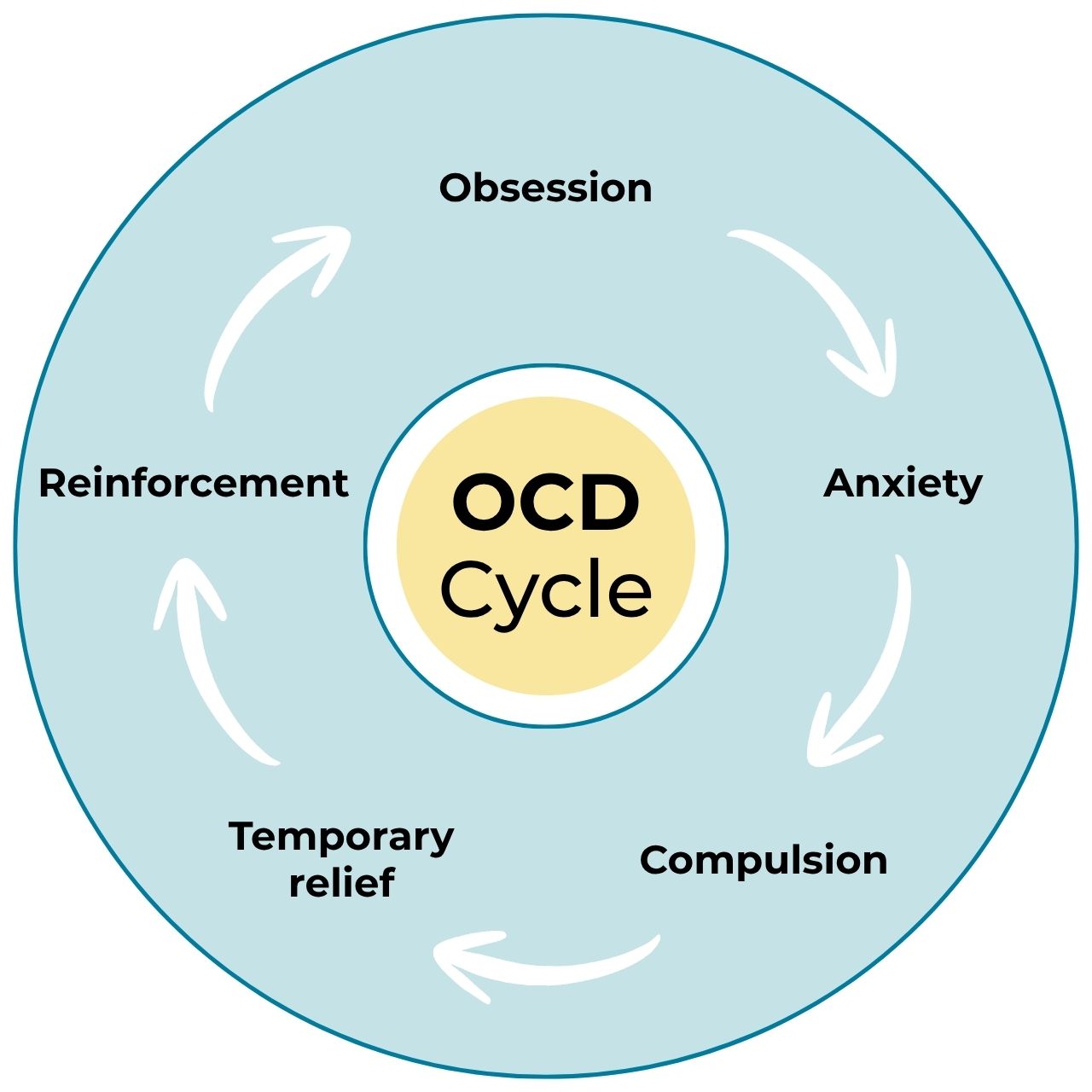
Obsession → Anxiety → Compulsion → Temporary relief → Reinforcement
Instead of reducing anxiety immediately, ERP helps you learn that anxiety can rise and fall on its own without performing compulsions. This process is often explained through inhibitory learning, where the brain gradually updates its threat predictions over time.
In practice, this means therapy may feel counterintuitive at first. Rather than avoiding discomfort, you’re guided to approach it in a structured and supported way, because that’s what leads to long-term change.
How to find an ERP therapist in Ontario (not just general anxiety therapy)
Finding a therapist trained in ERP requires more than a simple directory search. We often see that many therapists genuinely want to help, but may not have specific OCD training.
Look for explicit ERP specialization
A qualified ERP therapist will clearly state:
- “Exposure and Response Prevention (ERP)”
- “Therapist with focused experience in ERP”
- “Evidence-based OCD treatment”
If ERP is mentioned vaguely among many modalities, it may not be their primary approach.
Prioritize OCD-focused clinics
Clinics like Forward Thinking Psychological Services® focus on OCD and anxiety disorders, which typically means:
- More consistent ERP training
- Greater familiarity with complex OCD presentations
- Structured treatment protocols
Understand Ontario credentials (and their limits)
In Ontario, therapists may come from a range of regulated professions, such as psychology or social work. While these credentials reflect professional training and standards, they do not necessarily indicate specific experience in treating OCD with Exposure and Response Prevention (ERP). That’s why it’s important to ask directly about a therapist’s approach and experience with OCD. Asking a few targeted questions during a consultation can help you quickly determine whether a therapist’s approach is a good fit.
Consider virtual ERP therapy
For many people, virtual therapy has become a strong option because:
- It allows access to therapists with strong experience outside your immediate area
- Exposures can be done in your real environment (often more effective)
- It reduces geographic barriers within your province
Why do many therapists say they treat OCD but don’t actually do ERP?
This is one of the most common and frustrating experiences for people with OCD.
General CBT is not the same as ERP
While ERP is a form of Cognitive Behavioural Therapy (CBT), not all CBT includes exposure work. Many therapists focus on:
- Thought challenging
- Coping strategies
- Emotional processing
These can be helpful for general anxiety. However, these strategies alone are usually insufficient for OCD.
Reassurance and avoidance can reinforce OCD
In practice, we often see clients who were previously told:
- “That won’t happen”
- “You’re safe”
- “Try to avoid triggers for now”
While well-intentioned, these responses can strengthen the OCD cycle by preventing new learning.
Lack of focused ERP training
We often see that OCD can present in complex ways, including:
- Contamination fears
- Harm-related intrusive thoughts
- Primarily mental compulsions
Without ERP training, therapists may inadvertently:
- Support compulsions
- Focus on symptom relief instead of behavioural change
- Avoid necessary exposure work
What does ERP therapy actually look like week to week?
Understanding the structure of ERP can help you identify whether a therapist is using it correctly.
Step 1: Assessment and education
You and your therapist map out:
- Obsessions (intrusive thoughts, images, urges)
- Compulsions (visible and mental rituals)
- Triggers and avoidance patterns
Step 2: Building a fear hierarchy
You rank situations from least to most distressing. For example:
- Touching your own desk without washing
- Touching a public doorknob without washing
- Using public transit without sanitizing
Step 3: Gradual exposures
Exposures are specific and measurable. For example:
- Touching a doorknob and waiting 30 to 60 minutes before washing
- Locking your door once and leaving without checking
- Writing down a feared thought and sitting with the uncertainty
Step 4: Response prevention
This is the core of ERP:
- No compulsions (physical or mental)
- No reassurance seeking
- No neutralizing rituals
For people with primarily mental compulsions, this might mean:
- Not analyzing thoughts
- Not mentally trying to “prove” safety
- Letting uncertainty exist without resolution
Step 5: Tracking progress
Effective ERP includes measurable change, such as:
- Reduced frequency of compulsions
- Increased tolerance of uncertainty
- Improved daily functioning
In practice, many clients begin to notice meaningful shifts within a few months, especially when they consistently engage with exposures between sessions.
ERP vs other OCD treatments: what’s the difference?
ERP vs talk therapy
Talk therapy can provide emotional support and insight, but it typically does not interrupt the OCD cycle directly. ERP focuses on behavioural change and learning through experience.
ERP vs medication
Medications such as SSRIs are sometimes used to reduce symptom intensity. Treatment decisions around medication are typically made with a physician or psychiatrist, and are often combined with ERP, which addresses the behavioural patterns maintaining OCD.
ERP vs mindfulness
Mindfulness can support ERP by helping you observe thoughts without reacting. However, on its own, it usually doesn’t replace the need for structured and guided exposure work.
Best ERP therapy options in Ontario
Ontario offers several pathways, but the quality and specialization vary.
Experienced OCD clinics
Clinics like Forward Thinking Psychological Services® focus specifically on ERP-based treatment, often providing:
- Structured treatment plans
- Therapists trained in OCD-specific interventions
- Consistent use of exposure-based methods
Virtual ERP providers
Many therapists now offer online ERP across Ontario, which can:
- Improve access to experienced clinicians
- Allow real-life exposures in your own environment
- Reduce wait times compared to in-person programs
Hospital-based programs
Some hospitals offer OCD programs, though:
- Waitlists can be long
- Treatment may be more generalized
- Access may require referrals
What questions should I ask an ERP therapist before starting?
Choosing the right therapist can significantly impact your progress.
Ask directly:
“Do you primarily use ERP for OCD?”
You’re looking for a clear, direct answer.
“How do you structure ERP treatment?”
A strong answer will include:
- Fear hierarchies
- Gradual exposures
- Assigned homework between sessions
“Will I be doing exposures between sessions?”
ERP requires active participation outside therapy sessions.
“How do you handle compulsions?”
An ERP-trained therapist will focus on helping you resist compulsions. The focus should be on helping you resist them, not accommodate them.
Red flags to watch for
Be cautious if a therapist:
- Offers frequent reassurance (“That won’t happen”)
- Encourages avoiding triggers
- Focuses heavily on relaxation during exposures
- Does not assign structured homework
Conclusion
If you have OCD and live in Ontario, finding a therapist who truly focuses on ERP can be the turning point in your recovery. Not all therapy is equally effective for OCD, and approaches that focus only on coping or reassurance may leave the underlying cycle unchanged.
Working with an ERP-trained therapist, such as those at Forward Thinking Psychological Services®, means engaging in an intentional, effective OCD treatment approach, designed to reduce compulsions and increase your ability to tolerate uncertainty.
If you’ve tried therapy before and felt like something was missing, it may not have been the right type of treatment. ERP can feel more challenging, but it is also consistently associated with meaningful, lasting improvement.
For many people, finding the right fit can make the process feel less overwhelming and more manageable from the beginning.
If you’re considering your next step, reaching out for a consultation can help you understand whether ERP-based therapy is the right fit for you.

FAQs: Finding an ERP Therapist
DISCLAIMER: This content is meant for informational and educational purposes only. Only a licensed psychologist or psychiatrist can diagnose a mental health disorder. The content of this website is not meant to be a substitute for therapy. Visiting this website should not be considered to be equivalent to a relationship with FTPS. Mental health concerns should only be discussed in the context of providing professional services after the consent process has been completed with a qualified FTPS associate outside of our website.
Make FTPS a Google Preferred Source
If you found our blog helpful, you can ensure our latest evidence-based mental health insights, tools, and recovery strategies always appear at the top of your Google Search and AI Overviews.