

Many people ask themselves, “Is this OCD or just anxiety?” It is one of the most common questions psychologists hear, and for good reason.
Obsessive-compulsive disorder (OCD) and generalized anxiety disorder (GAD) can look remarkably similar. Both can involve distressing thoughts, doubts, uncertainty, repetitive “what if” questions, reassurance seeking, and significant anxiety. Because both conditions can involve experiencing similar types of symptoms, it can be difficult for someone to know whether they are experiencing OCD, generalized anxiety disorder, or another form of anxiety.
This confusion is understandable. Many people with OCD initially wonder whether they simply have anxiety, while people with generalized anxiety disorder sometimes question whether their repetitive worries might actually be OCD. Because both conditions can involve feeling mentally “stuck,” they are frequently confused by the people experiencing them.
However, psychologists are often interested in something different. Rather than asking only, “What is this person thinking?”, they also ask:
“How did the mind arrive at this thought?”
Two people may have nearly identical worries yet receive different diagnoses because the underlying reasoning process is different. Understanding how the mind generated the thought, not simply what the thought is, provides important clues about the cognitive processes involved and helps psychologists determine which treatment approach is likely to be most helpful.
In this article, we’ll explore why OCD and generalized anxiety disorder are so often confused, how psychologists distinguish between them, and how understanding the thinking process, not just the thought itself, can provide a clearer picture of what may be happening.

Why Are OCD and Generalized Anxiety Disorder So Often Confused?
OCD and generalized anxiety disorder share many features, making it understandable that people often struggle to tell them apart.
One of the main reasons these conditions are so often confused is that both involve the experience of uncertainty. Human beings naturally find uncertainty uncomfortable, and both OCD and generalized anxiety disorder can leave people searching for greater confidence, reassurance, or predictability. From the outside, these attempts may look remarkably similar. The important difference is often not that one person experiences uncertainty while the other does not, it is how their mind responds to uncertainty that begins to separate the two conditions.
Both conditions may involve anxiety, distress, repetitive thinking, and an ongoing sense that something does not feel completely settled. People living with either disorder may spend hours caught up in distressing thoughts, mentally reviewing situations, seeking reassurance, or trying to feel more certain that “everything will be okay.” Family members often notice that the person seems stuck on particular concerns or finds it difficult to let worries go.
Adding to the confusion, the thoughts themselves can sometimes sound remarkably similar.
Consider these examples:
Person A (OCD)
“I remember turning the stove off before I left the house… but what if I somehow missed something?”
Person B (Generalized Anxiety Disorder)
“I’m worried something could happen while I’m at work today.”
-or-
Person A (OCD)
“I know I washed my hands, but what if I unknowingly contaminated my family?”
Person B (Generalized Anxiety Disorder)
“What if someone in my family becomes seriously ill?”
At first glance, these examples all involve worry about something bad happening. Each person experiences anxiety or some type of distress. Each is seeking greater certainty. Each may seek reassurance or spend considerable time thinking through possible outcomes.
However, psychologists rarely stop at the thought itself.
Instead, they begin asking questions such as:
- What information is this person relying on?
- How did they arrive at this conclusion?
- What is the mind trying to accomplish by continuing to think about it?
- What happens if they resist the urge to keep thinking, checking, or seeking reassurance?
These questions often reveal important differences that are not obvious from the thought alone.
This is why it is often difficult to distinguish OCD from generalized anxiety disorder based solely on what someone says they are thinking about. The same “what if” question could occur in either condition. In fact, intrusive thoughts, doubt, and “what if” thinking can occur in people with OCD, generalized anxiety disorder, other anxiety disorders, and even individuals without a mental health condition. The presence of intrusive thoughts and doubts alone does not automatically indicate OCD.
Instead of focusing only on what someone is thinking, psychologists are interested in how the mind arrived at that conclusion. Did the person begin doubting something they had already observed? Did an imagined possibility gradually become more convincing than the evidence available in the present moment? Or did the worry grow from a genuine life concern that became increasingly difficult to let go of?
These questions help psychologists uncover the thinking processes that maintain distress rather than focusing solely on the content of the thought itself. This distinction is important because effective treatment is designed to interrupt the psychological processes that keep anxiety going. Understanding how the mind is generating doubt or worry often provides much more useful clinical information than understanding what someone is worrying about.
This is why OCD and generalized anxiety disorder can look remarkably similar on the surface while functioning very differently underneath.
Two people can have nearly identical types of “what if” thoughts and still receive different diagnoses. Psychologists are rarely diagnosing OCD or generalized anxiety disorder based on the thought alone. Instead, they are trying to understand the reasoning process that gave rise to the thought, how convincing it feels, and what the person feels driven to do in response. The types of thoughts experienced are also part of the clinical understanding. All those patterns often provide far more useful clinical information than the content of the thought itself.
What’s the Difference Between OCD and Generalized Anxiety Disorder?
After reading the previous section, you might be wondering: If OCD and generalized anxiety disorder can both involve repetitive “what if” thoughts, anxiety, uncertainty, and reassurance seeking, what actually distinguishes them?
The answer is more nuanced than simply looking at the thought itself.
The DSM-5-TR describes OCD and generalized anxiety disorder as separate conditions with different diagnostic criteria. These differences help psychologists determine whether someone meets the criteria for one disorder, the other, or in some cases, both.
Although OCD and generalized anxiety disorder share many features, they each have distinct diagnostic criteria that allow psychologists to differentiate between them.
For example, OCD is characterized by the presence of obsessions, compulsions, or both. Obsessions are recurrent, intrusive thoughts, images, or urges that create distress. Compulsions are repetitive behaviours or mental acts that a person feels driven to perform in an attempt to reduce anxiety or prevent a feared outcome. Seeking reassurance compulsively can fit within this presentation.
Generalized anxiety disorder, in contrast, is characterized by excessive anxiety and worry about multiple areas of everyday life that are difficult to control. Worries often involve realistic concerns such as health, work, finances, relationships, or family responsibilities and are accompanied by symptoms such as restlessness, muscle tension, difficulty concentrating, irritability, fatigue, and sleep disturbance. Although individuals with GAD might engage in repetitive reassurance seeking, it is not understood as the same type of a compulsion that a person with OCD would experience.
These symptom differences are an important part of psychological assessment and help guide both diagnosis and treatment planning.
However, psychologists are often interested in understanding something else as well:
How can we better understand the thinking process that led to these conclusions?
This question provides valuable information because two people can report similar worries while experiencing very different underlying reasoning processes.
One helpful way of understanding this distinction is to consider where the mind is getting its information and how it is processing it.
Healthy thinking naturally relies on both direct experience and imagination. We use our senses to understand what is happening around us, while imagination may help us to solve problems, anticipate future events, learn from past experiences, and prepare for uncertainty. We all rely on imagination within our thinking at times. In fact, it is one of our greatest cognitive strengths.
The difficulty arises when the mind begins placing too much weight on imagined possibilities while gradually losing confidence or awareness of direct experience and what we know to be true according to direct perceptual experience.
Numerous cognitive models have been developed to help explain why OCD develops and persists. One contemporary model that offers a particularly helpful way of understanding obsessional doubt is Inference-Based Cognitive Behavioural Therapy (I-CBT).
One contemporary way of understanding this shift comes from Inference-Based Cognitive Behavioural Therapy (I-CBT), which proposes that obsessional doubt develops as imagined possibilities become increasingly trusted over direct perceptual experience.
Comparing OCD and Generalized Anxiety Disorder
The table below summarizes some of the key differences between OCD and generalized anxiety disorder. It is intended as a general guide rather than a diagnostic checklist.
|
Feature |
OCD |
GAD |
|---|---|---|
|
DSM-5-TR core feature |
Obsessions and/or compulsions |
Excessive, difficult-to-control worry |
|
Primary focus |
Doubting what is already known or observed |
Anticipating future problems |
|
Typical source of uncertainty |
“Maybe what I observed isn’t true.” |
“Something bad could happen later.” |
|
Relationship to evidence |
Direct experience gradually loses credibility |
Evidence often supports a realistic concern that becomes amplified |
|
Common cognitive process |
Obsessional doubt, inferential confusion |
Catastrophizing, intolerance of uncertainty, problem-solving attempts |
|
Behavioural response |
Compulsions, checking, mental rituals, reassurance seeking, avoidance |
Reassurance seeking, overthinking, planning, repeated problem solving |
|
What the mind is trying to achieve |
Absolute certainty |
Preparation or prevention |
It is important to remember that this table describes general patterns, not absolute rules. Every person’s experience is unique, and some individuals meet criteria for both OCD and generalized anxiety disorder. Further, different treatment approaches understand these presentations in different ways and interventions are often aligned with these conceptualizations.
OCD: When Imagined Possibilities Begin to Override Direct Experience
Imagine that you lock your front door before leaving for work.
Most people might briefly think:
“Did I lock the door?”
A moment later, they remember locking it and continue with their day. They may remember hearing the click of the lock or, possibly, jiggling the lock before they walk away
Someone experiencing OCD may begin in exactly the same place. However, instead of settling on what did happen, the mind starts generating increasingly persuasive imagined possibilities:
“Yes…but what if I only imagined locking it?”
“What if I was distracted?”
“What if I touched the lock but never actually turned it?”
Notice what has changed.
Importantly, the person is not choosing to ignore reality. In fact, people with OCD often recognize that their doubts seem excessive or unlikely. The difficulty is that the imagined possibility begins to feel sufficiently believable that it becomes difficult to rely on what they already know. This can create an intense urge to resolve the uncertainty through checking, reassurance seeking, mental review, or other compulsions.
The person’s direct experience has not changed. What changes is the amount of trust placed in that experience. The imagined possibility begins to feel increasingly believable despite the available evidence.
This does not happen because the person is irrational or unintelligent. Rather, OCD can gradually shift the reasoning process toward possibilities that could be true, even when direct observation suggests otherwise.
As uncertainty grows, many people understandably begin checking, seeking reassurance, mentally reviewing events, or performing other compulsions in an effort to feel certain again.
Unfortunately, these strategies usually provide only temporary relief before the doubt returns.
Generalized Anxiety Disorder: When Realistic Concerns Continue to Grow
Generalized anxiety disorder also involves imagination, but it often follows a different pathway.
A person may begin with a realistic concern:
“My child has an important exam tomorrow.”
That concern then expands:
“What if they fail?”
“What if failing affects their confidence?”
“What if it changes their future opportunities?”
The worry develops from a genuine life concern and becomes increasingly difficult to disengage from as the mind anticipates future problems.
Unlike OCD, the worry process in generalized anxiety disorder often feels useful. People may believe that continuing to think through possible outcomes will help them prepare, solve problems, or prevent something bad from happening. Although these intentions are understandable, the process can become repetitive and difficult to disengage from, even when it no longer leads to effective problem solving.
People are generally not questioning something they already know or directly observed. Instead, the mind remains focused on preparing for future uncertainty by considering increasingly negative possibilities. Thought processes can become catastrophic in nature. In this way, imagined possibilities make their way into GAD as well.
Although this process often feels productive or protective, it can become exhausting and difficult to stop.
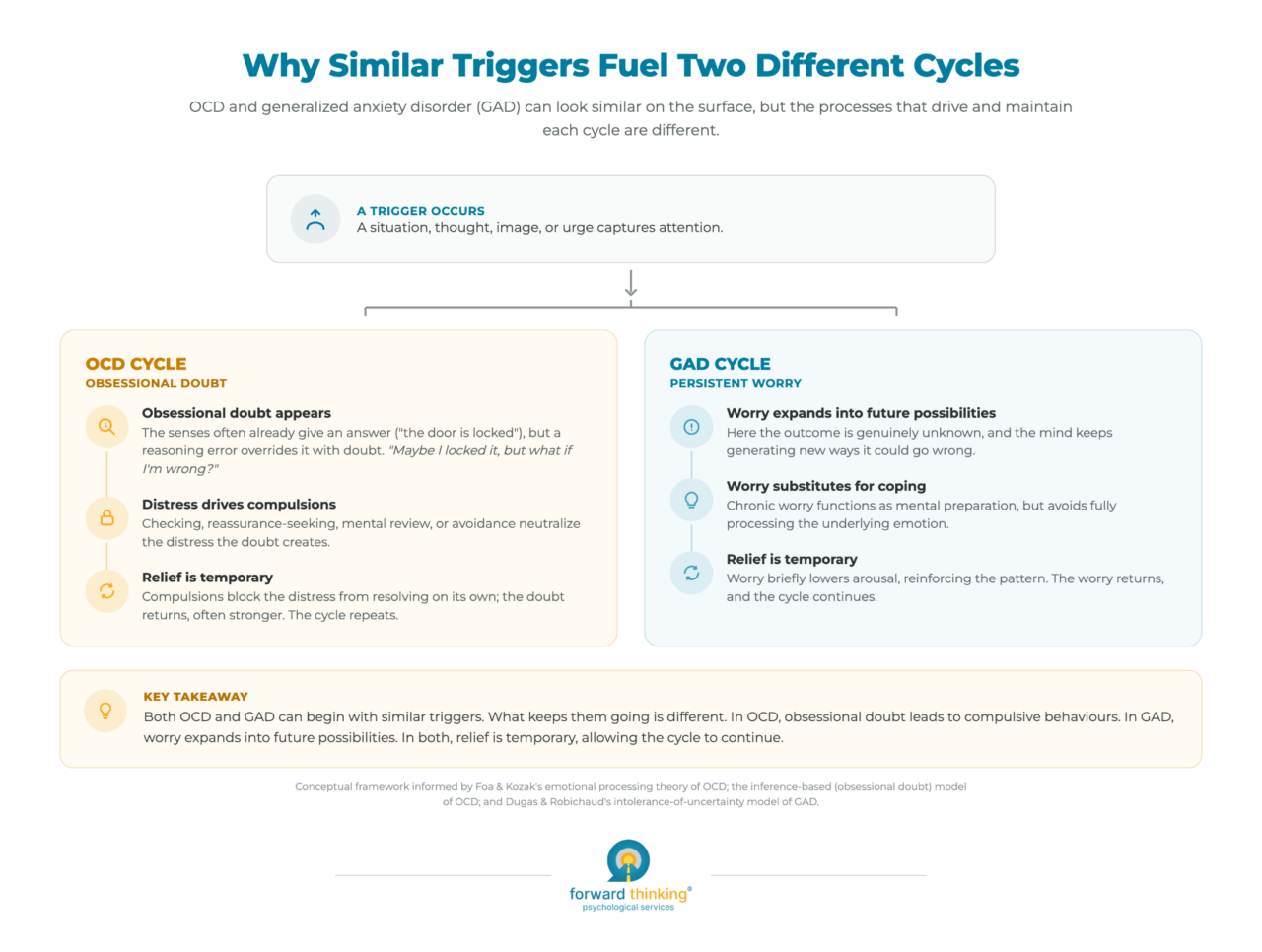
Both OCD and generalized anxiety disorder involve our imagination in different ways. In OCD, imagined possibilities may gradually become more convincing than direct experience. In that sense, when obsessional doubt is present, imagination is more heavily relied upon than our direct senses. In generalized anxiety disorder, imagination more often expands genuine life concerns into increasingly catastrophic future scenarios. Understanding this distinction helps explain why two people can have similar “what if” thoughts while benefiting from different treatment approaches.
The figure below provides a simplified overview of these different patterns.
Can You Have Both OCD and Generalized Anxiety Disorder?
The short answer is yes. In fact, OCD and generalized anxiety disorder commonly occur together.
A person may experience obsessional doubt in some areas of life while also experiencing excessive worry about others. For example, someone may repeatedly question whether they accidentally harmed another person while driving (i.e., an OCD presentation) while also worrying extensively about work, finances, or the health of family members (i.e., more characteristic of generalized anxiety disorder).
When both conditions are present, it can become difficult to determine where one ends and the other begins. This is one reason why psychologists spend time understanding not only the symptoms a person experiences, but also the thinking processes that maintain them.
Although OCD and generalized anxiety disorder may overlap, the reasoning patterns underlying each concern are not always the same. Understanding these differences helps psychologists develop an individualized treatment plan that targets the processes contributing most to a person’s distress.
How Do Psychologists Tell the Difference?
Because OCD and generalized anxiety disorder share many similarities, psychological assessment involves much more than checking whether someone has intrusive thoughts or excessive worries.
Instead, psychologists become curious about the reasoning process that gave rise to those thoughts. They also inquire about the types of thoughts, the domains of concerns and the ways in which they are interfering. Psychologists also explore how thoughts and behaviours interfere with day-to-day functioning.
During an assessment, they may explore questions such as:
- What triggered the concern?
- What information is the person relying on to determine the level of concern?
- Did the person begin doubting something they had already observed or knew to be true?
- Is the person trying to solve a realistic problem or eliminate uncertainty altogether?
- What behaviours follow the thought? Is the person checking, seeking reassurance, mentally reviewing events, or avoiding situations?
- What appears to be maintaining the cycle over time?
The answers to these questions often provide a much clearer picture than the content of the thought alone. They help psychologists understand which cognitive and behavioural processes are contributing to distress and guide the selection of the most appropriate evidence-based treatment.
A psychological assessment is not simply about assigning a diagnosis. It is about understanding how your mind works. Two people may describe nearly identical worries while benefiting from different treatment approaches because the processes maintaining those worries are different.
How Treatment May Differ
Although OCD and generalized anxiety disorder can feel similar, treatment for these presentations is not the same. Once psychologists understand the processes maintaining a person’s symptoms, they can recommend interventions that best address those patterns.
For OCD, treatment often involves Exposure and Response Prevention (ERP), which helps individuals gradually face situations that trigger obsessional doubt while resisting compulsive behaviours. Another evidence-based approach, Inference-Based Cognitive Behavioural Therapy (I-CBT), focuses on helping individuals recognize when imagined possibilities begin to outweigh direct experience and learn to place greater trust in what they directly know and observe.
For generalized anxiety disorder, treatment often emphasizes identifying unhelpful worry patterns, improving tolerance of uncertainty, strengthening problem-solving skills when appropriate, and reducing repetitive worry that no longer serves a useful purpose. Cognitive behavioural therapy (CBT) has extensive research supporting its effectiveness for generalized anxiety disorder.
Many people also benefit from learning mindfulness and acceptance-based strategies, developing healthier responses to feelings of uncertainty, or, in some cases, combining psychotherapy with medication. Treatment should always be individualized to the person’s unique experiences, goals, and needs.
Conclusion
Psychological diagnoses are based on symptom patterns, but effective treatment is guided by understanding the processes that maintain those symptoms.
Obsessive-compulsive disorder and generalized anxiety disorder can look remarkably similar on the surface. Both can involve anxiety, uncertainty, repetitive thinking, and a strong desire to feel more certain.
However, what often distinguishes them is not simply the thought itself, but the reasoning process that gave rise to it, the way in which impairment occurs and the core processes that underlie the thoughts and belief systems.
By understanding how the mind responds to uncertainty and doubt, where it places its trust, and what behaviours keep the cycle going, psychologists can better understand a person’s experience and recommend treatment that targets the underlying processes rather than only the symptoms.
If there is one idea to take away from this article, it is this:
Psychologists are often less interested in what someone is thinking than in how their thought processes are functioning and the ways in which their mind arrived at that thought.
Understanding that distinction can make the difference between simply managing symptoms and selecting a treatment approach that addresses the processes keeping them going.
When Should You Consider a Psychological Assessment?
If you find yourself spending large amounts of time caught in repetitive doubt, worry, reassurance seeking, checking, or mental reviewing, and these experiences are interfering with your daily life, it may be helpful to speak with a psychologist.
A comprehensive psychological assessment can help clarify whether your experiences are most consistent with OCD, generalized anxiety disorder, another anxiety-related condition, or a combination of concerns. More importantly, it can help identify the psychological processes maintaining your distress so that treatment can be tailored to your specific needs.
Seeking an assessment is not simply about receiving a diagnosis. It is about gaining a clearer understanding of how your mind works and identifying the evidence-based strategies most likely to help. From there, you can work with your clinician to develop a collaborative and evidence-based treatment plan.
Ready to Learn More?
At Forward Thinking Psychological Services®, we provide evidence-based assessment and treatment for OCD, generalized anxiety disorder, and other anxiety-related conditions. Our psychologists work with adolescents and adults across Canada through secure virtual therapy, helping individuals better understand their experiences and develop practical strategies for lasting change.
If you’re wondering whether your symptoms are related to OCD, generalized anxiety disorder, or another anxiety condition, we’d be happy to help.
Contact us to learn more about our services or to book an appointment.

FAQs:
DISCLAIMER: This content is meant for informational and educational purposes only. Only a licensed psychologist or psychiatrist can diagnose a mental health disorder. The content of this website is not meant to be a substitute for therapy. Visiting this website should not be considered to be equivalent to a relationship with FTPS. Mental health concerns should only be discussed in the context of providing professional services after the consent process has been completed with a qualified FTPS associate outside of our website.
Make FTPS a Google Preferred Source
If you found our blog helpful, you can ensure our latest evidence-based mental health insights, tools, and recovery strategies always appear at the top of your Google Search and AI Overviews.