

When a teenager is experiencing panic attacks, intrusive thoughts, intense worry, compulsive behaviours or increasing avoidance, parents often know that something is wrong before they know exactly what it is.
The next question is often practical: Where do we go to get this assessed?
In Ontario, there are several possible starting points. A teenager may be assessed through a psychologist in private practice, a family physician or pediatrician, a psychiatrist, or a publicly funded child and youth mental health service. Some hospital and specialty programs also provide assessment for particular concerns, although referral requirements and eligibility vary.
The right starting point depends partly on what you need the assessment to answer.
A teen with relatively clear symptoms of anxiety or OCD may not need a lengthy comprehensive psychological assessment before beginning treatment. In other situations, particularly when the clinical picture is complicated, or it is unclear what is contributing to the difficulties, a broader assessment may be helpful.
Parents do not need to determine the diagnosis or the type of assessment on their own before asking for help.

Does My Teen Need an Anxiety or OCD Assessment?
If anxiety, intrusive thoughts, compulsive behaviours, panic, reassurance seeking or avoidance are interfering with a teenager’s everyday life, seeking professional input can be worthwhile.
But “getting assessed” does not always mean arranging a large battery of psychological tests.
For many mental health concerns, assessment begins with a careful clinical evaluation. A clinician may speak with the teenager and their parent or caregiver, explore the symptoms and when they began, consider how they are affecting school, friendships, family life and other areas of functioning, and ask about other factors that could be relevant.
The Canadian Paediatric Society recommends that anxiety assessment in children and adolescents consider the young person’s symptoms and functioning, medical and developmental history, broader mental health concerns, standardized measures where appropriate, previous assessments and direct clinical observation. Importantly, questionnaires need to be interpreted in the context of the overall clinical picture rather than being used in isolation.
For adolescents, the teenager’s own perspective is particularly important. A teen may experience worries, intrusive thoughts, rituals or avoidance that parents do not see.
The first question, therefore, is often not “Which test does my teenager need?”
It is “What are we trying to understand?”
What Is the Difference Between Screening, Assessment and Diagnosis?
These terms are sometimes used interchangeably, but they do not necessarily mean the same thing.
Screening usually involves identifying whether symptoms suggest that further evaluation may be warranted. A questionnaire may be part of screening, but a high score does not necessarily establish that a teenager has a particular disorder. Diagnoses should not be based on screening tools alone.
Clinical assessment involves gathering and interpreting information to understand a teenager’s symptoms, functioning and circumstances. This may be relatively focused when the presenting concern is clear.
A comprehensive psychological assessment may examine a broader range of questions. Depending on the referral question, this could involve developmental history, diagnostic interviews, standardized measures, information from parents or teachers, review of school or previous clinical records, and assessment of other areas of functioning.
Diagnosis involves determining whether the young person’s presentation meets criteria for a particular mental health condition and considering whether another explanation better accounts for the symptoms. A diagnosis can be determined from a focused clinical assessment or a comprehensive psychological assessment.
Not every teenager needs every level of assessment.
Clinical assessments and interviewing should only be conducted by professionals who have the proper training and experience. Typically, this includes primary physicians, psychologists and psychiatrists.
The most extensive assessment is not automatically the best assessment.
A useful assessment is one that is sufficiently thorough to answer the clinical questions that matter and guide appropriate recommendations.
Does My Teen Need a Full Psychological Assessment Before Starting Treatment?
Often, no.
When symptoms are relatively clear, assessment and treatment do not necessarily need to be completely separate processes. A clinician experienced in treating adolescent anxiety or OCD may conduct an initial clinical assessment, determine whether the presenting concerns fall within their area of competence, and begin evidence-based treatment when appropriate.
For example, a teenager presenting with a recognizable pattern of obsessive fears and compulsions may not necessarily benefit from waiting months for a broad assessment before accessing appropriate OCD treatment.
Similarly, a teen experiencing panic attacks may be able to begin treatment after an appropriate clinical evaluation rather than undergoing a comprehensive psychological assessment first.
A broader assessment may be more useful when:
- it is unclear what is causing the difficulties
- symptoms appear to span several conditions
- ADHD, autism, learning difficulties, depression, trauma or other concerns may also be relevant
- symptoms have changed substantially or appeared unexpectedly
- the teenager’s difficulties look very different across settings
- previous treatment has not helped as expected
- diagnostic clarification would meaningfully affect treatment or recommendations
- there are broader questions about the teenager’s functioning that need to be answered
The goal is not to accumulate diagnoses. It is to understand the teenager well enough to determine what kind of evidence-based support is likely to be useful.
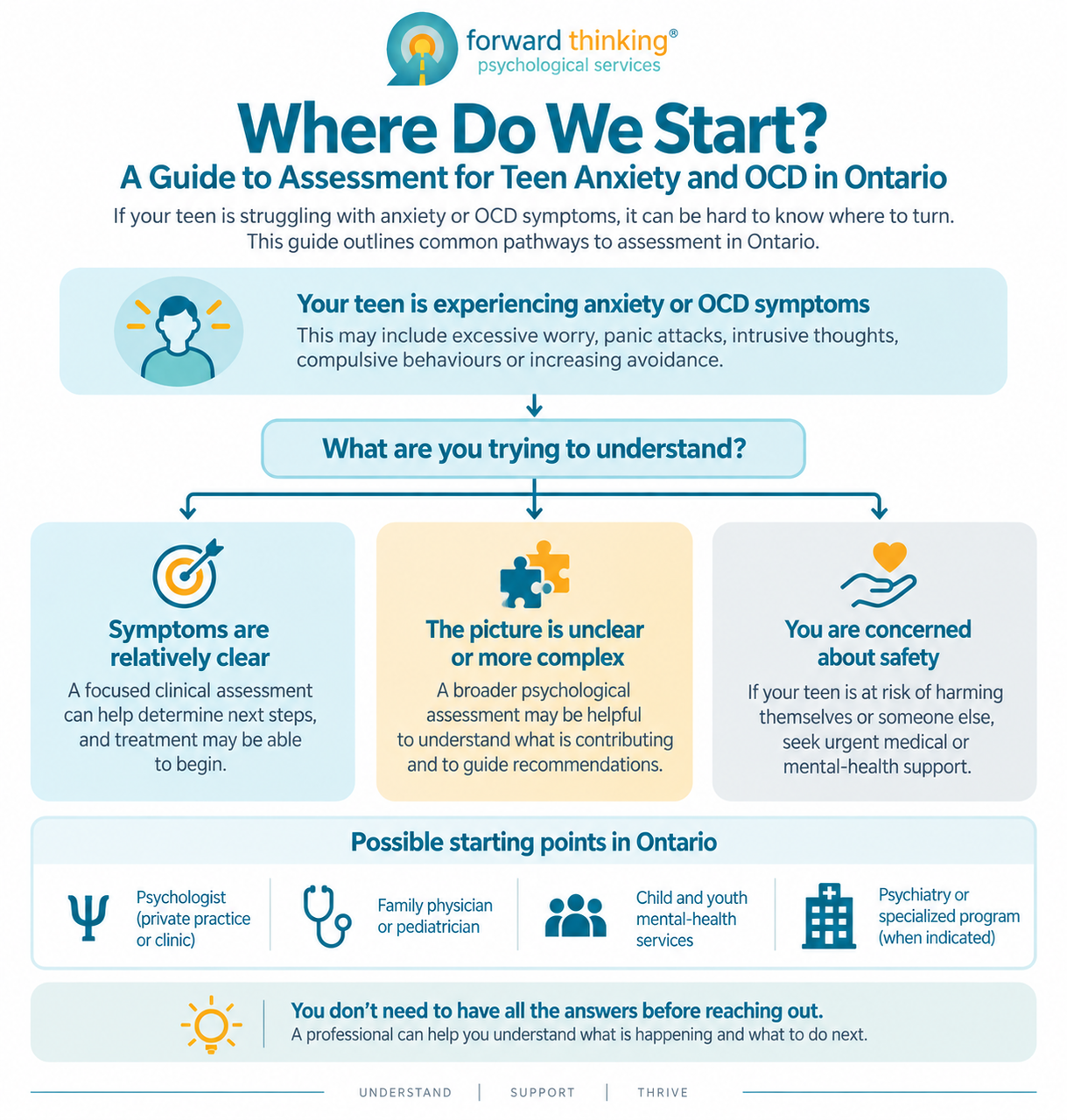
Alt text: Assessment pathways for teenagers with anxiety or OCD symptoms in Ontario, including focused clinical assessment, broader psychological assessment and urgent support for safety concerns.
What Does an Anxiety Assessment for a Teenager Involve?
Anxiety is not a single condition.
A teenager might experience generalized anxiety, social anxiety, panic attacks, specific fears, separation anxiety or another anxiety-related presentation. Anxiety can also occur alongside other mental health or neurodevelopmental concerns.
A clinician assessing anxiety will typically want to understand not only whether a teen feels anxious, but what the anxiety looks like.
Questions might include:
- What situations trigger the anxiety?
- What does the teenager fear might happen?
- What do they do when they feel anxious?
- Are they avoiding particular situations?
- How frequently do symptoms occur?
- How long have they been present?
- Are there panic attacks or significant physical symptoms?
- Is anxiety affecting school attendance, academic functioning, friendships, activities or family life?
- How much distress is the teenager experiencing?
- Are other mental health concerns present?
It is also important to distinguish developmentally expected worry from an anxiety disorder. Anxiety becomes more clinically concerning when it is persistent, disproportionate and significantly interferes with functioning.
Standardized questionnaires can help clinicians gather information about symptom patterns and severity, but they are one source of information rather than a stand-alone answer.
What Does an OCD Assessment for a Teenager Involve?
An OCD assessment requires particular attention to the experience of obsessions and compulsions.
Obsessions are intrusive thoughts, images, urges or doubts that create distress. Compulsions are behaviours or mental acts a person feels driven to perform, often in an effort to reduce distress, prevent something feared from happening, or achieve a sense of certainty or “rightness.”
Some compulsions are easy to see, such as repeated washing or checking. Others may be much less visible, including mental reviewing, repeating words internally, trying to neutralize a thought or repeatedly seeking certainty.
An assessment may explore:
- the nature of intrusive thoughts, images, urges or doubts
- behaviours or mental rituals that follow them
- avoidance of people, places, objects or situations
- reassurance seeking
- how much time symptoms consume
- distress and interference with everyday functioning
- the degree to which family members have become involved in rituals or accommodation
- other mental health or developmental concerns
- whether another condition might better explain the symptoms
This matters because intrusive thoughts do not automatically mean OCD.
Unwanted or distressing thoughts can occur in several contexts. Conversely, OCD can sometimes be missed when compulsions are primarily mental or internal and when a teenager is embarrassed or frightened to disclose the content of their thoughts.
For OCD in particular, experience with the disorder matters. CAMH’s clinical guidance on OCD identifies diagnostic uncertainty, complex or co-occurring presentations and the need for specialized CBT as reasons specialist involvement may be appropriate.
Who Can Assess Anxiety or OCD in a Teenager in Ontario?
There is no single professional that every family needs to see first.
Psychologists and Psychological Associates
Psychologists and psychological associates in Ontario are regulated by the College of Psychologists and Behaviour Analysts of Ontario. They are trained in psychological assessment and treatment, and qualified psychology registrants can formulate and communicate psychological diagnoses within their areas of authorized practice and competence.
Some psychologists focus primarily on treatment, while others provide formal psychological assessments, and some do both.
When contacting a psychologist, parents can ask whether the clinician works with adolescents and whether assessment and treatment of anxiety or OCD fall within their area of practice.
Family Physicians and Pediatricians
A family doctor or pediatrician can also be a useful starting point.
They can assess mental health concerns, consider medical factors that might be contributing, discuss treatment options and make referrals when specialized assessment, psychiatry or other services are indicated.
They can also be particularly important when medication is being considered or when a publicly funded program requires a medical referral.
Psychiatrists
Psychiatrists are physicians specializing in mental health. Psychiatric consultation may be particularly useful when symptoms are severe or complex, medication questions are prominent, significant co-occurring conditions are present, diagnostic clarification is needed, or treatment has not produced the expected improvement.
In Ontario, accessing child and adolescent psychiatry commonly requires a referral rather than direct self-referral. For example, the SickKids Psychiatry Clinic requires physician referral.
Other Mental Health Professionals
Social workers, psychotherapists and other mental health clinicians also play important roles in assessing concerns within their professional scope and providing treatment.
However, professional titles, training, areas of competence and authority to communicate a diagnosis are not interchangeable.
For parents, the most useful question is often not simply “Does this person work with anxiety?” but “Does this clinician have the training and scope needed to answer the particular question we have?”
Where Can My Teen Get Assessed for Anxiety or OCD in Ontario?
Ontario families generally have several possible routes.
Private Psychological Services
Families can often contact a private psychology practice directly without first obtaining a physician referral.
This can provide access to a focused clinical assessment, a more comprehensive psychological assessment, treatment, or some combination of these services depending on the practice and the teenager’s needs.
Private psychological services involve fees, although some families have extended health insurance that reimburses part of the cost. Coverage varies considerably, so families should check the requirements of their individual plan.
When contacting a private practice, ask specifically what type of service is being offered. “Assessment” could mean an initial treatment assessment, diagnostic consultation or a comprehensive psychological assessment, and those are not necessarily equivalent.
Publicly Funded Child and Youth Mental Health Services
Ontario funds community-based child and youth mental health services throughout the province. Depending on location and need, these can include brief services, counselling and therapy, specialized consultation and assessment, crisis support and more intensive services. Ontario indicates that these programs are available without a fee, although the specific services available vary by community.
Parents can contact their local child and youth mental health service to ask about available programs, eligibility and whether a referral is required.
Family Doctor or Pediatrician
For some families, primary care is the easiest place to start, particularly when it is unclear what service is needed.
A physician can conduct an initial assessment, consider physical health factors, discuss treatment and medication where appropriate, and make referrals to psychiatry, psychology or other specialty services.
Hospital and Specialized Mental Health Programs
Some hospitals and specialty programs provide assessment for children and adolescents with particular presentations.
These services often have specific eligibility requirements and may require professional referral.
For example, CAMH’s Mood & Anxiety Service for Children & Youth currently provides assessment and treatment for youth with mood and anxiety difficulties and requires a physician referral.
Ontario’s Child and Parent Resource Institute Mood and Anxiety Clinic also provides comprehensive diagnostic assessment and consultation for children and youth with more complex presentations. Local services are generally accessed first, and referral forms must be signed by the child or youth’s doctor.
These examples illustrate why parents should check the current referral criteria of the particular program rather than assuming that a hospital provides direct assessment for every mental health concern.
What If We Are Stuck on a Waitlist?
Waitlists can be particularly frustrating when a teenager is already struggling. It can also amplify understandable anxiety that a family might be experiencing when the diagnostic picture is not clear.
Being on a waitlist for one service does not necessarily mean that nothing can happen in the meantime.
Depending on the teenager’s needs, parents might explore:
- whether a local child and youth mental health agency offers brief or interim services
- whether treatment can begin while a more specialized consultation is pending
- whether a family physician or pediatrician can provide initial assessment or support
- whether private psychological services for assessment or intervention are an option
- what school-based supports may be available
- whether another appropriate service has a shorter route to care
The important point is that assessment and treatment pathways do not always have to occur one after another.
Sometimes appropriate support can begin while a family is still pursuing additional diagnostic clarification.
Do I Need a Doctor’s Referral for My Teen to Be Assessed?
It depends on the service.
Families can generally approach private psychological services directly.
Some community-based mental health services also allow families to contact them directly, while hospital psychiatry and specialized programs frequently have specific referral requirements.
For example, CAMH’s child and youth Mood & Anxiety Service requires physician referral, as does the SickKids Psychiatry Clinic.
This is worth checking before joining a waitlist or asking a physician to send a referral. Programs differ in whom they serve, what they assess and how referrals are accepted.
What Should I Ask When Contacting an Assessment Provider?
Parents do not need to know the language of psychological assessment to ask useful questions.
It can help to ask:
- Do you assess and/or treat adolescents?
- Do you have experience assessing anxiety and OCD in teenagers?
- Is this a focused clinical assessment or a comprehensive psychological assessment?
- Who conducts the assessment and what are their professional qualifications?
- Does the service provide diagnostic clarification when appropriate?
- What information will you want from the teenager and parents?
- Are questionnaires or standardized measures used?
- Is information from school or other professionals needed?
- Will we receive recommendations?
- Will a school receive recommendations?
- Are accommodations recommended when appropriate following the assessment process?
- Is a written report provided, and do we need one?
- If treatment is recommended, can it begin through the same service?
- Is a physician referral required?
- What are the fees, if any?
- What is the current wait time?
- Does our extended health plan have requirements we should know about?
For OCD specifically, I would add another question:
What experience does the clinician have assessing and treating pediatric OCD?
A clinician may have extensive experience treating general anxiety without having the same depth of experience with OCD.
When Should Parents Seek More Urgent Help?
Routine assessment pathways are not designed for emergencies.
If a teenager is at immediate risk of harming themselves or someone else, is unable to maintain basic safety, or is experiencing another acute psychiatric emergency, urgent or emergency evaluation is appropriate rather than waiting for a routine psychological assessment.
Ontario advises calling 911 or going to the nearest emergency department when someone is in immediate danger.
Severity also matters in OCD. When symptoms become so severe that a young person cannot eat adequately, manage basic self-care, take necessary medication or leave home, CAMH recommends considering urgent or emergency evaluation.
Support for Teen Anxiety and OCD at Forward Thinking Psychological Services
At Forward Thinking Psychological Services, our psychologists, social workers and clinicians work with teenagers experiencing anxiety, OCD and related mental health concerns.
Our approach begins with understanding the teenager’s individual presentation rather than assuming that a particular symptom necessarily indicates a particular diagnosis.
Depending on the referral question, services may involve clinical assessment and evidence-based treatment or psychological assessment when greater diagnostic clarification is needed. When appropriate, information from parents and other sources can help develop a fuller understanding of the teenager’s strengths and difficulties.
For OCD, evidence-based treatment may include cognitive behavioural therapy with exposure and response prevention (ERP). Treatment for anxiety is similarly individualized according to the nature of the anxiety and the teenager’s needs.
Services are available virtually in Ontario and in several other Canadian provinces.
Conclusion
When a teenager is struggling with panic attacks, intrusive thoughts, anxiety, compulsive behaviours or avoidance, parents often feel pressure to find the “right” assessment before they can do anything else.
There may not be one single right doorway.
In Ontario, families can access help through private psychology, primary care, community child and youth mental health services, psychiatry and specialized programs, depending on what the teenager needs.
The more important question is often what needs to be clarified in order to help this particular teenager?
Sometimes that requires a comprehensive assessment. Sometimes a focused clinical assessment followed by appropriate treatment is enough. And sometimes the first professional a family contacts can help determine which route makes the most sense.
Parents do not need to arrive already knowing the diagnosis.
They need a starting point that can help them understand what is happening and what to do next.

FAQs:
DISCLAIMER: This content is meant for informational and educational purposes only. Only a licensed psychologist or psychiatrist can diagnose a mental health disorder. The content of this website is not meant to be a substitute for therapy. Visiting this website should not be considered to be equivalent to a relationship with FTPS. Mental health concerns should only be discussed in the context of providing professional services after the consent process has been completed with a qualified FTPS associate outside of our website.
Make FTPS a Google Preferred Source
If you found our blog helpful, you can ensure our latest evidence-based mental health insights, tools, and recovery strategies always appear at the top of your Google Search and AI Overviews.