

Virtual therapy makes it possible to access psychological treatment from the comfort of your home, without the time and travel involved in attending an office. But if you live with family members, a partner, or roommates, you might wonder how to make sure your sessions remain private.
The good news is that many people attend virtual therapy comfortably while sharing their living space. With a few practical strategies, you can create an environment that supports privacy and allows you to focus on getting the most out of treatment.

What Are the Benefits of Virtual Therapy?
Virtual therapy allows clients to attend psychological treatment from a convenient location without travelling to an office.
Some of the benefits include:
- Greater convenience: Eliminating travel time makes it easier to fit therapy into work, school, and family schedules.
- Improved access to clinicians: Virtual appointments allow people to connect with therapists whose experience and therapeutic approaches align with their needs, even when those clinicians are not located nearby.
- Comfort and familiarity: Some clients appreciate participating in therapy from a familiar environment, particularly when discussing personal concerns.
- Greater flexibility: Online appointments can make it easier to maintain consistent treatment while managing other responsibilities.
- Access across geographic regions: Virtual therapy can expand access to psychological services for people living in smaller communities or areas with fewer local treatment options.
Importantly, research supports the effectiveness of video-based psychotherapy for a range of mental health concerns. A meta-analysis by Fernandez and colleagues (2021) found that video-delivered psychotherapy was associated with substantial improvements in symptoms, with overall treatment outcomes comparable to in-person psychotherapy. Particularly encouraging findings were reported for cognitive behavioural therapy (CBT).
Can You Attend Virtual Therapy Privately When Living With Others?
Although a dedicated home office can be helpful, it is not necessary for everyone. A bedroom, study, or another quiet room may provide sufficient privacy, particularly when appointments are scheduled during quieter periods of the day.
If you are exploring private online therapy, these practical considerations can be discussed with your therapist before treatment begins.
How Can You Create a Comfortable and Private Space for Online Therapy?
A few straightforward strategies can make virtual appointments easier when you share your home.
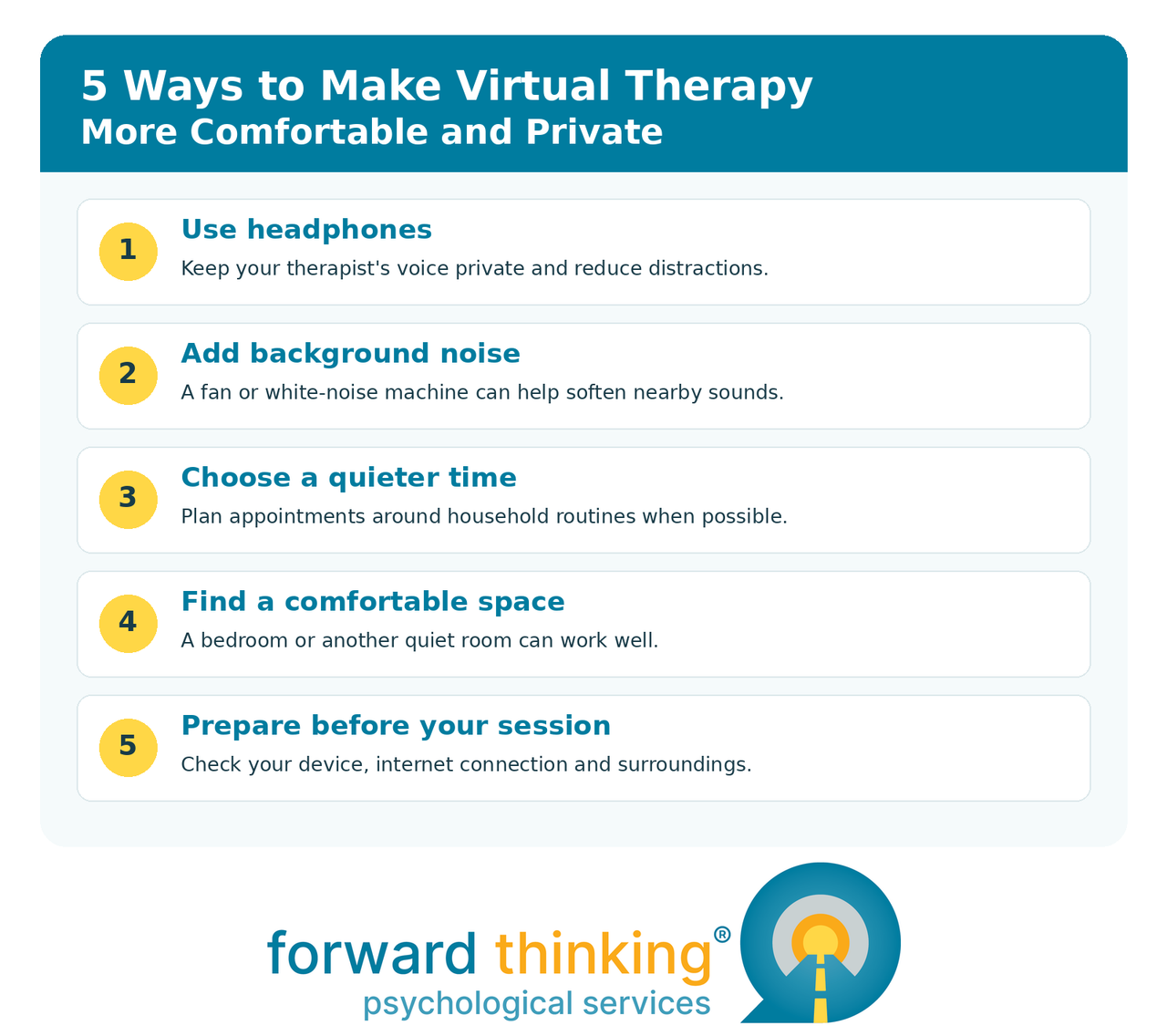
Use headphones or earbuds
Headphones help keep your therapist’s voice private and can reduce distractions during the session. They are particularly useful when combined with a quiet room.
Consider background noise
A fan or white-noise machine placed outside the room may help reduce how clearly conversations can be heard elsewhere in the home.
Schedule appointments around household routines
You may find it easier to attend when family members are at work or school, roommates are out, or the household is generally quieter.
Let others know you need uninterrupted time
If you feel comfortable doing so, you can let household members know that you have a private appointment and would appreciate not being interrupted.
You do not necessarily need to explain the nature of the appointment.
Prepare your space before the session
Before your appointment, check that your device is charged, your internet connection is working, and you have a comfortable place to sit.
What If You Don’t Have a Dedicated Private Room?
Some people arrange sessions when others are out of the house. Others use a private office, meeting room, or another quiet location where they can participate without interruption.
The important consideration is finding a space where you feel comfortable speaking openly. If you are unsure about your options, your therapist can help you consider what might work best.
Can Online Therapy Be Effective for OCD?
Yes. Research also supports the use of virtual therapy for obsessive-compulsive disorder (OCD), including exposure and response prevention (ERP), a well-established treatment for OCD.
In a large study published in the *Journal of Medical Internet Research*, Feusner and colleagues (2022)examined outcomes for 3,552 adults receiving video-based ERP through the NOCD treatment program.
The researchers reported a mean reduction of 43.4% in OCD symptoms, with 62.9% of participants meeting the study’s criteria for treatment response. Improvements were also observed in symptoms of anxiety and depression.
Although this observational study did not directly compare virtual ERP with in-person ERP in a randomized trial, its findings provide encouraging evidence that effective OCD treatment can be delivered remotely.
For individuals considering online OCD therapy or virtual ERP therapy, remote treatment can offer both greater accessibility and meaningful opportunities to practise therapeutic skills in real-life settings.
How Can Virtual Therapy Help You Apply What You Learn in Everyday Life?
Many evidence-based approaches, including cognitive behavioural therapy (CBT), involve learning new skills and practising them between sessions. Attending therapy from home can sometimes make it easier to move from discussing a strategy to actually putting it into practice.
For example:
- Anxiety: Someone who experiences anxiety about making phone calls might practise calling to book an appointment during a virtual session, with their therapist providing guidance before and after the exercise. This creates an opportunity to work directly with a situation they have been avoiding.
- Depression: A client who has been struggling with low motivation might work with their therapist to develop a realistic morning routine or identify a manageable activity to begin that day. The therapist and client can discuss specific barriers in the person’s home environment and plan how to address them.
- OCD: Someone experiencing checking compulsions might practise leaving a household appliance unchecked after completing an appropriate safety check, while their therapist guides them through resisting additional checking or reassurance-seeking. Virtual ERP can allow treatment to take place in the environment where the compulsions typically occur.
- Executive functioning: A client who finds it difficult to initiate or organize tasks might work with their therapist to break down a real-life responsibility, such as sorting paperwork or preparing for an upcoming deadline. They may then practise taking the first step during the appointment rather than leaving the entire task for later.
Not every therapeutic exercise needs to take place during a video appointment, and much of the work in therapy continues between sessions. However, virtual treatment offers additional opportunities to practise skills in meaningful contexts.
How Does FTPS Support Confidentiality During Virtual Therapy?
At Forward Thinking Psychological Services® (FTPS), virtual appointments take place through Owl Practice, the secure platform used for clinical sessions.
A secure video platform helps protect information transmitted during appointments. Clients can also take practical steps to support privacy in their own environment, such as choosing a quiet room and limiting interruptions.
For example, you might want to consider what to do if someone unexpectedly enters the room or whether a particular location is appropriate for your sessions.
Feeling Comfortable in Your Therapy Environment
Privacy in therapy is not only about whether someone can overhear a conversation. It is also about whether you feel comfortable enough to speak openly about your thoughts, emotions, and experiences.
For example, someone who worries that a family member might overhear them discussing a difficult relationship may find themselves holding back important details. Even when interruptions are unlikely, the anticipation of being overheard can make it harder to engage fully in a session.
This is worth discussing with your therapist. Together, you can consider whether your current environment allows you to participate comfortably or whether some adjustments might help.
The goal is not to create a perfectly soundproof environment, but to find a space where you feel sufficiently comfortable and secure to engage meaningfully in your therapeutic work.
How Can You Find an Online Psychologist or Virtual Therapy Services?
When looking for private online therapy, it can be helpful to consider the clinician’s experience, therapeutic approach, and how they support confidentiality during virtual appointments. An online psychologist can also explain how sessions are conducted and whether this format fits your needs.
Virtual therapy offers the opportunity to work with a clinician whose experience aligns with your concerns, even if they are not located in your immediate community, provided they are authorized to offer services where you are located.
How Can FTPS Help You Get Started With Online Therapy?
At Forward Thinking Psychological Services®, we provide evidence-based psychological services through virtual appointments for individuals experiencing anxiety disorders, OCD, depression, trauma, relationship difficulties, and other mental health concerns.
FTPS offers virtual therapy in Ontario, online therapy in British Columbia, online therapy in Alberta, and services in other Canadian provinces where our clinicians are authorized to practise.
Our intake team helps connect prospective clients with a clinician whose experience and approach may be a good fit. Before beginning treatment, clients are offered a complimentary meet-and-greet with their prospective therapist.
This provides an opportunity to learn more about the therapist, ask questions about the treatment process, and discuss practical considerations such as privacy during online sessions.
If you are considering virtual therapy services, contact FTPSto learn more about our team and arrange a complimentary meet-and-greet.
Moving Forward: Making Virtual Therapy Work for You
For people living with family members, partners, or roommates, maintaining privacy may require a little planning, but it does not necessarily need to be a barrier to getting support.
If you are considering virtual therapy in Ontario or elsewhere in Canada, contact our intake team to begin the online therapy consultation process and arrange a complimentary meet-and-greet with a prospective therapist.

FAQs:
References
Fernandez, E., Woldgabreal, Y., Day, A., Pham, T., Gleich, B., & Aboujaoude, E. (2021). Live psychotherapy by video versus in-person: A meta-analysis of efficacy and its relationship to types and targets of treatment. *Clinical Psychology & Psychotherapy, 28*(6), 1535–1549. https://doi.org/10.1002/cpp.2594
Feusner, J. D., et al. (2022). Online video teletherapy treatment of obsessive-compulsive disorder using exposure and response prevention: Clinical outcomes from a retrospective longitudinal observational study. *Journal of Medical Internet Research, 24*(5), e36431. https://doi.org/10.2196/36431
Canadian Psychological Association. (2023). *Guidelines on telepsychology.*
College of Psychologists and Behaviour Analysts of Ontario. (2024). *Standards of Professional Conduct*, Standard 17: Use of Technology
DISCLAIMER: This content is meant for informational and educational purposes only. Only a licensed psychologist or psychiatrist can diagnose a mental health disorder. The content of this website is not meant to be a substitute for therapy. Visiting this website should not be considered to be equivalent to a relationship with FTPS. Mental health concerns should only be discussed in the context of providing professional services after the consent process has been completed with a qualified FTPS associate outside of our website.
Make FTPS a Google Preferred Source
If you found our blog helpful, you can ensure our latest evidence-based mental health insights, tools, and recovery strategies always appear at the top of your Google Search and AI Overviews.