

Many adults begin wondering about ADHD after years of struggling with attention, organization, procrastination, time management, impulsivity, or feeling as though everyday responsibilities require far more effort than they seem to require for other people.
Sometimes the question emerges for a parent after their child has been diagnosed with ADHD. Individuals may recognize themselves in something they have read or heard about ADHD. Others have spent years being treated for anxiety, depression, or other concerns but continue to wonder whether ADHD could help explain longstanding difficulties that have not improved with other treatments.
This often leads to a practical question: Is it actually worth getting assessed for ADHD as an adult?
For many people, an adult ADHD assessment can be worthwhile when longstanding difficulties are interfering with everyday life, and there is genuine uncertainty about what is contributing to them. A comprehensive assessment can determine whether ADHD is present, explore other possible explanations, identify co-occurring concerns, and provide information that can guide treatment and supports.
The value of an assessment is therefore not simply in receiving an ADHD diagnosis. It is in developing a clearer understanding of what is happening and what may help.

Why Do Adults Seek an ADHD Assessment?
Adults arrive at the question of ADHD in many different ways.
Some have experienced difficulties with attention, organization or impulsivity for as long as they can remember but developed strategies that helped them manage. Others functioned relatively well until the demands of adulthood increased. University, full-time employment, managing a household, parenting or taking on greater professional responsibility can place increasing demands on executive functioning.
A person may begin recognizing longstanding patterns such as repeatedly missing deadlines, procrastinating despite significant consequences, losing track of responsibilities, struggling to organize tasks, becoming easily distracted, or finding it difficult to complete things they genuinely intend to do.
For others, the possibility of ADHD emerges after someone else in the family is diagnosed.
An assessment can help move the question from “Do these experiences sound like ADHD?” to a more clinically useful question: “What best explains this pattern, and what would help?”
Is It Worth Getting Diagnosed With ADHD as an Adult?
It certainly can be.
For someone who has spent years struggling without understanding why, an assessment can provide a framework for making sense of longstanding patterns and identify treatment options and strategies that are better matched to the difficulties they are experiencing.
Research examining adults’ experiences of receiving an ADHD diagnosis later in life suggests that diagnosis can influence how people understand themselves and reinterpret previous experiences. A systematic review found that diagnosis was often associated with greater self-understanding and self-compassion, although people also described more complicated reactions such as grief, anger or questions about identity.
When ADHD is present, diagnosis can also inform treatment. Depending on the individual, this might include medication consultation, psychological treatment, strategies targeting executive functioning, environmental changes, or workplace or educational accommodations when appropriate.
Difficulties with task initiation, organization, time management or sustained attention may also be understood differently when placed in the context of ADHD rather than interpreted as laziness, lack of motivation or simply “not trying hard enough.”
A diagnosis can therefore be meaningful, but it is not a solution in itself. Its usefulness comes partly from what someone can do with the information afterward.
For many adults, the most useful outcome of assessment is not simply being told whether they have ADHD. It is gaining a more coherent understanding of their strengths, difficulties and patterns of functioning, and clearer direction about what may help.
What Can an ADHD Assessment Tell You Beyond a Diagnosis?
A comprehensive assessment looks beyond the question of whether someone meets criteria for ADHD.
Attention and executive-functioning difficulties can have multiple causes, and ADHD can also occur alongside other psychological or neurodevelopmental concerns. A psychologist therefore considers the broader clinical picture, including developmental history, current symptoms, functional impairment and other factors that may be contributing to the person’s experiences.
High-quality adult ADHD assessment standards similarly emphasize that assessment should occur within a broader psychiatric and neurodevelopmental review rather than in isolation. The standards also emphasize impairment, developmental history, real-life examples, differential diagnosis and collateral information where available.
This broader evaluation can help determine not only whether ADHD is present, but what combination of factors best accounts for the person’s difficulties and what recommendations are most appropriate.
Isn’t an Online ADHD Test Enough?
No. An online ADHD screener can be a useful starting point, but it cannot diagnose ADHD.
Questionnaires can help identify symptoms that warrant further investigation. However, ADHD symptoms are not unique to ADHD, and endorsing symptoms on a checklist does not establish why those symptoms are occurring.
This distinction is particularly important when considering very brief assessment services. Adult ADHD can be a complex diagnostic question, and screening results should not be treated as equivalent to a comprehensive assessment.
Research examining commonly used adult ADHD self-report measures has similarly found that although these tools can be useful for screening, clinicians should not rely on rating scales alone to establish an ADHD diagnosis.
A comprehensive assessment instead involves clinical interviewing and consideration of the person’s developmental history, current functioning and impairment. Diagnosis should also be conducted by an appropriately trained healthcare professional with expertise in ADHD assessment. Clinical guidance similarly emphasizes specialist training, knowledge and experience in ADHD diagnosis.
What if I Have Managed Well Until Now?
Doing well in some areas of life does not automatically rule out ADHD.
Adults can develop sophisticated ways of compensating for areas they find difficult. Structure, routines, external reminders, working extremely long hours, relying on urgency, or choosing environments that fit one’s strengths can sometimes make difficulties less visible.
The question is therefore not simply whether someone has achieved well academically or professionally. A psychologist will also be interested in how the person has managed to achieve those things and what the process has required of them.
For example, someone may consistently meet deadlines but only by working late into the night at the last minute. Another person may appear exceptionally organized because they rely on elaborate systems to avoid forgetting things. Someone may function very well in a highly structured environment and struggle substantially when that structure disappears.
Understanding the strategies a person has developed can be an important part of understanding their overall pattern of functioning.
At What Age Should I Consider an ADHD Assessment?
There is no particular age at which someone should seek an ADHD assessment. It may be worth considering at any point in adulthood when longstanding difficulties with attention, organization, impulsivity, time management or other areas of executive functioning are interfering with everyday life or raising questions about whether ADHD may be contributing.
The decision is therefore less about age and more about the pattern and impact of the difficulties. Some people seek assessment as young adults when the increased demands of university or work make difficulties more apparent. Others do so much later, after years of developing strategies that helped them manage.
Should I Get Tested for ADHD at 30 or 40?
If there are longstanding concerns that are affecting your life, it is not too late to seek an assessment.
ADHD is a neurodevelopmental condition, which means that an adult assessment considers whether relevant patterns were present earlier in development. But this does not mean ADHD must have been recognized or diagnosed during childhood.
Some people are not identified until adulthood because their symptoms were less disruptive, they developed effective compensatory strategies, or their difficulties became more apparent only as demands in their lives increased.
This can be particularly relevant for people whose ADHD presentation was less likely to attract attention earlier in life. Research on women diagnosed with ADHD in adulthood, for example, has documented the impact of living for years with previously unrecognized difficulties.
There is therefore no particular age at which an ADHD assessment stops being worthwhile. The more relevant question is whether understanding these patterns now could meaningfully inform what you do next.
What If the Assessment Finds That I Don’t Have ADHD?
That does not mean the assessment was unsuccessful.
A comprehensive psychological assessment is designed to evaluate the diagnostic question rather than confirm a predetermined answer.
If ADHD does not best explain someone’s difficulties, an assessment may identify another condition, multiple interacting factors, or areas of strength and difficulty that require a different approach. The aim is to leave the person with a clearer understanding of their functioning and useful recommendations for next steps.
This is also why the quality of the diagnostic process matters. A 2025 review of adult ADHD diagnostic practices found substantial variability in how adult ADHD was diagnosed across randomized controlled studies and concluded that accurate diagnosis should be prioritized through comprehensive differential diagnosis by skilled psychologists or psychiatrists.
Does an ADHD Diagnosis Actually Help Adults?
It can, particularly when the diagnosis leads to appropriate treatment, strategies or supports.
ADHD can affect multiple areas of adult functioning, including work, relationships and quality of life. Diagnosis may create an opportunity to understand these difficulties differently and pursue interventions that better match the person’s needs.
But diagnosis itself is not the endpoint.
Its value is greatest when the information changes something: how a person understands their difficulties, the treatment they receive, the strategies they use, or the supports available to them.
How Do I Know Whether an ADHD Assessment Is Worth It for Me?
It may be worth considering an assessment when you have longstanding difficulties that are affecting important areas of your life, and you want greater clarity about why they are occurring.
You might consider whether:
- difficulties with attention, organization, impulsivity, task initiation or time management are persistent rather than occasional;
- similar patterns have appeared across different periods or areas of your life;
- you have developed extensive strategies to compensate for these difficulties;
- the difficulties are interfering with work, education, relationships, household responsibilities or other aspects of everyday functioning;
- previous explanations or treatments have not fully accounted for what you experience; or
- knowing whether ADHD is present would meaningfully affect treatment, supports or decisions you are considering.
You do not need to be certain that you have ADHD before seeking an assessment. Figuring that out is the purpose of the assessment.
Is an Adult ADHD Assessment Worth the Cost?
This is an understandably important consideration, particularly because comprehensive psychological assessments require both time and financial investment.
Whether the assessment is worth the cost depends partly on what you hope to gain from it.
If someone is seeking only confirmation of something they already believe, a comprehensive assessment may feel like a substantial undertaking. But if the goal is to understand longstanding difficulties, distinguish ADHD from other possible explanations, obtain individualized recommendations, or establish documentation that may be required for certain supports or accommodations, the information may have considerable practical value.
Before proceeding, it can be helpful to ask what the assessment includes, who conducts it, whether differential diagnosis is considered, what kind of feedback is provided, and whether you will receive a written report and individualized recommendations.
A high-quality assessment should provide considerably more than a diagnostic label.
What Should I Look for in an Adult ADHD Assessment?
Look for an assessment that is comprehensive rather than one that relies primarily on a questionnaire or single test, and ensure that it is completed by a healthcare professional with appropriate training and expertise in ADHD assessment.
Adult ADHD diagnosis requires consideration of symptoms and impairment across time and contexts. Published adult ADHD assessment quality standards emphasize a detailed clinical and developmental history, exploration of real-life examples of symptoms and impairment, consideration of other psychological and neurodevelopmental conditions, and meaningful post-assessment discussion.
Standardized questionnaires and other measures can contribute useful information, but they should inform the clinical formulation rather than determine the diagnosis on their own.
Collateral information can also be valuable. Where appropriate and available, information from someone who knows the person well, childhood informants, school reports or previous assessments can contribute to understanding when difficulties emerged and how they have affected functioning over time. Current adult ADHD assessment standards specifically recommend seeking independent information where possible to corroborate self-report and help establish the nature and severity of symptoms and impairment.
You should also understand what you will receive at the end of the process. Feedback should explain the findings in understandable language and provide recommendations based on your particular profile rather than simply stating whether diagnostic criteria were met.
The question is not simply whether an assessment includes a particular test. The more important issue is whether the clinician integrates information from multiple sources to understand the person’s developmental history, current functioning, areas of impairment and possible alternative explanations.
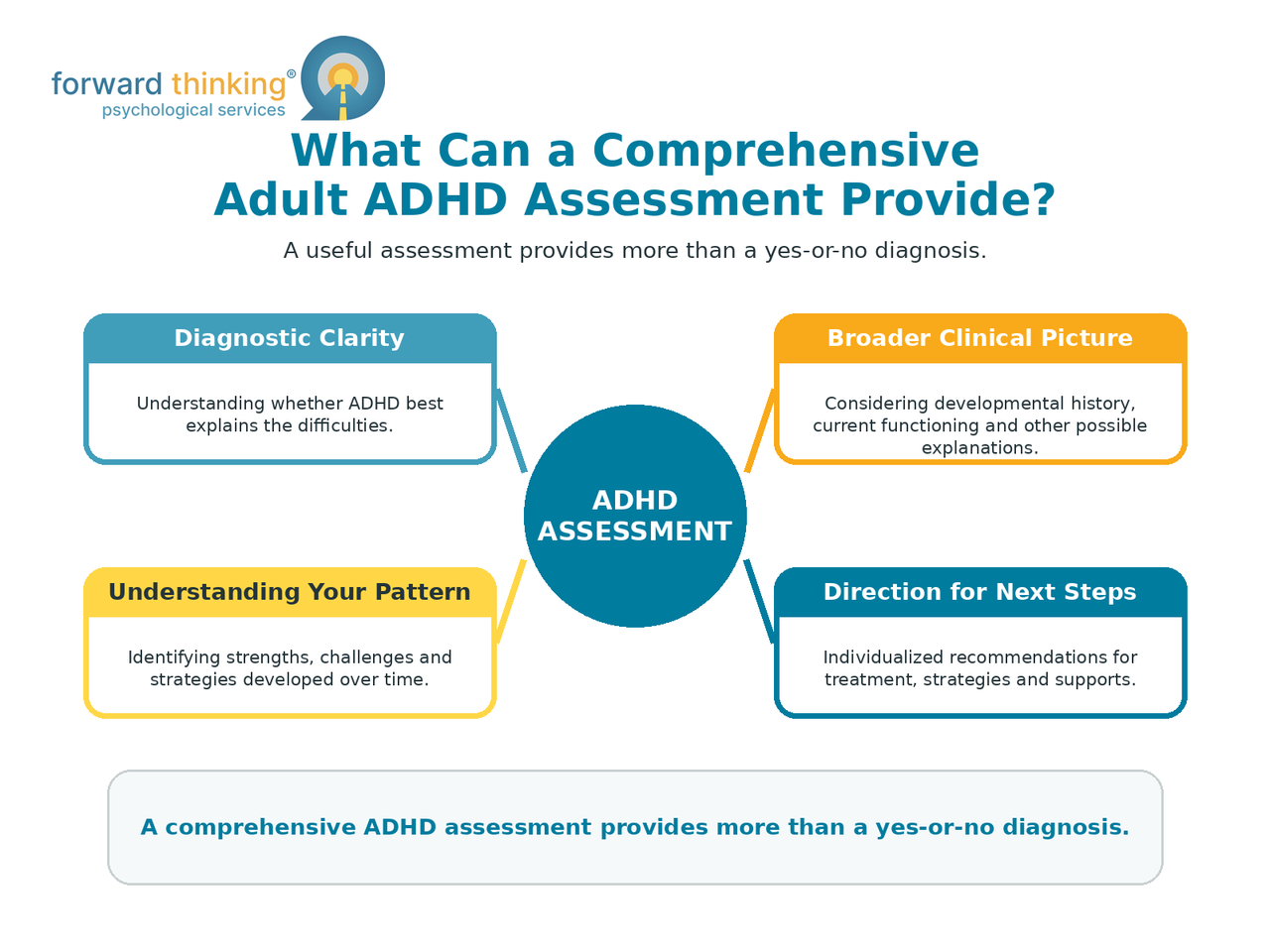
A comprehensive ADHD assessment is about more than determining whether diagnostic criteria are met. It can help develop a clearer picture of longstanding patterns, identify factors contributing to current difficulties, and provide direction about what may help moving forward.
Conclusion
It is possible to reach your 30s, 40s or later without having ADHD recognized, particularly when you have developed effective ways of compensating or your difficulties did not fit common expectations of what ADHD should look like.
If longstanding attention or executive-functioning difficulties are affecting everyday life, an assessment can provide information that is difficult to obtain from symptom checklists alone.
A comprehensive assessment considers whether ADHD criteria are met while also examining developmental history, current functioning, impairment and other factors that may contribute to the person’s experiences.
For many adults, the real value of assessment lies in gaining a clearer understanding of those patterns and having better information about what may help.
Adult ADHD Assessments at Forward Thinking Psychological Services
Forward Thinking Psychological Services® provides comprehensive adult ADHD assessments across Canada. Our assessment process is designed to look beyond symptom checklists and develop an individualized understanding of each person’s presentation.
The assessment considers developmental and clinical history, current symptoms and functioning, standardized measures and other relevant information. Where appropriate, psychologists also consider other psychological or neurodevelopmental factors that may contribute to the person’s experiences.
Following the assessment, clients receive feedback about the findings and individualized recommendations to help guide next steps.

FAQs:
DISCLAIMER: This content is meant for informational and educational purposes only. Only a licensed psychologist or psychiatrist can diagnose a mental health disorder. The content of this website is not meant to be a substitute for therapy. Visiting this website should not be considered to be equivalent to a relationship with FTPS. Mental health concerns should only be discussed in the context of providing professional services after the consent process has been completed with a qualified FTPS associate outside of our website.
Make FTPS a Google Preferred Source
If you found our blog helpful, you can ensure our latest evidence-based mental health insights, tools, and recovery strategies always appear at the top of your Google Search and AI Overviews.