

Obsessive-compulsive disorder (OCD) in teenagers does not always look the way parents expect it to.
A teenager with OCD may wash their hands repeatedly or check that a door is locked. But they may also repeatedly ask whether they have done something wrong, spend hours re-reading homework, avoid particular people or situations without explaining why, confess minor events to their parents, or become stuck trying to make an ordinary decision.
Some compulsions are almost entirely invisible. A teenager might replay conversations in their mind, silently repeat particular words, review whether something “really happened,” or try to determine with certainty what a thought they have means about them.
This can make OCD difficult for parents to recognize, particularly when a teenager is embarrassed by their symptoms or actively trying to hide them. Pediatric OCD can also overlap with anxiety, depression, ADHD, autism and other concerns, making careful assessment important.
The key is often not simply what a teenager is doing, but why they feel they need to do it.

What Does OCD Look Like in a Teenager?
OCD involves obsessions, compulsions, or both.
Obsessions are recurring thoughts, images, urges or doubts that are intrusive and unwanted. They may involve contamination, harm, morality, sexuality, religion, relationships, mistakes, responsibility, or a sense that something is simply not “right.”
Compulsions are behaviours or mental acts performed in response to an obsession or according to rigid rules. Their purpose is typically to reduce distress, prevent something feared from happening, resolve uncertainty, or achieve a particular feeling of certainty or “rightness.”
Some compulsions are easy to see:
- washing or cleaning
- checking
- repeating actions
- arranging objects
- asking the same question repeatedly
Others are much harder to notice:
- mentally reviewing what happened
- replaying conversations
- silently repeating words or phrases
- trying to replace a “bad” thought with a “good” one
- checking one’s memory
- analyzing what a thought means
- repeatedly seeking reassurance
- confessing
This distinction matters. A teenager can have significant OCD without the expected visible rituals many people associate with the disorder. OCD involving uncomfortable sexual, violent, religious or moral thoughts may be easier to conceal, and compulsions associated with these symptoms are often covert or mental.
What Are Some Signs of OCD Parents May Miss?
Parents often notice that something has changed before they understand what is driving it.
Repeated reassurance seeking
A teenager may repeatedly ask questions such as:
“Are you sure I’m not sick?”
“Do you think I did something wrong?”
“Are you mad at me?”
“Would I know if I had hurt someone?”
“Do you think this means I’m a bad person?”
Answering may settle the question briefly. But another doubt will often appear shortly, or the teenager will ask the same question again in a slightly different way.
Reassurance seeking can function as a compulsion when the goal becomes obtaining certainty or neutralizing an obsessional fear.
Confessing things that don’t seem to require confession
Some teenagers feel compelled to tell a parent every potentially “bad” thought, mistake or action.
A parent might hear detailed accounts of something the teenager said at school, an intrusive thought they had, whether they may have lied, or something they did years ago.
The important question is not whether teenagers sometimes seek their parents’ perspective; they certainly do. It is whether confessing has become repetitive and driven by a need to resolve obsessional doubt or guilt.
Ordinary tasks take much longer than they should
Homework may take three hours because a teenager repeatedly rereads a paragraph until it feels right or until they read through to completion without a spontaneous negative thought.
An assignment may be rewritten because it doesn’t feel right when first completed.
Getting ready for school may involve repeating parts of a routine, desiring symmetry when getting dressed or needing movements to be completed in a certain way.
Bedtime may also become increasingly elaborate due to time-consuming rituals that must take place.
Parents can sometimes observe procrastination, perfectionism or poor time management. But when a teenager repeatedly checks, repeats, restarts or seeks certainty, OCD may also be worth considering.
Avoidance seems difficult to explain
Compulsions are not always about doing something. Sometimes they involve not doing something.
A teenager may avoid particular objects, bathrooms, foods, people, places, numbers, words, websites or situations because they trigger obsessional fears.
Avoidance can make OCD particularly difficult to identify because the underlying obsession may remain completely hidden.
The teenager seems unable to “let something go”
Parents may find themselves in conversations that seem to have no endpoint.
The teenager isn’t necessarily looking for more information. They may be trying to reach a level of certainty that ordinary life cannot provide.
This can look like indecisiveness, rumination or excessive questioning. What distinguishes OCD is the broader pattern: intrusive doubt followed by repeated attempts to resolve or neutralize that doubt.
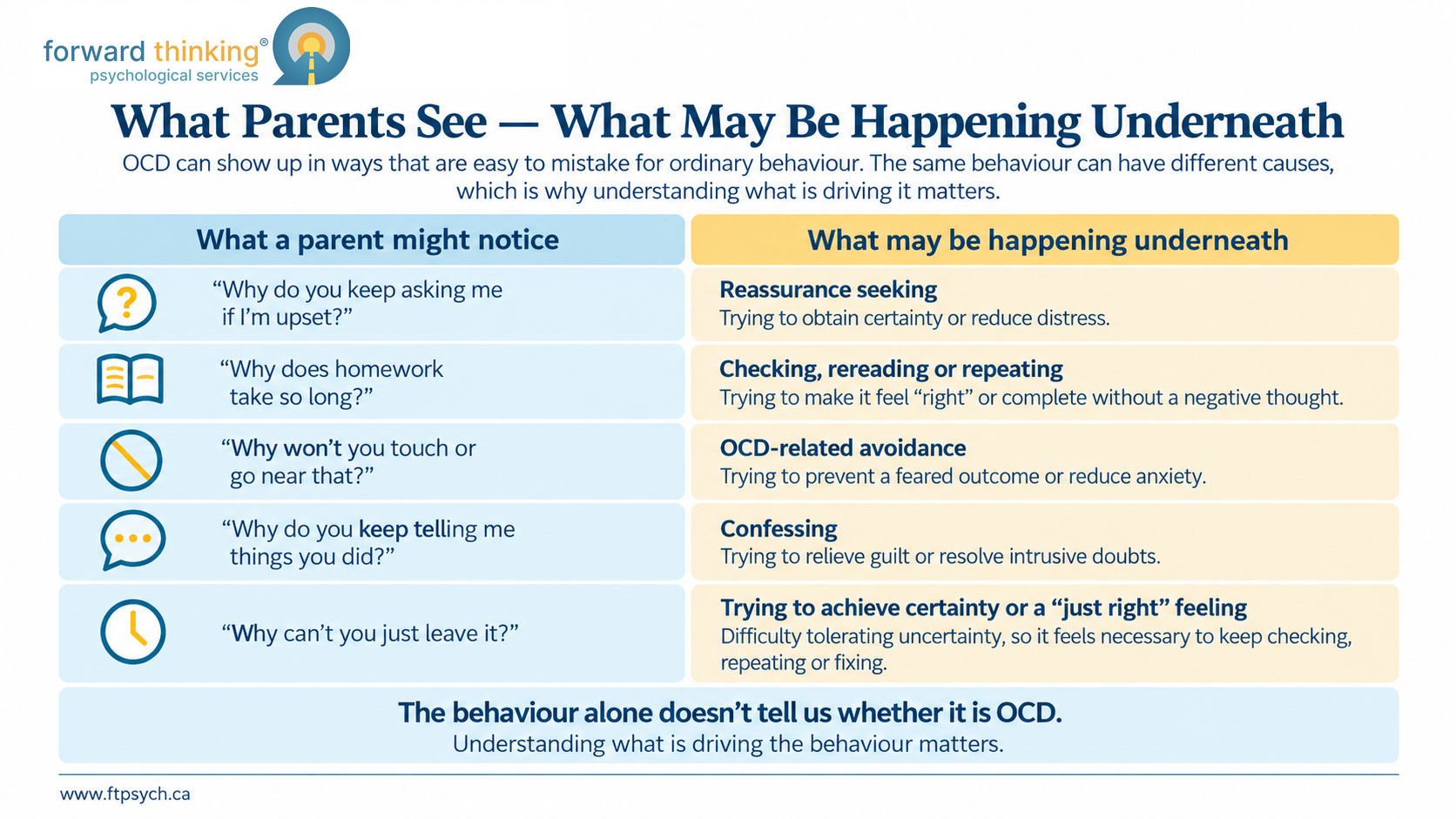
OCD can show up in ways that are easy to mistake for ordinary worry, perfectionism or difficult behaviour. Understanding what is driving the behaviour can help clarify whether further assessment may be useful.
Why Might Teenagers Hide OCD Symptoms?
Some OCD symptoms are relatively easy to talk about. Others can feel frightening or shameful.
A teenager experiencing an intrusive thought about harming someone may fear that having the thought means they actually want to do it. A teenager experiencing an unwanted sexual thought may worry that the thought reveals something about their identity or intentions. Others may fear being judged for religious or moral obsessions.
These thoughts can feel especially alarming precisely because they conflict with what matters to the person.
As a result, teenagers may hide their thoughts, provide only part of the story, or describe the anxiety without explaining what they are actually afraid of. Clinical literature on pediatric OCD specifically notes that young people may not spontaneously disclose symptoms such as violent or sexual obsessions.
Parents therefore may see the consequences of OCD, namely distress, avoidance, lengthy routines, irritability or reassurance seeking, before they know what is happening internally.
How Is OCD Different From Ordinary Teen Worry or Anxiety?
Not every repetitive worry is OCD.
Teenagers have many genuine uncertainties to navigate: friendships, school performance, appearance, relationships, health, family expectations and their future. Anxiety about these issues can be significant, yet normative, without being considered obsessive-compulsive in nature.
Within the context of OCD, the person typically becomes caught in a cycle involving an intrusive doubt or feared possibility and an attempt to obtain relief or certainty through a compulsion.
Consider two teenagers worried about an upcoming test.
One thinks, “I’m worried I’m going to fail,” studies excessively and has trouble sleeping. This could reflect anxiety or perfectionism.
Another repeatedly wonders whether they accidentally skipped a page of notes, rereads the same material, checks with classmates that nothing was missed, and cannot stop because they never feel sufficiently certain that they have reviewed everything correctly.
The behaviour may look similar from the outside. The process underneath it is different.
This is also why diagnosis based on a single behaviour can be misleading. Repetitive behaviour, rigid routines, avoidance, reassurance seeking and difficulty with uncertainty can occur in several clinical presentations. A careful assessment considers the function of the behaviour, the teenager’s internal experience, developmental history, co-occurring symptoms and the broader pattern of functioning.
Could Reassurance Seeking Be a Compulsion?
Yes. But not every request for reassurance is a compulsion.
Parents often reassure their children. However, a distressed teenager asking for comfort does not automatically have OCD.
The pattern becomes more concerning when reassurance provides only temporary relief and the same question, or a new version of it, quickly returns.
For example:
Teen: “Are you sure I didn’t offend her?”
Parent: “I’m sure.”
Teen: “But did I sound rude?”
Parent: “No.”
Teen: “Would you tell me if I did?”
Parent: “Yes.”
Teen: “But what if you didn’t notice?”
The problem is no longer a lack of information. The teenager is trying to eliminate uncertainty.
Parents can understandably become part of this cycle because answering the question reduces their teenager’s distress in the moment. Research refers to this broader process as family accommodation: family members may provide reassurance, participate in rituals, help a child avoid triggers, or alter family routines around OCD symptoms. Family accommodation is common in pediatric OCD and is associated with greater symptom severity and impairment.
This does not mean parents have caused or reinforced OCD intentionally. Accommodation usually develops because parents are trying to help a distressed child.
What Can OCD Look Like at Home or at School?
OCD can interfere with everyday functioning in ways that do not initially look like OCD.
At home, parents might notice:
- difficulty getting out of the house because routines must be completed in a particular way
- lengthy showering, grooming or bathroom routines
- repeated questions or requests for reassurance
- conflict when family members refuse to participate in rituals
- difficulty going to bed
- avoiding particular rooms, objects or family members
At school, OCD might contribute to:
- repeatedly checking or rewriting work
- difficulty finishing tests
- excessive concern about making mistakes
- rereading instructions or assignments
- avoiding certain classes, spaces or people
- difficulty handing in work because it doesn’t feel complete or correct
- school lateness or avoidance
Again, none of these behaviours by themselves establish OCD. The goal is to understand what is getting in the way.
When Should Parents Consider an OCD Assessment?
It may be worth seeking an assessment when intrusive thoughts, repetitive behaviours, mental rituals or avoidance are causing significant distress or interfering with a teenager’s life.
Parents might particularly consider seeking help when:
- rituals or obsessional thinking are taking up substantial time
- schoolwork or daily routines are becoming unusually lengthy
- avoidance is increasing
- sleep, friendships, school or family life are being impacted
- reassurance seeking or confessing has become repetitive
- family members are increasingly being asked to participate in rituals or change routines
- the teenager says they know something doesn’t make sense but still feels unable to stop
- the teenager is distressed by intrusive thoughts they do not understand or is afraid to disclose
Parents do not need to determine whether the problem is definitely OCD before asking for help. That is one purpose of an assessment.
What Happens During an OCD Assessment for a Teenager?
A good OCD assessment involves more than asking whether someone washes or checks.
The clinician will typically want to understand the teenager’s intrusive thoughts, doubts, images or urges; visible and mental compulsions; avoidance; triggers; feared consequences; reassurance seeking; and the amount of time and distress associated with symptoms.
It is also important to assess how symptoms affect school, friendships, family life and daily functioning, and whether family members have become involved in accommodating OCD.
Because OCD can overlap with other difficulties, assessment should also consider alternative or co-occurring explanations for the symptoms. Pediatric OCD assessment literature emphasizes diagnostic clarification, differential diagnosis, comorbid conditions, symptom severity, psychosocial functioning and family functioning.
Standardized measures can supplement the clinical interview. One widely used clinician-administered measure is the Children’s Yale-Brown Obsessive Compulsive Scale (CY-BOCS), which assesses OCD symptom severity in children and adolescents. Measures can be useful, but they are not substitutes for a thorough clinical interview.
For teenagers in particular, it can also be important to create opportunities to speak privately with the clinician. A young person may disclose thoughts or rituals when speaking individually that they have been too embarrassed to describe in front of a parent.
What Treatment Helps Teenagers With OCD?
OCD is treatable.
Cognitive behavioural therapy (CBT) incorporating exposure and response prevention (ERP) has the strongest evidence base as a psychological treatment for pediatric OCD. In ERP, teenagers gradually practise approaching situations, thoughts or uncertainty that trigger OCD while reducing the compulsions and avoidance they would ordinarily use to feel safe or certain.
Good ERP is collaborative and developmentally appropriate. It should not simply involve forcing a teenager to confront their worst fear. Treatment is planned with the young person, progresses thoughtfully, and helps them learn that they can experience uncertainty or discomfort without relying on OCD’s rules.
Parents can also play an important role. Treatment may include helping parents recognize accommodation, respond differently to reassurance seeking, and support their teenager’s therapeutic goals without becoming another part of the OCD cycle.
Medication may also be considered in some circumstances, particularly when symptoms are more severe or significantly impairing. Medication decisions should be made with an appropriately qualified medical professional.
Other OCD-specific psychological approaches are also being studied. For example, inference-based cognitive behavioural therapy (I-CBT) focuses on the reasoning process that gives rise to obsessional doubt. Current randomized evidence for I-CBT is promising in adults, but the evidence base is not yet comparable to that for ERP in children and adolescents.
How Can Parents Help a Teenager With OCD?
One of the most useful things parents can do is become curious about the pattern rather than arguing about whether the fear makes sense.
A teenager with OCD usually does not need a better argument for why the feared outcome is unlikely. They may already know that. The difficulty is feeling compelled to obtain certainty anyway.
Parents can begin by noticing:
- What situations trigger the distress?
- What does my teenager fear might happen?
- What do they do to feel safer, more certain or “just right”?
- How long does the relief last?
- Have we started changing family routines around the fear?
- Are we answering the same questions repeatedly?
If OCD is present, parents may eventually need to reduce reassurance and accommodation. However, abruptly refusing every request for reassurance without a plan can lead to significant distress and conflict. This is often best addressed collaboratively as part of treatment with a knowledgeable OCD clinician.
The goal is not to become less supportive. It is to learn how to support the teenager rather than the OCD.
Getting Help for a Teenager With Possible OCD
It can be difficult for parents to know whether they are seeing ordinary adolescent anxiety, OCD, another mental-health concern, or some combination of these.
You do not need to solve that question before reaching out.
At Forward Thinking Psychological Services®, our psychologists and supervised clinicians work with teenagers experiencing OCD and related anxiety concerns. Assessment can help clarify what is contributing to a teenager’s symptoms and guide recommendations for treatment and support.
For teenagers with OCD, treatment can be tailored to their developmental level, symptoms, family context and individual goals. Our approach to OCD treatment for teenagers includes evidence-based CBT and ERP, with parents involved when clinically appropriate.
Concerned that your teenager may be experiencing OCD? Contact Forward Thinking Psychological Services® to learn more about assessment and treatment options for teens.

FAQs:
DISCLAIMER: This content is meant for informational and educational purposes only. Only a licensed psychologist or psychiatrist can diagnose a mental health disorder. The content of this website is not meant to be a substitute for therapy. Visiting this website should not be considered to be equivalent to a relationship with FTPS. Mental health concerns should only be discussed in the context of providing professional services after the consent process has been completed with a qualified FTPS associate outside of our website.
Make FTPS a Google Preferred Source
If you found our blog helpful, you can ensure our latest evidence-based mental health insights, tools, and recovery strategies always appear at the top of your Google Search and AI Overviews.