

Receiving an obsessive-compulsive disorder (OCD) diagnosis can sometimes bring relief for individuals. For a teenager who has been struggling with intrusive thoughts, rituals, reassurance seeking or avoidance, finally having an explanation for what has been happening may help things make more sense.
But not every teenager responds this way.
Some teenagers disagree with the diagnosis. Others become angry when OCD is mentioned, insist that their worries are reasonable and make sense to them. Others may refuse to discuss treatment. A teenager may acknowledge that something is difficult while strongly rejecting the idea that OCD has anything to do with it.
For parents, this can be confusing and frustrating. If you can clearly see how much OCD is interfering with your teenager’s life and family functioning, it can be tempting to keep explaining the diagnosis until they understand.
That approach does not always help.
A teenager does not necessarily need to fully accept an OCD diagnosis before a useful conversation about their difficulties can begin. Often, it is more productive to become curious about how they understand what is happening and what, if anything, they would like to change.
Throughout this article, we use the term “parents” for simplicity, while recognizing that other caregivers and loved ones may also play an important role in supporting a teenager with OCD.

Why Might a Teenager Reject an OCD Diagnosis?
There is no single reason.
Some teenagers are embarrassed by the diagnosis or worried about what it means about them. Others may be concerned about friends finding out or being treated differently at school. Research examining adolescents’ experiences with OCD has identified stigma, trust, privacy and worries about being treated as a person rather than simply as someone with a diagnosis as meaningful concerns.
For other teenagers, the issue may be insight.
In OCD, insight refers to the extent to which someone recognizes that their obsessive fears and compulsive responses are related to OCD rather than being entirely reasonable or necessary. Poor or absent insight occurs in a meaningful minority of young people with OCD and has been associated with greater symptom severity and impairment.
This can look very different from deliberately refusing to acknowledge a problem.
A teenager who repeatedly checks that the door is locked may genuinely believe that checking is necessary. A teen with contamination fears may believe avoiding certain objects is simply sensible and that they are preventing harm to themselves or others. Someone who repeatedly confesses upsetting thoughts may see the problem as the thoughts themselves rather than the need to confess them.
From the teenager’s perspective, the parent may therefore appear to be asking them to stop doing something that feels protective or necessary.
Is Rejecting the Diagnosis the Same as Refusing Help?
Not necessarily.
This distinction can be very useful for parents.
A teenager might say:
“I don’t have OCD.”
But they might also say:
“I hate how long it takes me to get ready.”
“I wish I didn’t have to ask you the same question all the time.”
“I want to be able to go places without worrying about this.”
“I’m exhausted from thinking about it.”
These statements provide a possible starting point.
Rather than making agreement about the diagnostic label a prerequisite for treatment, parents and clinicians can sometimes begin with the difficulties the teenager already recognizes.
The initial question becomes less about “How do I convince my teenager that they have OCD?” and more about “Is there something happening in their life that they would like to be different?”
Clinical Insight
A teenager who rejects an OCD diagnosis is not necessarily refusing help. They may disagree with the diagnostic label while still recognizing that certain thoughts, routines, reassurance seeking or avoidance are interfering with their life. Finding the part of the problem the teenager already wants to change can sometimes provide a more productive starting point for treatment.
Why Can Trying to Convince a Teenager Backfire?
When parents know that their teenager has been carefully assessed, it is understandable to want them to accept the conclusion and figure out next steps together.
But repeatedly trying to prove that a behaviour is OCD can turn the diagnosis into an argument.
A parent says:
“That’s your OCD talking.”
The teenager responds:
“No, it isn’t.”
The parent provides more evidence.
The teenager becomes more defensive.
Soon, the family is arguing about whether the teenager’s fear is reasonable rather than talking about the impact the problem is having.
Adolescence also involves an increasing need for autonomy. Being repeatedly told what they think, why they are doing something or which experiences “count” as OCD may make some teenagers feel misunderstood or controlled.
This does not mean parents should pretend that they agree with an OCD-driven fear. It means that understanding the teenager’s perspective and agreeing with the OCD are not the same thing.
How Can Parents Talk About OCD Without Escalating Conflict?
Curiosity is often more useful than persuasion.
Instead of:
“You need to understand that this is OCD.”
A parent might ask:
“What did you think about what the psychologist said?”
“Was there anything about the assessment that made sense to you?”
“Was there anything you disagreed with?”
“What do you think is making things difficult right now?”
The goal is not to lead the teenager toward the “correct” answer. It is to understand how they are making sense of their experience and how it compares to the information conveyed by the assessment and diagnosis.
Parents may discover that their teenager is not actually rejecting everything about the assessment. They may dislike the diagnosis but recognize that reassurance seeking is exhausting. They may disagree that their avoidance is excessive but wish they could spend more time with friends. They may not believe their rituals are unreasonable but hate how much time they consume.
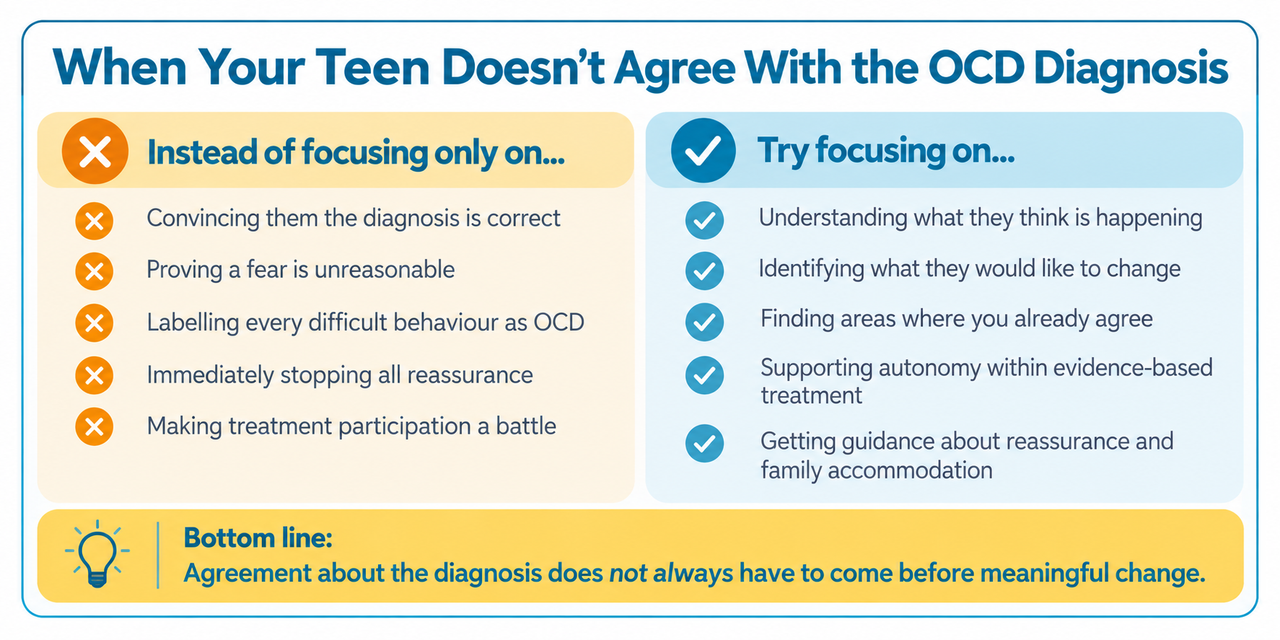
Those areas of agreement can become a place to begin. When a teenager does not agree with the diagnosis, shifting the focus of the conversation can help:
What Should Parents Avoid Saying?
There is rarely a perfect sentence that will make a teenager accept a diagnosis. However, certain patterns can make conversations more adversarial.
Parents may want to be cautious about repeatedly saying things such as:
“That’s just OCD.”
“You know that doesn’t make sense.”
“The psychologist already told you this.”
“If you would just stop doing the compulsions, you would feel better.”
Even when there is truth behind the parent’s concern, these statements can inadvertently communicate that the teenager’s experience is being dismissed.
It can also be helpful not to label every interfering behaviour as OCD. Teenagers with OCD are still teenagers. They can procrastinate, become irritable, change their minds, avoid chores and disagree with their parents for reasons that have nothing to do with OCD.
As a parent, remembering that distinction matters.

What If My Teenager Wants Me to Reassure Them?
This can become particularly complicated when a teenager rejects the diagnosis but repeatedly asks parents to participate in behaviours that may be maintaining OCD.
For example, a teenager may ask:
“Are you sure I didn’t offend her?”
“Do you think this is contaminated?”
“Promise me I didn’t do anything wrong.”
“Can you check this one more time?”
Parents often provide reassurance because their teenager is distressed, and reassurance helps in the moment. Understandably, family members want to support their loved ones.
When reassurance becomes part of an OCD compulsion, however, repeatedly providing certainty can contribute to the OCD cycle.
Family accommodation can include providing reassurance, participating in rituals, facilitating avoidance or changing family routines around OCD. Research consistently finds an association between family accommodation and greater OCD symptom severity.
That does not mean parents should suddenly refuse every request for reassurance.
Abruptly changing well-established family responses can produce considerable distress and conflict. Family-based OCD treatment can help parents learn how to respond supportively while gradually reducing their participation in compulsions and avoidance. Teens might also want to participate in these modifications so that changes to the family system are collaborative.
The goal is not to become less supportive. It is to learn how to support the teenager without supporting and maintaining the OCD.
Can Parents Help If Their Teenager Refuses OCD Treatment?
Yes.
A teenager’s reluctance to participate does not mean parents have no role.
Parents can learn about OCD, become more aware of family accommodation, change how they respond to reassurance seeking and compulsions, and work on communication patterns within the family.
There is evidence that reductions in family accommodation occur alongside improvement during pediatric OCD treatment, and family-based approaches specifically address how parents respond to OCD symptoms.
For some families, parent-focused work may therefore be useful even when a teenager is not yet willing to participate fully.
This is particularly important because parents can easily become caught between two extremes: accommodating OCD to prevent distress or confronting OCD so strongly that every interaction becomes a battle.
Neither extreme is usually the goal.
What Helps a Teenager Become More Willing to Engage in Treatment?
Treatment engagement may be easier when therapy connects with something that matters to the teenager.
A teenager may not be particularly motivated by the goal of “reducing OCD symptoms.”
They may care much more about:
- finishing homework faster
- doing well at school
- having more privacy from parents
- getting to school on time
- spending more time with friends
- being comfortable in new situations
- being able to play sports or participate in activities
- feeling less exhausted
- having fewer arguments at home
These goals can provide a more meaningful starting point for treatment.
It can also help for teenagers to have some appropriate choice in the therapeutic process. Depending on their age and circumstances, this might include participating in decisions about treatment goals, discussing what they want help with first or having an opportunity to speak privately with the clinician. Helping to choose their clinician may also increase comfort and engagement.
Giving a teenager a voice in the process does not mean allowing OCD to determine the treatment plan. Of course, treatment would still be structured around evidence-based principles.
It means recognizing that treatment is something being done with the teenager rather than to them.
What Does OCD Treatment for Teenagers Usually Involve?
Cognitive behavioural therapy incorporating exposure and response prevention (ERP) has a strong evidence base for pediatric OCD.
ERP helps teenagers gradually approach situations, thoughts or feelings that trigger obsessive fear while reducing the compulsions and avoidance they normally use to obtain certainty or reduce distress.
For a teenager who is unsure about the diagnosis, treatment does not necessarily need to begin with an argument about whether every thought or behaviour is OCD.
A clinician can first work to understand the teenager’s goals, explain the treatment model in a way that makes sense to them, and collaboratively identify patterns that may be keeping the problem going.
Parents may also be involved in treatment, particularly when OCD has become woven into family routines.
When Should Parents Seek Additional Help?
Parents may want to seek further professional support when a teenager’s symptoms are significantly interfering with school, friendships, family life, sleep or daily routines, particularly when the teenager is unwilling to engage in treatment or disagreements about OCD are creating substantial family conflict.
It can also be helpful to revisit the assessment itself.
A teenager’s disagreement should not automatically be assumed to reflect poor insight. They may have questions about how the diagnosis was reached, feel that important aspects of their experience were misunderstood or have concerns about another explanation for their symptoms.
A thoughtful clinician should be able to discuss those concerns rather than treating disagreement itself as evidence of OCD.
At the same time, a teenager does not need to reach complete agreement with every part of an assessment before the family can begin addressing the difficulties that everyone can see.
Sometimes the first step is simply finding one shared goal.
Moving Forward When Your Teenager Doesn’t Agree
It can be difficult for parents to watch OCD interfere with a teenager’s life while hearing that same teenager insist that nothing is wrong.
As described, complete agreement about the diagnosis does not always need to be the first goal.
Parents can remain clear about what they are observing while also becoming curious about their teenager’s experience. They can reduce patterns that inadvertently accommodate OCD, support goals that matter to their teenager and seek professional guidance about how to respond when OCD has become embedded in family life.
Sometimes engagement begins not with “I agree that I have OCD,” but with something much smaller:
“I don’t want this to keep taking up so much of my life.”
That can be enough of a place to start.
At Forward Thinking Psychological Services®, we provide evidence-based assessment and treatment for teenagers with OCD, including CBT with exposure and response prevention (ERP). We also work with parents and families to better understand OCD, reduce accommodation and develop supportive ways of responding when OCD is affecting family life. Treatment can be tailored to a teenager’s individual needs, goals and readiness to engage. Families who would like to learn more about assessment or OCD treatment for their teenager can contact Forward Thinking Psychological Services® to discuss available services.

FAQs:
DISCLAIMER: This content is meant for informational and educational purposes only. Only a licensed psychologist or psychiatrist can diagnose a mental health disorder. The content of this website is not meant to be a substitute for therapy. Visiting this website should not be considered to be equivalent to a relationship with FTPS. Mental health concerns should only be discussed in the context of providing professional services after the consent process has been completed with a qualified FTPS associate outside of our website.
Make FTPS a Google Preferred Source
If you found our blog helpful, you can ensure our latest evidence-based mental health insights, tools, and recovery strategies always appear at the top of your Google Search and AI Overviews.