

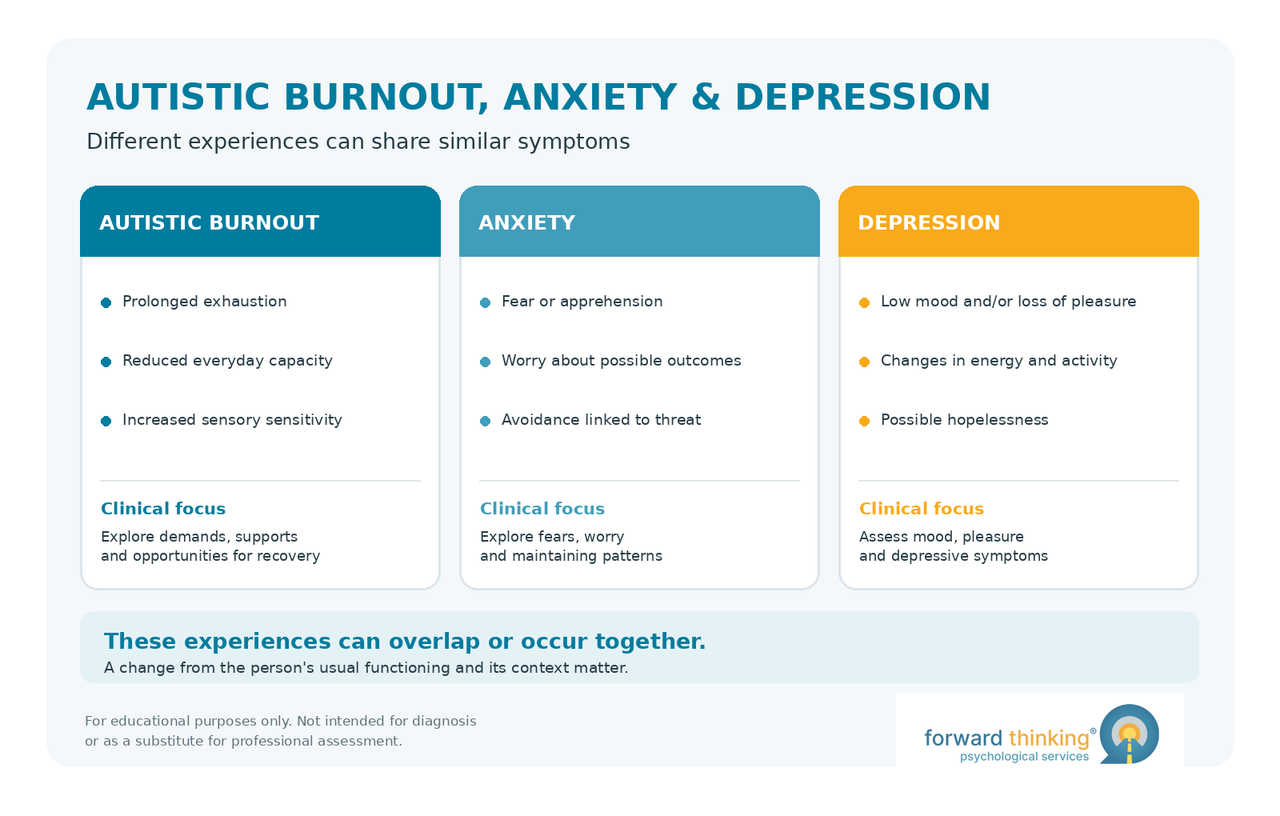
Autistic burnout can be difficult to recognize, particularly when its symptoms overlap with anxiety, depression or ongoing stress. An adult experiencing autistic burnout may feel profoundly exhausted, find everyday responsibilities increasingly difficult, become more sensitive to sensory input or notice that activities they previously managed are now overwhelming.
For some adults, these changes may initially be interpreted as anxiety, depression or an inability to cope with everyday demands. However, autistic burnout describes a particular pattern of exhaustion and reduced functioning that may develop when ongoing demands exceed a person’s available resources and opportunities for recovery.
Understanding the differences between autistic burnout, anxiety and depression can help individuals identify what may be contributing to their difficulties and determine when additional support or a clinical assessment may be helpful.

What Is Autistic Burnout?
Autistic burnout refers to an experience of profound and often prolonged exhaustion, reduced capacity to manage everyday activities and increased sensitivity to environmental demands.
Research on autistic burnout has been shaped by the experiences of autistic adults themselves. In a foundational qualitative study, Raymaker and colleagues (2020) worked with autistic adults to explore how burnout is experienced, what contributes to it and what may help individuals recover.
The researchers identified three central features: chronic exhaustion, reduced functioning or difficulty accessing previously established skills, and increased sensitivity to sensory input. Participants described burnout as arising from the cumulative effects of navigating environments and expectations that required sustained effort without sufficient opportunities for recovery.
An important finding was the relationship between external expectations and available supports. Participants described the ongoing demands of meeting social, occupational and other expectations, often while concealing autistic characteristics or working in environments that did not adequately accommodate their needs. Over time, these demands could exceed their available resources.
Participants also identified factors they perceived as helpful in recovery, including opportunities to reduce demands, receive practical support, access accommodations and experience greater acceptance of their autistic characteristics.
This research also helps explain why burnout may develop after years of apparently successful functioning. The effort involved in meeting expectations is not always visible to others. Someone may appear to be managing work, relationships and everyday responsibilities while devoting considerable energy to maintaining that level of functioning. The impact may only become apparent when their capacity starts to decline.
Although autistic burnout is not currently recognized as a separate diagnosis in the DSM-5-TR, the associated experiences can be clinically significant and impairing. Research continues to examine how autistic burnout can be defined, measured and distinguished from related conditions.
What Does Autistic Burnout Feel Like?
Autistic adults describe burnout in different ways. The experience may affect physical energy, cognitive functioning, sensory tolerance, communication and the ability to manage everyday responsibilities.
One important feature is that these difficulties often represent a change from the person’s usual level of functioning. Someone may retain the knowledge and skills needed to complete an activity but find that accessing or applying those abilities has become substantially more difficult.
Persistent Exhaustion
Exhaustion associated with autistic burnout may be physical, cognitive or emotional. Some individuals describe feeling depleted before the day has begun or needing unusually long periods of recovery following routine activities.
For example, an adult who previously managed a full workday may begin to find that the combined demands of meetings, decision-making, sensory input and social interaction leave little capacity for household responsibilities or personal activities afterward.
This exhaustion may persist despite attempts to rest, particularly when the demands contributing to burnout remain unchanged.
Reduced Everyday Functioning
Some individuals experience difficulties with abilities they previously used consistently, including planning, organization, communication, concentration or daily living activities.
For example, someone may fully understand all the stages of meal preparation but struggle to initiate the process, organize the groceries or manage all the steps involved from start to finish. Another person may find it increasingly difficult to respond to emails, schedule appointments or make decisions.
These experiences are sometimes described as a loss of skills. However, it may be more accurate in some cases to understand them as a reduction in the person’s current capacity to access and apply familiar skills.
The distinction matters because it avoids assuming that underlying abilities have permanently disappeared.
Increased Sensory Sensitivity
Sensory sensitivities are common among autistic individuals and may be part of their usual day-to-day experience. During periods of burnout, however, an individual may notice that previously manageable sensory input becomes considerably more difficult to tolerate.
For example, someone who has always found fluorescent lighting uncomfortable may begin experiencing substantial distress in environments they previously navigated using established coping strategies.
Sounds, crowds, physical sensations or competing sensory demands may also become more overwhelming, increasing the need for quieter environments or additional recovery time.
Greater Difficulty Managing Social Demands
Social interaction can involve multiple simultaneous demands, including processing verbal and nonverbal information, responding to others, managing sensory input and navigating social expectations.
During burnout, individuals may have less capacity to manage these demands, even in relationships or settings they previously found enjoyable.
Some may find conversations more difficult to follow, need additional time to formulate responses or become less able to sustain masking strategies.
Reduced social participation should not automatically be interpreted as a loss of interest in relationships. For some individuals, it reflects a need to manage limited energy and reduce overwhelming demands.
Increased Emotional Vulnerability
Autistic burnout may also involve increased frustration, irritability, emotional overwhelm or difficulty managing stress.
An individual who previously tolerated unexpected changes may find that relatively minor disruptions now trigger significant distress. Others may experience a reduced capacity to manage competing responsibilities or recover emotionally after demanding interactions.
These experiences may overlap with anxiety or depression, making it important to understand when the changes began, what circumstances contribute to them and whether other mental health concerns are present.
What Causes Autistic Burnout?
Research suggests that autistic burnout may develop when there is a sustained mismatch between environmental demands and the resources, supports and recovery opportunities available to an individual.
A 2025 systematic review by Ali and colleagues examined the growing literature on autistic burnout. The findings highlight the importance of considering burnout in the context of ongoing demands, environmental barriers and individual support needs.
Potential contributing factors include:
- Sustained sensory, social, occupational or academic demands.
- Ongoing efforts to mask autistic characteristics or meet neurotypical social expectations.
- Limited opportunities for rest and recovery.
- Insufficient accommodations or practical support.
- Major life transitions or periods of increased responsibility.
- The cumulative effects of navigating environments that do not adequately account for individual needs.
How Can These Demands Accumulate?
These demands can build gradually. Someone might manage a busy work schedule, household responsibilities and regular social commitments individually, yet find that the combination leaves too little time or energy for recovery. Strategies that have worked for years may become less effective when responsibilities increase or circumstances change.
Importantly, burnout does not necessarily follow a single stressful event. Some individuals describe a gradual reduction in their capacity, while others recognize a more pronounced change following an additional demand or life transition.
The relationship between demands and available resources also helps explain why reducing symptoms alone may be insufficient. If the conditions contributing to exhaustion remain unchanged, individuals may continue to struggle despite attempts to rest or develop additional coping strategies.
These are proposed contributing processes, not established causal pathways that apply to every autistic person. Experiences of burnout vary, and not everyone exposed to similar demands will develop burnout.
Autistic Burnout vs Anxiety: What Is the Difference?
Autistic burnout and anxiety can share several features, including difficulty concentrating, irritability, sleep disruption, avoidance and feeling overwhelmed.
However, they may differ in the experiences and processes contributing to these difficulties.
Anxiety commonly involves fear, worry, apprehension or anticipation of potential threats. A person may avoid situations because they are concerned about making mistakes, being judged negatively, experiencing distress or encountering an uncertain outcome.
Autistic burnout is more closely associated with sustained exhaustion, reduced capacity and difficulty managing demands that have become overwhelming.
Consider someone who finds a workplace presentation difficult. Fear of negative evaluation may be part of the picture, but so might exhaustion, sensory demands or difficulty processing information under pressure. Understanding these different factors is essential when deciding what kind of support would be helpful.
Why Does the Reason for Avoidance Matter?
From a clinical perspective, the presence of avoidance alone does not explain what is maintaining a person’s difficulties.
Consider an autistic adult who has begun declining social invitations. Several explanations are possible:
- They may fear being judged or making a social mistake.
- They may anticipate sensory overload in a noisy environment.
- They may be too exhausted to manage the interaction.
- They may be experiencing low mood or reduced interest in activities.
- Several of these factors may be contributing simultaneously.
These distinctions matter because the most appropriate intervention may differ.
When avoidance is primarily maintained by anxiety, evidence-based treatment may involve gradually approaching feared situations while reducing behaviours that maintain the fear.
When an activity is genuinely exceeding the person’s current sensory or cognitive capacity, reducing demands or introducing accommodations may be more appropriate.
In many cases, both considerations are relevant. For example, repeated experiences of sensory overwhelm may contribute to understandable anticipatory anxiety about future situations. Similarly, anxiety about declining performance may add to the demands experienced during burnout.
Effective treatment requires understanding these interacting processes rather than assuming that all avoidance should be approached in the same way.
Comparing Autistic Burnout and Anxiety
|
Area |
Autistic burnout |
Anxiety |
|---|---|---|
|
Central experience |
Prolonged exhaustion and reduced capacity |
Fear, worry or apprehension |
|
Common contributing factors |
Sustained demands, masking, sensory overload, insufficient recovery |
Perceived threats, uncertainty, feared outcomes |
|
Everyday functioning |
Activities previously manageable may become difficult |
Functioning may be affected by worry, avoidance or heightened arousal |
|
Sensory experiences |
Sensory tolerance may decrease |
Sensory discomfort may occur, particularly during heightened arousal |
|
Avoidance |
May reflect exhaustion or insufficient capacity |
May reflect fear or anticipated negative outcomes |
|
Clinical considerations |
Examine functional changes, demands, accommodations and recovery |
Examine feared outcomes, worry, avoidance and anxiety symptoms |
These are general distinctions, not diagnostic rules. Individuals may experience features of both, and the reasons for avoidance or reduced functioning may be complex.
How Is Autistic Burnout Different From Depression?
Autistic burnout and depression can overlap substantially. Both may involve exhaustion, social withdrawal, concentration difficulties, reduced activity and difficulty completing everyday responsibilities.
Depression may also involve persistent low mood, diminished interest or pleasure, hopelessness, feelings of worthlessness and other symptoms associated with a depressive episode.
However, it is important not to assume that an individual who wants to engage in activities but lacks the energy to do so is necessarily experiencing burnout rather than depression. Depression can also involve significant fatigue, difficulties initiating activities and a desire to participate despite feeling unable to do so.
What Would a Clinician Consider?
Distinguishing these experiences involves looking beyond individual symptoms to understand their development and context.
A clinician might explore:
- Mood and pleasure: Is the person experiencing persistent low mood or a pervasive reduction in their ability to enjoy activities?
- Onset and course: Did difficulties emerge alongside increasing environmental demands, or were there other significant changes?
- Changes in functioning: Which activities have become more difficult, and how does this compare with the individual’s usual functioning?
- Context: Do difficulties vary across environments, sensory conditions or levels of demand?
- Additional symptoms: Are there changes in sleep, appetite, self-worth, hopelessness or other features that warrant assessment for depression?
- Co-occurring concerns: Could anxiety, depression, burnout and other factors be contributing together?
For example, an autistic adult may withdraw from social activities because the combined demands of travelling, navigating noise and sustaining conversation have become overwhelming. Another individual may withdraw because they are experiencing persistent low mood and reduced pleasure in previously meaningful activities.
These examples illustrate different possible processes, but neither explanation can be established from one behaviour alone.
In a study of 238 autistic adults, Mantzalas and colleagues (2024) examined measures of autistic burnout and found strong associations with depression, anxiety, stress and fatigue. Although the researchers identified promising preliminary screening measures, their findings also highlighted the difficulty of distinguishing these experiences and the need for further validation.
A careful clinical assessment therefore considers the possibility that autistic burnout and depression may coexist. Symptoms of depression, particularly significant hopelessness or suicidal thinking, should not be attributed to burnout without appropriate assessment.
Clinical Example: When Autistic Burnout and Anxiety Overlap
The following fictional example illustrates how clinicians may consider overlapping difficulties.
Alex is a 34-year-old autistic adult who has worked in a demanding professional role for several years. Although workplace interactions and sensory demands have always required considerable effort, Alex has developed routines that help manage these challenges.
Over the past six months, Alex’s responsibilities have increased. There are more meetings, unpredictable deadlines and fewer opportunities to work independently. Alex begins experiencing persistent exhaustion, heightened sensitivity to office noise and difficulty concentrating on tasks that were previously manageable. Social interactions outside work have also become increasingly difficult.
Alex also reports growing anxiety about making mistakes and worries about being unable to keep up with workplace expectations.
A clinical assessment would explore several questions. How significantly has Alex’s functioning changed from their usual baseline? How have increased workplace demands and reduced recovery opportunities contributed to exhaustion? Is anxiety related to fears of negative evaluation, concerns about declining performance or both? Are there symptoms suggesting co-occurring depression, sleep difficulties or other contributing conditions?
In this example, autistic burnout and anxiety may both be relevant. Understanding how they interact could inform recommendations involving workplace accommodations, more sustainable routines and targeted treatment for anxiety where appropriate.
The goal is not necessarily to identify one explanation that accounts for every difficulty, but to develop a formulation that reflects the different factors affecting Alex’s functioning.
Why Is a Change in Everyday Functioning So Important?
One of the most clinically useful questions when considering autistic burnout is:
What has changed from this person’s usual level of functioning?
Everyone has their own baseline needs, strengths, preferences and patterns of functioning. These vary considerably between individuals, whether or not they are autistic.
For autistic adults, this baseline may include longstanding sensory sensitivities, social communication differences, executive functioning challenges or established strategies for managing daily responsibilities. These characteristics alone do not indicate burnout.
Instead, burnout may involve a noticeable change in functioning relative to the individual’s own baseline.
For example, someone may have always needed quiet time after social events but now require several days to recover from an ordinary work meeting.
Another person may have consistently managed household responsibilities using routines and organizational strategies but now struggle to initiate familiar tasks.
Understanding the nature, timing and extent of these changes helps clinicians distinguish longstanding characteristics from more recent difficulties. It also provides an opportunity to examine the roles of anxiety, depression, sleep problems, medical concerns and environmental demands.
The aim is not to compare the person with an assumed standard of functioning, but to understand what has changed for them and why.
Can Autistic Burnout Happen in Adults Who Have Not Been Diagnosed With Autism?
Yes. An adult who has not received an autism diagnosis may experience difficulties consistent with descriptions of autistic burnout.
Some autistic adults recognize their neurodevelopmental differences only later in life, particularly if they have developed effective compensatory strategies or have spent considerable effort masking their characteristics.
An individual may have managed educational, occupational or social demands for years before experiencing a significant decline in their capacity to maintain those demands.
However, experiencing exhaustion, sensory overwhelm or reduced functioning does not, by itself, establish that someone is autistic.
These experiences can arise for many reasons.
A comprehensive adult autism assessment considers developmental history, social communication, restricted or repetitive patterns of behaviour, sensory experiences and other relevant clinical information.
At Forward Thinking Psychological Services®, we offer comprehensive adult autism assessments to help clarify diagnostic questions and develop individualized recommendations.
What Can Help When Someone Is Experiencing Autistic Burnout?
Support should be individualized and informed by the person’s circumstances, current functioning and the factors contributing to their difficulties.
Although research on autistic burnout has expanded, there is not yet a well-established, empirically validated treatment protocol specifically for autistic burnout. Recommendations are therefore informed by emerging research, autistic adults’ reported experiences, clinical formulation and established approaches to treating co-occurring mental health concerns.
A helpful starting point is understanding which demands are contributing to exhaustion, what resources are available and which changes may support more sustainable functioning.
Reducing Unsustainable Demands
Identifying demands that contribute to exhaustion may involve examining occupational responsibilities, social expectations, sensory environments and the cumulative effort required to manage daily life.
An individual may benefit from reviewing which activities are essential, which can be modified and where additional support or accommodations may be appropriate.
For example, workplace adjustments could involve greater scheduling predictability, fewer unnecessary meetings, access to quieter workspaces or flexibility in how responsibilities are completed.
For some individuals, temporary reductions in responsibilities may be necessary. Others may benefit primarily from changes in how activities are structured.
An important consideration is whether the individual’s current demands are sustainable over time. The goal is not necessarily to eliminate challenging activities, but to develop a more manageable balance between responsibilities, available resources and opportunities for recovery.
Supporting Rest and Recovery
Rest and recovery may require more than simply taking occasional breaks.
For some autistic adults, everyday activities involve substantial sensory, social or cognitive demands. Recovery may therefore need to be incorporated into daily routines rather than reserved for weekends or periods of significant exhaustion.
For example, an individual who spends much of the day managing social interactions and sensory demands may benefit from a predictable restorative routine afterward. This could involve time in a quieter environment, engaging in a preferred activity, limiting additional social obligations or allowing time without competing demands.
Other individuals may find that adjusting the timing of demanding activities, introducing breaks between appointments or maintaining consistent sleep and daily routines helps make responsibilities more manageable.
Importantly, restorative activities will differ between individuals. What is relaxing for one person may be overstimulating or demanding for another.
Therapy may also help individuals identify early warning signs of overload, such as changes in sleep, concentration, sensory tolerance or the amount of recovery needed after everyday activities. For some, this may include exploring perfectionism, self-criticism or longstanding expectations about productivity and independence. Recognizing these patterns can help individuals respond to increasing demands before difficulties become more pronounced.
The focus should be on identifying opportunities for recovery that are meaningful, realistic and compatible with the person’s circumstances.
Examining Masking and Environmental Expectations
Masking or camouflaging may involve modifying or suppressing autistic characteristics to meet social expectations. These strategies can require considerable effort, particularly when maintained across multiple environments.
Therapy may provide a supportive environment in which individuals can explore their experiences of masking and feel comfortable expressing autistic characteristics without pressure to conform to particular social expectations. This may include exploring where masking occurs, what purposes it serves and whether there are situations in which expectations could be adjusted.
Masking outside of therapy can also serve important protective or practical functions. Decisions about disclosure, accommodations and changes in social behaviour should consider personal safety, employment circumstances, relationships and the individual’s preferences.
The aim is not to eliminate masking indiscriminately, but to explore opportunities to reduce unnecessary demands while respecting the individual’s circumstances and choices.
Addressing Co-Occurring Mental Health Concerns
Autistic adults may experience anxiety, depression or other mental health conditions alongside burnout. When these concerns are present, therapy for anxiety or depression may be helpful.
Evidence-based psychological treatment, including cognitive behavioural therapy (CBT), can be adapted to address these concerns while considering the individual’s communication preferences, sensory needs, cognitive style and environmental circumstances.
Treatment should be guided by an individualized clinical formulation that considers both co-occurring mental health concerns and the demands contributing to burnout. This helps ensure that interventions address clinically significant anxiety or depression without overlooking the need for appropriate accommodations and sustainable expectations.
When Should an Adult Seek Assessment or Therapy?
Persistent exhaustion, increased sensory overwhelm or difficulty managing everyday responsibilities can be distressing, particularly when the reasons for these changes are unclear. Understanding whether these experiences relate to autistic burnout, anxiety, depression or other concerns can help identify appropriate next steps.
Professional support may be particularly helpful when:
- Everyday responsibilities, work or relationships have become increasingly difficult to manage.
- Sensory sensitivities or environmental demands feel more overwhelming than usual.
- Anxiety, low mood or emotional distress are persistent or worsening.
- Rest or reduced demands have not led to meaningful improvement.
- There are longstanding questions about autism or other neurodevelopmental differences.
A psychological assessment may be helpful when there are longstanding questions about autism or other neurodevelopmental differences and diagnostic clarification is needed.
How Can Forward Thinking Psychological Services® Help?
At Forward Thinking Psychological Services®, we offer comprehensive adult autism assessments for individuals seeking greater clarity about whether autism may help explain longstanding patterns in their experiences. Assessments consider developmental history, current functioning and individual circumstances, with recommendations tailored to each person.
For adults experiencing anxiety, depression or related concerns, our clinicians also provide evidence-based psychological treatment, including CBT, adapted to individual needs and preferences. Therapy may help address co-occurring mental health concerns and develop strategies for managing daily challenges.
A formal autism assessment is not required to seek therapy. The most appropriate starting point depends on the individual’s concerns and goals.
If you’re uncertain about whether an assessment or therapy would be most helpful, you can book a free Client Consultation Call or complete our secure consultation form. Our intake team can help you explore the services available at FTPS.
Persistent or unexplained physical symptoms should also be discussed with a medical professional. Significant hopelessness, suicidal thoughts or immediate safety concerns warrant prompt professional attention.
When an autistic adult experiences a decline in functioning, it is important not to assume that the change reflects either autism itself or a particular mental health condition. A careful assessment considers the person’s previous level of functioning, the onset and course of symptoms, environmental demands, opportunities for recovery and any co-occurring psychological or medical concerns. This individualized formulation helps determine which supports and interventions are most appropriate.
Moving Forward: Understanding Autistic Burnout and Finding Appropriate Support
Autistic burnout can have a substantial impact on daily functioning and well-being. Although it shares features with anxiety and depression, understanding the context in which difficulties develop can help clarify what support may be needed.
For some individuals, reducing demands and improving accommodations may be particularly important. Others may benefit from treatment for co-occurring anxiety or depression, or from a comprehensive assessment to clarify longstanding questions about autism.
At Forward Thinking Psychological Services®, we provide adult autism assessments and evidence-based psychological treatment. Our approach considers neurodevelopmental differences, mental health concerns and the everyday circumstances affecting each individual’s functioning.
If you’re experiencing persistent exhaustion, changes in functioning or questions about autism, our adult autism assessment services may be a helpful starting point. You can also book a free Client Consultation Call or complete our secure consultation form to explore assessment or therapy options with our intake team.

FAQs:
DISCLAIMER: This content is meant for informational and educational purposes only. Only a licensed psychologist or psychiatrist can diagnose a mental health disorder. The content of this website is not meant to be a substitute for therapy. Visiting this website should not be considered to be equivalent to a relationship with FTPS. Mental health concerns should only be discussed in the context of providing professional services after the consent process has been completed with a qualified FTPS associate outside of our website.
Make FTPS a Google Preferred Source
If you found our blog helpful, you can ensure our latest evidence-based mental health insights, tools, and recovery strategies always appear at the top of your Google Search and AI Overviews.