

You notice a headache that feels slightly different than usual. You wonder whether it could mean something serious, so you search your symptoms online.
At first, the information seems reassuring. Then you notice a rare condition listed among the possibilities. You open another page. Then another. Before long, you are comparing symptoms, checking your body, reading discussion forums, and trying to determine whether your headache really matches what you have read.
Eventually, you find something reassuring and feel better.
But the relief does not last.
Later that evening, the headache returns. Or perhaps you notice another sensation. The questions begin again, and you find yourself reaching for your phone.
For people experiencing health anxiety, this pattern can become remarkably difficult to interrupt. Googling symptoms, checking the body the next time anxiety appears, asking other people what they think, re-checking test results, or repeatedly seeking medical reassurance may all feel like reasonable attempts to determine whether something is wrong. The difficulty is that these behaviours can provide temporary relief while unintentionally strengthening the need to check again the next time one’s anxiety appears.
Research has found a strong relationship between health anxiety and problematic or repetitive online health searching, sometimes called “cyberchondria”. This needs to be defined as a term not recognized as an official diagnosis or within the DSM (and what the DSM is). The problem is not simply having access to health information. It is the role that searching begins to play in managing anxiety.
This article explains why reassurance can become part of the health-anxiety cycle, how symptom Googling and body checking can maintain that cycle, and how cognitive behavioural therapy (CBT) helps people develop a different relationship with health concerns.

What Is Health Anxiety?
Health anxiety refers to persistent concern about having or developing a serious illness or medical condition.
People with health anxiety may become highly attentive to bodily sensations or changes that other people might barely notice. A headache, swollen lymph nodes, change in heart rate, unusual mark on the skin, stomach sensation, or moment of dizziness may quickly become the focus of significant concern.
The experience is not simply “worrying too much.”
The physical sensation may be completely real. What becomes difficult to manage is the meaning assigned to it and the amount of attention, worry, checking, reassurance seeking, or avoidance that follows.
Someone might notice a sensation and think:
“What if this is something serious?”
They may then check the area repeatedly, search symptoms online, ask someone else whether it looks “normal”, compare the sensation with descriptions of illnesses, or arrange medical consultation.
Sometimes medical evaluation is exactly the appropriate response to a new or concerning symptom.
Health anxiety becomes particularly important clinically when reassurance does not settle the concern for long. A reassuring test result, medical appointment, or conversation may help temporarily, only for another question to appear:
“What if the test missed something?”
“What if the symptoms have changed since then?”
“What if I did not explain it properly?”
The person can become caught in an ongoing effort to establish that they are healthy enough to stop worrying.
What Happened to the Term Hypochondria?
People still frequently search for terms such as “hypochondria” or describe themselves as a “hypochondriac,” but these are no longer formal diagnostic terms.
The DSM-5-TR, the diagnostic manual used by mental health professionals to classify mental health conditions, includes diagnoses such as illness anxiety disorder and somatic symptom disorder rather than the former diagnosis of hypochondriasis.
However, “health anxiety” is widely used clinically and in research to describe problematic anxiety focused on health and illness. Not everyone who experiences health anxiety will necessarily meet criteria for illness anxiety disorder.
Why Does Googling Symptoms Make Health Anxiety Worse?
Searching for health information online is not inherently unhealthy.
The internet can help people understand a diagnosis, prepare questions for a medical appointment, learn about treatment, or determine when professional medical attention may be appropriate.
The problem is therefore not simply “Googling symptoms.”
The more useful question is:
What function is the searching serving?
For someone with health anxiety, searching may gradually shift from gathering useful information to trying to make anxiety disappear.
A person may search:
“Can headaches be caused by stress?”
Then:
“How do I know my headache isn’t a brain tumour?”
Then:
“Brain tumour symptoms people miss.”
Then:
“Can doctors miss brain tumours?”
Each search is intended to settle the concern. Instead, each answer can generate another possibility that appears to require investigation.
Research has found a strong relationship between health anxiety and problematic or repetitive online health searching, sometimes called “cyberchondria.” Cyberchondria is not a formal diagnosis in the Diagnostic and Statistical Manual of Mental Disorders (DSM-5-TR), the diagnostic manual used by mental health professionals to classify mental health conditions. Rather, the term describes excessive or repetitive online searching for health information that can increase anxiety or distress.
The internet is particularly well suited to keeping this process going. Almost any symptom can appear in descriptions of both common and serious conditions. Search results also provide virtually unlimited opportunities to continue investigating. It is easy for someone to go down the rabbit hole researching information and never feeling fully satisfied by what they find.
The person may therefore begin with one bodily sensation and end up considering possibilities that had never occurred to them before the search began.
The clinically important distinction is not simply whether someone searches for health information. Psychologists are interested in what prompts the search, what the person hopes the search will accomplish, whether relief lasts, and what happens when the urge to search returns.
Why Does Reassurance Make Health Anxiety Worse?
This can initially seem counterintuitive.
If someone is frightened that a symptom means something serious, why would reassuring them make things worse?
The answer lies in what happens immediately after reassurance.
Imagine someone notices their heart beating differently and becomes worried. They ask their partner whether they think something is wrong.
Their partner says:
“I’m sure you’re fine.”
Anxiety decreases. Often temporarily.
That relief matters because it reinforces the use of reassurance as a safety behaviour. When reassurance reduces anxiety in the moment, the person becomes more likely to seek it again when another health concern arises.
The next time the person notices an unusual sensation, asking someone for reassurance becomes an increasingly attractive way to feel better. Over time, the person may learn:
“When I feel frightened about my health, I need confirmation before I can move on.”
Reassurance can therefore become a safety behaviour.
The difficulty is not that reassurance never works. In fact, the opposite is often true: it works very well in the short term.
The problem is that the relief may be temporary.
Soon another sensation, thought, story, search result, or question appears, and reassurance is needed again. The person has had little opportunity to discover what might happen if they did not immediately respond to the concern by checking.
This creates a repeating cycle:
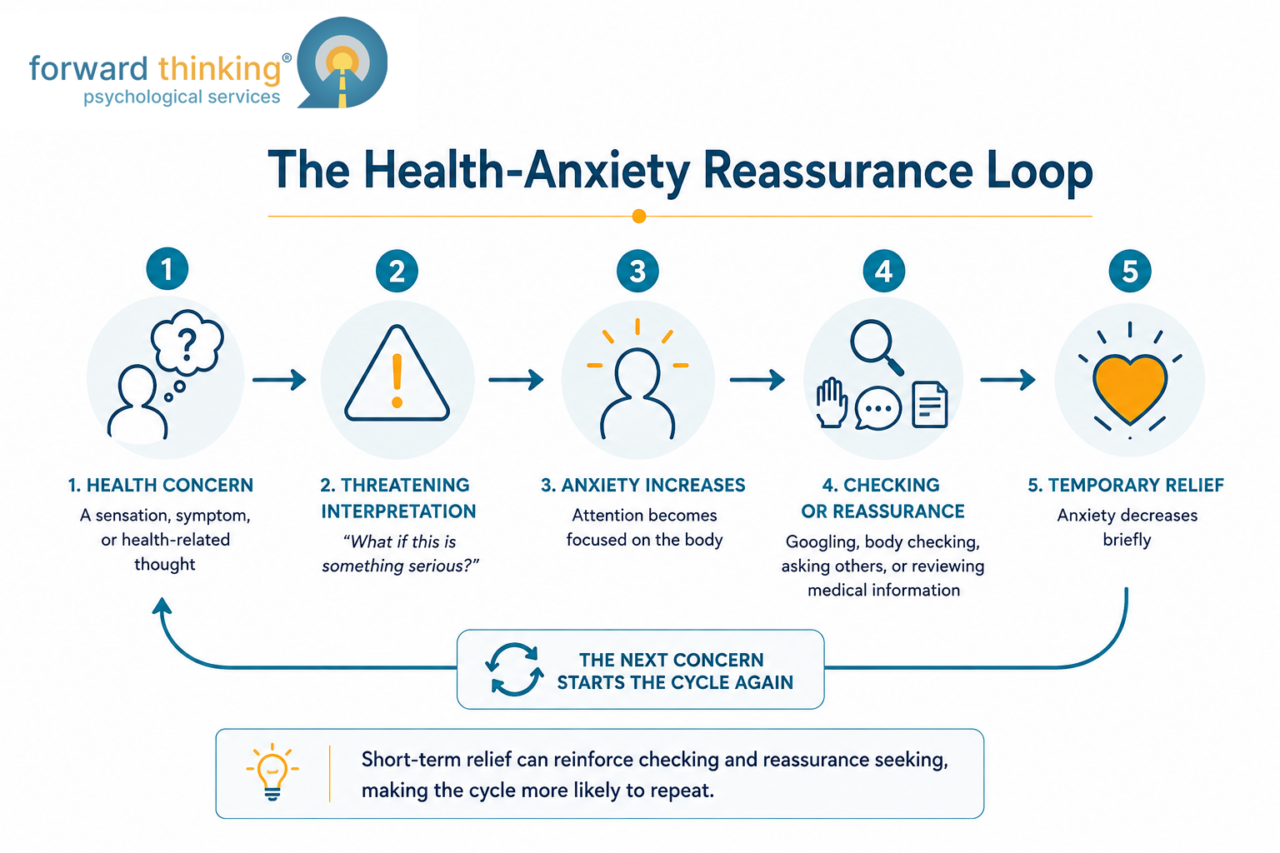
Health concern → anxiety → checking or reassurance → temporary relief → renewed concern
Over time, the person can become increasingly reliant on reassurance while becoming less confident in their own ability to respond to ordinary bodily sensations and health concerns.
What Counts as Reassurance Seeking in Health Anxiety?
Reassurance seeking can be much broader than repeatedly asking a doctor, “Are you sure I’m okay?”
It may include:
- Googling symptoms repeatedly
- asking family members whether something looks or feels normal
- repeatedly checking a symptom against online descriptions
- returning to previous medical reports or test results
- comparing symptoms with other people’s experiences
- posting symptoms in online forums
- repeatedly asking whether a doctor could have missed something
- visiting multiple doctors regarding the same issue
- checking health-monitoring devices or apps
- taking photographs to compare a physical feature over time
- asking different people the same health-related question
- repeatedly reviewing whether a sensation has changed
People can also reassure themselves mentally.
For example, someone might repeatedly review all the reasons a symptom is probably harmless or mentally replay what their physician told them.
The specific behaviour matters less than its function.
If the behaviour is repeatedly being used to answer the question “Can I be certain that I am okay?”, it may be functioning as reassurance seeking.
Is Checking Your Body a Compulsion?
Body checking can become an important part of health anxiety, although the term “compulsion” needs some nuance.
Someone may repeatedly feel their lymph nodes, examine their skin, check their pulse, test their vision, monitor their breathing, inspect a body part in the mirror, or compare one side of their body with the other.
Checking often begins because the person wants information.
But repeated checking can have several unintended effects.
First, it directs even more attention toward the body. Sensations and variations that might otherwise go unnoticed become increasingly noticeable.
Second, repeated touching, pressing, measuring, or examining can sometimes change the very sensation or appearance the person is monitoring.
Third, checking may produce the same short-term relief as reassurance:
“It seems okay right now.”
That relief can reinforce another check later.
Whether a psychologist describes a particular behaviour as a compulsion, safety behaviour, reassurance seeking, or checking behaviour may depend on the broader clinical presentation. More important than the label is understanding how the behaviour functions and whether it is maintaining anxiety.
Why Doesn’t Medical Reassurance Always Last?
This is an especially important distinction because people with health anxiety can have genuine medical conditions and, like anyone else, sometimes need appropriate medical assessment.
CBT for health anxiety does not teach people to dismiss physical symptoms or avoid medical care.
Instead, psychologists look at what happens after appropriate medical information has been obtained.
Someone may attend an appointment and receive an appropriate medical assessment. Later, however, doubt develops:
“What if I forgot to mention something?”
“What if the doctor didn’t order the right test?”
“What if the test was done too early?”
Another appointment or test may then feel like the only way to settle the question.
If the underlying problem is the repeated need to eliminate health-related doubt, additional reassurance may not provide a durable solution. The concern can simply move to the reliability of the reassurance itself.
This helps explain why health anxiety can persist despite repeated normal investigations.
It does not mean that medical information is irrelevant. It means that psychological treatment must address the process that repeatedly turns new sensations or residual questions into a renewed search for reassurance.
How Can Attention to the Body Intensify Health Anxiety?
Health anxiety does not involve thoughts and behaviours alone. Attention also plays an important role.
When people become concerned about their health, they may begin monitoring their bodies more closely. Sensations that would ordinarily pass unnoticed can become increasingly noticeable, while normal variations in bodily functioning may begin to feel significant.
Anxiety can add another layer. Changes in heart rate, muscle tension, breathing, digestion, sweating, dizziness, and other physical sensations can occur when someone is anxious. Once attention becomes focused on the body, these sensations may themselves become interpreted as further evidence that something could be wrong.
This can create a feedback loop: concern increases attention to the body, increased attention makes more sensations noticeable, and those sensations generate additional concern.
The sensations are real. The difficulty lies in how attention, interpretation, and anxiety can amplify their significance and keep the person monitoring for more information.
Is All Health Checking a Problem?
No.
This distinction is essential.
Taking medication as prescribed, attending recommended medical appointments, following appropriate screening guidelines, monitoring a condition when advised by a healthcare professional, or seeking medical attention for a new or concerning symptom are not behaviours psychologists would simply tell someone to stop.
Similarly, looking up reliable information about a diagnosed condition can be useful.
Psychologists are more interested in patterns such as:
- checking far more frequently than medically recommended
- repeating checks because the previous result no longer feels convincing
- seeking the same information from multiple sources
- continuing to search after the original question has reasonably been answered
- checking primarily to obtain immediate relief from anxiety
- finding that reassurance lasts for increasingly short periods
- becoming more rather than less preoccupied as checking continues
The distinction is therefore not:
Responsible health behaviour versus never checking.
It is whether the behaviour is proportionate, useful, and guided by genuine healthcare needs, or has become part of an anxiety-maintaining cycle.
Treatment for health anxiety is not about becoming careless with your health. The goal is to distinguish appropriate healthcare from repeated attempts to obtain a level of reassurance that health and medicine can rarely provide.
Health anxiety can become self-reinforcing when checking and reassurance provide short-term relief. The cycle below illustrates how a health concern can lead to increased anxiety, checking or reassurance seeking, temporary relief, and eventually renewed concern.
How Do Psychologists Assess Health Anxiety?
A psychological assessment begins with understanding the person’s concerns rather than assuming that every health worry represents health anxiety.
A psychological assessment looks at the broader pattern: the person’s health concerns, how bodily sensations are interpreted, how much time is spent thinking about or monitoring health, and the role of checking, reassurance seeking, online searching, and avoidance. Psychologists also consider how these concerns affect daily functioning, relevant medical history, and whether other psychological difficulties may be contributing to the presentation.
Psychologists do not diagnose health anxiety by deciding that someone’s physical symptoms are “not real.” A person can experience health anxiety while also having genuine health conditions.
Instead, the clinical question concerns whether anxiety, interpretation, attention, checking, reassurance seeking, or avoidance has become excessive and is creating additional distress or impairment.
How Is Health Anxiety Treated?
Cognitive behavioural therapy is one of the most extensively studied psychological treatments for health anxiety.
Systematic reviews and meta-analyses of randomized controlled trials have found CBT to be effective in reducing health-anxiety symptoms, with benefits maintained at follow-up in many studies.
Treatment is individualized, but it commonly involves developing a shared understanding of the person’s health-anxiety cycle and then changing the processes that keep it going.
This may include examining how bodily sensations are interpreted, reducing excessive monitoring and checking, modifying reassurance-seeking patterns, changing attentional habits, testing predictions through behavioural experiments, and gradually approaching situations that have been avoided because of health fears.
The goal is not simply:
“Stop Googling.”
If symptom searching is serving an important psychological function, removing Google without understanding that function may simply lead to another form of checking.
Instead, treatment asks:
“What happens when the concern appears, and how can you learn to respond differently?”
How Do You Stop Googling Symptoms When You Have Health Anxiety?
For many people, abruptly banning all health-related searching is neither realistic nor necessary.
A more useful starting point is learning to recognize the difference between information seeking and reassurance seeking.
Before searching, someone might begin noticing:
- What triggered the urge to search?
- What question am I hoping Google will answer?
- Have I already searched this concern?
- Am I looking for new information or trying to feel less anxious?
- How long did reassurance last the last time I searched?
- What am I predicting will happen if I do not search immediately?
Treatment may then involve delaying searches, reducing repeated searches, limiting the number of sources consulted, or practising allowing an urge to check to pass without responding to it.
These strategies are most useful when they form part of a broader CBT formulation rather than becoming rigid rules.
For example, a rule such as “I am never allowed to Google anything about health” could itself become another anxiety-driven strategy.
The broader aim is greater flexibility: using health information when it is genuinely useful without needing repeated searches every time anxiety appears.
What Happens When You Stop Seeking Reassurance?
Initially, anxiety may increase.
This is understandable. If checking and reassurance have become the person’s usual way of responding to health concerns, not performing them removes a familiar source of short-term relief.
This does not mean that reducing reassurance is making the underlying health situation more dangerous.
Instead, it creates an opportunity to learn that distress can change without repeatedly checking, researching, or obtaining confirmation.
Over time, the person may become better able to notice typical bodily sensations without immediately investigating them, allow health-related questions to remain unresolved when appropriate, and make healthcare decisions based on reasonable medical guidance rather than the immediate intensity of anxiety.
Importantly, treatment is usually gradual and individualized. Psychologists work collaboratively with clients to determine which behaviours are appropriate health behaviours and which appear to be maintaining anxiety.
Can Health Anxiety Improve?
Yes.
Health anxiety can become deeply entrenched, particularly when checking and reassurance seeking have been occurring for years. However, research provides good evidence that CBT can lead to meaningful and lasting improvement.
Improvement does not require becoming completely unconcerned about health.
Health matters, and bodies sometimes produce symptoms that deserve attention.
Instead, progress often means spending less time monitoring the body, reducing repetitive symptom searches, relying less on reassurance, responding more flexibly to bodily sensations, and making health decisions without anxiety dominating the process.
The goal is not certainty that nothing bad will ever happen.
It is developing a more balanced and workable way of responding to the ordinary reality that health cannot be monitored or predicted perfectly.
Conclusion
Google can provide extraordinary access to health information. For someone experiencing health anxiety, however, that access can also create an almost unlimited opportunity to seek one more answer.
The problem is not simply the search itself.
It is the cycle that can develop when Googling symptoms, checking the body, reviewing medical information, or asking for reassurance becomes the primary way of reducing health-related distress.
Because reassurance often works temporarily, the behaviour can become increasingly compelling even while health anxiety grows.
CBT helps people understand this pattern and begin responding differently. Treatment focuses not on ignoring genuine medical concerns, but on reducing the repeated checking, reassurance seeking, interpretations, attentional patterns, and avoidance that keep anxiety going.
For many people, breaking the reassurance loop is less about finding the perfect answer to a health concern and more about learning that they do not need to investigate every concern in order to continue with their lives. Bodies naturally produce sensations and variations in functioning, and not every change requires investigation. Learning to respond proportionately to health concerns, while continuing to seek appropriate medical care when needed, is an important part of breaking the health-anxiety cycle.
Psychological Treatment for Health Anxiety
If worries about your health are consuming significant amounts of time, leading to repeated Googling, body checking or reassurance seeking, or interfering with everyday life, psychological treatment can help clarify what is maintaining the pattern.
At Forward Thinking Psychological Services®, our psychologists provide evidence-based cognitive behavioural therapy for health anxiety and related anxiety concerns. Treatment begins with an individualized assessment and formulation so that strategies can be tailored to the specific thoughts and behaviours maintaining each person’s anxiety.
Contact us to learn more about psychological treatment for health anxiety.

FAQs:
DISCLAIMER: This content is meant for informational and educational purposes only. Only a licensed psychologist or psychiatrist can diagnose a mental health disorder. The content of this website is not meant to be a substitute for therapy. Visiting this website should not be considered to be equivalent to a relationship with FTPS. Mental health concerns should only be discussed in the context of providing professional services after the consent process has been completed with a qualified FTPS associate outside of our website.
Make FTPS a Google Preferred Source
If you found our blog helpful, you can ensure our latest evidence-based mental health insights, tools, and recovery strategies always appear at the top of your Google Search and AI Overviews.