

Experiencing violent or harm-related intrusive thoughts, including intrusive thoughts about hurting someone, can be deeply distressing, particularly when the thought feels completely inconsistent with who you are and how you behave day-to-day.
After having such a thought, someone may suddenly think, “What if I actually hurt someone?” and immediately begin wondering why the thought occurred. People can experience unwanted, distressing thoughts at times. For some individuals, the thought passes relatively quickly. For others, it becomes the beginning of repeated questioning about what the thought means, whether it says something about their character, and whether they can trust themselves.
When this pattern occurs as part of obsessive-compulsive disorder (OCD), it is commonly referred to as Harm OCD. Harm OCD is not a separate diagnosis in the DSM-5-TR, the diagnostic manual used by mental health professionals to classify mental health conditions. Instead, it describes an OCD presentation in which obsessions and compulsions centre around fears of causing harm to another person or being responsible for harm occurring.
Harm-related obsessions are common within OCD presentations. A recent meta-analysis found that aggressive obsessions are experienced by a substantial proportion of adults with OCD, and for some individuals they represent their primary and most distressing symptoms. These presentations are also particularly vulnerable to misunderstanding and stigma.
One reason Harm OCD can be so confusing is that people naturally focus on the content of the thought. Psychologists, however, are interested in much more than whether a frightening thought occurred. They also want to understand how the person interpreted the experience, what doubts followed, what behaviours developed in response, and whether the overall pattern is consistent with OCD.
This article explains what Harm OCD is, why harm-related intrusive thoughts can become so distressing, how different CBT approaches understand these experiences, how psychologists assess them, and what evidence-based treatment can look like.

What Is Harm OCD?
Harm OCD refers to an OCD presentation in which a person becomes preoccupied with the possibility that they could cause harm, lose control, or somehow be responsible for something harmful happening.
Like other OCD presentations, Harm OCD involves obsessions, compulsions, or both. Obsessions may take the form of unwanted thoughts, images, impulses, or persistent doubts. Compulsions are behaviours or mental acts performed in response to these experiences, often in an attempt to reduce distress, obtain certainty, or determine whether the feared possibility is true.
Harm OCD can be particularly difficult to recognize because many compulsions are not immediately visible.
For example, someone may repeatedly:
- review past interactions to determine whether they behaved dangerously
- seek reassurance about their character or intentions
- monitor their emotional or physical reactions
- avoid people or situations that trigger obsessional doubt
- mentally test themselves to determine what they “really” want
- repeatedly analyse why a particular thought occurred
- check whether they feel sufficiently distressed by the thought
From the outside, the person may appear to be thinking carefully about an important question. Internally, however, they may be spending hours trying to resolve a doubt that never seems completely settled.
Although Harm OCD can appear predominantly obsessional, compulsions are usually still present, particularly in the form of mental rituals, reassurance seeking, checking, and avoidance.
Why Can Harm-Related Intrusive Thoughts Feel So Significant?
One traditional cognitive behavioural explanation begins with an important observation: unwanted intrusive thoughts are not unique to OCD.
People without OCD can also experience unexpected, disturbing, or inconsistent thoughts. Research comparing intrusive cognitions across populations suggests that what distinguishes OCD is not simply the existence or topic of the thought. Obsessions occurring within OCD tend to be associated with substantially greater distress, guilt, interference, persistence, and personal significance.
From an appraisal-based CBT perspective, difficulties can develop when an unwanted thought is interpreted as highly meaningful.
Instead of:
“That was an odd thought.”
the person may begin asking:
“Why would I think that?”
“What if having that thought means something about me?”
“How can I know I would never act upon that thought?”
The thought itself may therefore become evidence that the individual believes should be analysed.
Several cognitive processes have been studied in OCD, including inflated responsibility and thought-action fusion. Thought-action fusion refers to beliefs that having a thought may somehow increase the likelihood of an event occurring or may say something morally significant about the person who experienced it. These beliefs have been associated particularly with responsibility-for-harm and unacceptable-thought OCD symptoms.
Attempts to suppress, neutralize, disprove, or gain certainty about the thought can then make it seem increasingly important.
A psychologist does not determine whether someone has Harm OCD simply because a harm-related intrusive thought occurred. The more informative clinical questions concern what meaning the person gives the experience, what doubts develop around it, what they feel driven to do in response, and how the pattern affects everyday functioning.
How Does I-CBT Understand Harm OCD Differently?
This is where it is helpful to distinguish everyday and traditional CBT language from the framework used in Inference-Based Cognitive Behavioural Therapy (I-CBT).
People often seek treatment describing “intrusive thoughts,” and traditional CBT models have extensively studied how people interpret and respond to intrusive cognitions.
I-CBT begins from a somewhat different premise.
Rather than viewing an intrusive thought that is later misinterpreted as the central starting point of OCD, I-CBT focuses on the development of obsessional doubt.
The question becomes:
How did this particular possibility come to feel relevant and believable in the first place?
According to the inference-based model, OCD involves inferential confusion, in which imagined or hypothetical possibilities begin to carry greater weight than information available through direct experience and ordinary reasoning. Research has linked inferential confusion with OCD symptoms, and I-CBT specifically targets these reasoning processes.
Consider someone who believes themselves to be a caring and responsible person through years of lived experience.
An obsessional doubt might nevertheless emerge:
“What if I am actually capable of harming someone?”
From an I-CBT perspective, the primary question is not:
“How can this person become comfortable having that thought?”
Instead, treatment becomes curious about:
What reasoning made this imagined possibility relevant enough to doubt what the person already knows through direct experience?
The individual may begin constructing an increasingly persuasive story based on possibilities:
“People can change.”
“Maybe I do not know myself as well as I think.”
“What if the fact that I had the thought proves there is something I have overlooked?”
Gradually, the imagined possibility can begin competing with the person’s lived experience.
This is the point at which I-CBT uses the language of obsessional doubt rather than focusing primarily on the intrusive thought itself.
Importantly, these models do not need to be presented as mutually exclusive explanations. They emphasize different parts of the OCD process and lead to somewhat different treatment strategies.
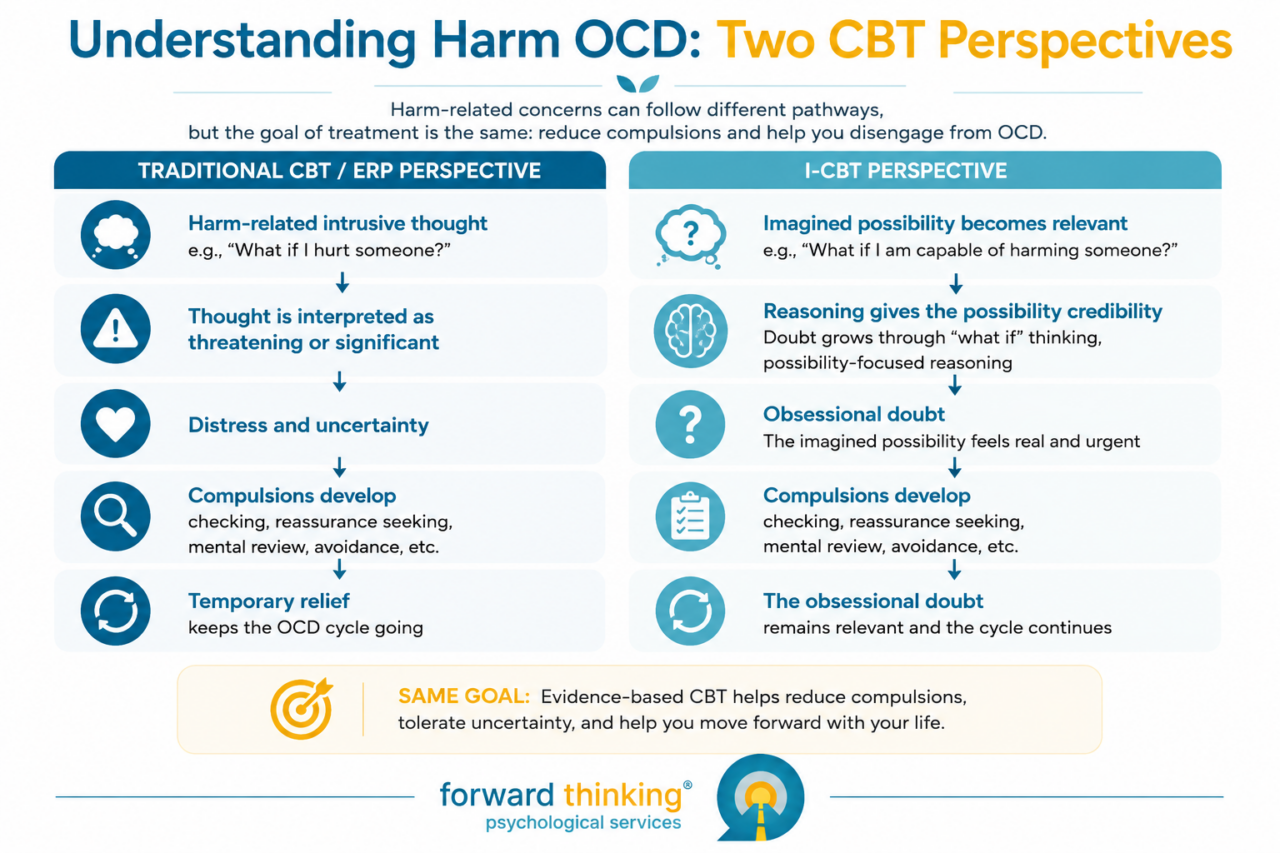
What Happens After a Harm-Related Intrusive Thought or Obsessional Doubt?
Regardless of which CBT model is used, psychologists pay close attention to what happens after the person experiences such a thought or doubt.
The person may feel compelled to resolve the question:
“Am I dangerous?”
But the methods used to solve that question frequently become part of the OCD cycle.
Someone may repeatedly examine memories, compare themselves with other people, ask loved ones for reassurance, search online, avoid situations, monitor internal reactions, or mentally argue against the feared possibility.
These behaviours may provide temporary relief.
Unfortunately, relief rarely lasts.
A new question appears:
“But what if I missed something?”
The person then returns to analysis.
Over time, the problem becomes less about one frightening thought and more about a repeated pattern of obsessional doubt followed by compulsive attempts to resolve it.
This is one reason treatment does not focus on providing increasingly convincing answers to the person’s feared question. Doing so can unintentionally become another form of reassurance.
Do Harm-Related Intrusive Thoughts Mean Someone Has Harm OCD?
No single thought is sufficient to diagnose Harm OCD.
This is an important distinction because intrusive or distressing thoughts can occur across many psychological conditions and among people without a mental health diagnosis as well.
Research suggests that obsessions occurring within OCD are distinguished by a combination of characteristics rather than by content alone.
Psychologists consider factors such as:
- whether the experience fits the broader diagnostic criteria for OCD
- whether obsessional doubt or repeated intrusive experiences are present
- whether compulsions or avoidance have developed
- the amount of time occupied by the symptoms
- the level of distress and impairment
- how the person understands and responds to the thoughts
- whether another psychological condition provides a better explanation
The pattern matters more than a particular phrase or image occurring in someone’s mind.
How Do Psychologists Assess Harm OCD?
Assessment of Harm OCD requires both diagnostic assessment and clinical formulation.
Psychologists are interested in the content of the person’s concerns, but they do not stop there.
They may explore:
- How did the concern begin?
- What does the person believe the thought or doubt might mean?
- What evidence are they relying on?
- What compulsions or avoidance behaviours have developed?
- Are they mentally reviewing, checking, testing, or seeking reassurance?
- How much time is being consumed by the process?
- How is it interfering with relationships, school, work, family life, or daily functioning?
- Does the overall presentation fit OCD, another condition, or a combination of concerns?
Assessment also involves appropriate consideration of risk. Psychologists do not assume that every violent thought represents Harm OCD, nor do they assume that frightening thought content alone establishes genuine intent.
Instead, the entire clinical presentation is considered.
This distinction is particularly important because harm-related obsessions are highly stigmatized and can sometimes be misunderstood by both the public and health professionals. Research has found that aggressive OCD symptoms are particularly vulnerable to perceptions of dangerousness and misidentification.
The content of a thought is only one piece of a psychological assessment. Psychologists are also interested in the reasoning surrounding the thought, the person’s behavioural response, the presence of compulsions, the level of impairment, and the broader clinical picture.
Harm OCD and Other Harm-Related Presentations: What Do Psychologists Consider?
This table illustrates what psychologists often consider when assessing harm-related themes within an OCD presentation.
Features Psychologists Consider When Assessing Harm-Related Thoughts
|
Area of Assessment |
Questions Psychologists Consider |
|---|---|
|
Nature of the experience |
Is the person describing intrusive thoughts, images, impulses, obsessional doubt, another type of cognition, or a combination? |
|
Meaning assigned to the thought |
What does the person believe the thought indicates about themselves or what could happen? |
|
Compulsive responses |
Are checking, reassurance seeking, mental review, avoidance, testing, or other rituals present? |
|
Reasoning process |
Is the person increasingly relying on imagined possibilities despite information available through direct experience? |
|
Functional impact |
How much time, distress, avoidance, and impairment is associated with the concern? |
|
Broader clinical picture |
Are there other symptoms or conditions that need to be considered in the assessment? |
|
Risk assessment |
Does the overall clinical presentation indicate a need for additional risk assessment or intervention? |
This table is intended to illustrate the breadth of psychological assessment, not to provide a self-diagnostic or risk-assessment checklist.
How Is Harm OCD Treated?
Evidence-based psychological treatment for Harm OCD generally involves treating the underlying OCD processes rather than attempting to prove that a particular feared outcome could never occur.
Two CBT approaches are particularly relevant: Exposure and Response Prevention (ERP) and Inference-Based Cognitive Behavioural Therapy (I-CBT).
Exposure and Response Prevention
ERP remains the psychological treatment for OCD with the largest evidence base and is often recommended as a well-researched intervention. Contemporary evidence continues to support substantial reductions in OCD symptoms for many individuals who complete ERP.
In ERP, individuals gradually approach situations, thoughts, images, or experiences that trigger OCD while reducing the compulsive responses that have been maintaining the cycle.
For Harm OCD, the treatment target is not focused on proving that the feared thought is untrue. This does not mean that one needs to accept it as being true either.
Instead, ERP helps individuals stop organizing their lives around compulsive attempts to neutralize, check, avoid, or obtain certainty about the obsession. Learning to tolerate the distress associated with these experiences without engaging in compulsions is also an important part of treatment.
Over time, this creates opportunities for new learning and helps reduce reliance on compulsive responses.
Inference-Based Cognitive Behavioural Therapy
I-CBT approaches Harm OCD differently.
Rather than asking someone to remain with obsessional doubt through exposure, I-CBT examines the reasoning process that gave rise to the doubt.
Treatment helps individuals identify when they have moved away from direct experience and into an imagined obsessional narrative. They learn to recognize the reasoning processes that made the feared possibility seem relevant and reconnect with information available through their senses, personal knowledge, and reality-based reasoning.
Recent research suggests that I-CBT can lead to meaningful improvements in OCD symptoms, although its evidence base remains smaller than that of ERP. In one large study comparing traditional CBT and I-CBT, participants improved with both approaches and rated I-CBT as a particularly acceptable treatment approach.
The most recent major clinical review describes ERP as the established first-line psychological treatment while recognizing I-CBT as a promising evidence-based alternative with a growing research base.
Which Treatment Is Better for Harm OCD?
There is no single answer that applies to every person.
ERP and I-CBT conceptualize OCD differently and target different aspects of the disorder during treatment.
ERP focuses particularly on changing the behavioural cycle by reducing compulsions and creating opportunities for new learning.
I-CBT focuses on the reasoning process that produces obsessional doubt and helps individuals restore trust in reality-based information and direct evidence.
Both ultimately aim to reduce compulsive responding and help individuals disengage from OCD.
Treatment selection should therefore be based on a comprehensive assessment, the person’s OCD presentation, previous treatment experiences, clinical formulation, preferences, and the psychologist’s training in the relevant approaches.
Can Harm OCD Improve?
Yes. OCD is treatable, including presentations involving harm-related obsessions.
Improvement does not necessarily mean never having another strange, unwanted, or uncomfortable thought.
Instead, meaningful progress may include:
- spending less time analysing thoughts or doubts
- reducing reassurance seeking and mental review
- decreasing avoidance
- becoming less governed by imagined feared possibilities
- reducing compulsions
- returning to relationships and activities that OCD has disrupted
- developing greater confidence in responding to future OCD symptoms
The goal is not to construct a life in which disturbing thoughts can never occur.
The goal is to reduce the power OCD has to turn those experiences into repeated doubt, compulsions, avoidance, and impairment.
Conclusion
Harm-related intrusive thoughts can be frightening, particularly when they feel inconsistent with how someone understands themselves.
However, psychologists do not understand Harm OCD by looking at the content of one thought in isolation.
Traditional CBT models help explain how unwanted intrusions may become highly significant through the way they are interpreted and responded to. I-CBT offers another perspective, focusing on how reasoning processes can generate obsessional doubt and lead imagined possibilities to compete with direct experience.
Both perspectives help us move beyond the question:
“Why did I have this thought?”
toward a more clinically useful question:
“What processes are turning this experience into an OCD problem?”
Understanding those processes allows treatment to focus on the compulsions, reasoning patterns, avoidance, and behavioural cycles that keep OCD going.
Psychological Assessment for Harm OCD
If harm-related thoughts or doubts are consuming significant amounts of time, causing distress, leading to avoidance or compulsive behaviours, or interfering with daily functioning, a psychological assessment can help clarify what is happening.
A comprehensive assessment considers whether the presentation is consistent with OCD, whether another condition may better explain the experience, and what psychological processes appear to be maintaining the symptoms.
At Forward Thinking Psychological Services®, our psychologists provide assessment and evidence-based treatment for OCD, including Harm OCD and other presentations involving intrusive thoughts and obsessional doubt. Treatment may incorporate ERP, I-CBT, and other cognitive behavioural approaches based on an individualized clinical formulation.
Contact us to learn more about OCD assessment or treatment.

FAQs:
DISCLAIMER: This content is meant for informational and educational purposes only. Only a licensed psychologist or psychiatrist can diagnose a mental health disorder. The content of this website is not meant to be a substitute for therapy. Visiting this website should not be considered to be equivalent to a relationship with FTPS. Mental health concerns should only be discussed in the context of providing professional services after the consent process has been completed with a qualified FTPS associate outside of our website.
Make FTPS a Google Preferred Source
If you found our blog helpful, you can ensure our latest evidence-based mental health insights, tools, and recovery strategies always appear at the top of your Google Search and AI Overviews.