

Online therapy has become a routine way of accessing psychological treatment. Yet many people still wonder whether meeting with a psychologist through a screen can really be as effective as sitting together in the same room.
It is a reasonable question. Psychotherapy depends on communication, collaboration, and the relationship between a client and therapist. It can be difficult to imagine that these elements will translate as effectively online.
Research increasingly suggests that, for many people and many psychological concerns, they can.
Studies comparing therapist-guided remote cognitive behavioural therapy (CBT) with in-person CBT have generally found comparable treatment outcomes. Research also suggests that strong therapeutic relationships can be developed through videoconferencing. Online therapy can offer advantages that extend beyond convenience, including increased access to psychologists with expertise in particular areas and opportunities to practise therapeutic strategies in the environments where difficulties actually occur.
This article looks at what research tells us about online therapy, how evidence-based treatments such as CBT translate to virtual care, whether online therapy can work for adolescents, and some of the unique opportunities that virtual treatment can provide.

What Do We Mean by Online Therapy?
“Online therapy” can describe several very different types of mental health care.
For the purposes of this article, online therapy primarily refers to psychotherapy delivered in real time by a regulated mental health professional through secure videoconferencing. A client and psychologist meet at an agreed-upon time and conduct the session much as they would in an office.
This is different from self-guided mental health apps, prerecorded programs, text-based support, or online CBT courses completed independently. These types of digital interventions have their own evidence base, but they are not equivalent to meeting directly with a psychologist online.
This distinction matters when considering research. When we ask whether online therapy can be as effective as in-person therapy, we need to compare similar forms of treatment rather than combining very different types of digital mental health care.
Is Online Therapy as Effective as In-Person Therapy?
For many psychological concerns, research suggests that it can be.
Studies directly comparing therapist-guided remote CBT with in-person CBT have generally found comparable treatment outcomes. Research specifically examining psychotherapy delivered through videoconferencing has also found meaningful improvements across a range of psychological concerns.
These findings challenge the assumption that effective psychological treatment requires the psychologist and client to be physically together. When evidence-based therapy is delivered by a qualified clinician, videoconferencing can provide a genuine treatment setting rather than simply serving as a substitute for office-based care.
The research also helps shift the question from “Is online therapy real therapy?” to a more useful one: “Can effective psychological treatment be delivered successfully online?”
For many clients and many evidence-based treatments, the answer is yes.
Online therapy is sometimes discussed as though it is a modified or reduced version of in-person treatment. Research increasingly suggests a different way of thinking about it: virtual therapy can be an effective mode of delivering psychological treatment in its own right.
Can You Build a Strong Therapeutic Relationship Online?
Yes. Research suggests that strong therapeutic relationships can develop through virtual therapy.
Psychotherapy is not simply the delivery of techniques. A strong therapeutic relationship involves trust, collaboration, shared treatment goals, and a sense that the psychologist understands the client’s experiences. It is therefore understandable that people sometimes wonder whether connecting through a screen could interfere with that relationship.
Research is reassuring on this point.
A systematic review and meta-analysis comparing therapeutic alliance in videoconference and in-person psychotherapy found no statistically significant difference in therapeutic alliance based on whether ratings came from clients or therapists.
Individual experiences will naturally vary, as they do with in-person therapy. Some people strongly prefer being in the same physical space as their psychologist. Others feel equally connected online, and some may find it easier to talk from a familiar environment such as their home.
The important finding is that a strong therapeutic relationship does not appear to depend on the psychologist and client being physically together.
Does Virtual CBT Actually Work?
Yes. CBT is particularly well suited to online delivery because treatment is typically active, collaborative, and structured.
A CBT session may involve identifying patterns, examining thoughts and interpretations, planning behavioural experiments, reviewing between-session practice, learning new skills, or developing an exposure plan. These processes can generally occur through videoconferencing much as they would in an office.
Research examining videoconference-delivered CBT has found significant treatment benefits across various psychological conditions.
Virtual CBT can also offer opportunities that are difficult to reproduce in an office. A client can practise skills in the environment where difficulties actually occur. A psychologist may be able to observe relevant situations in the home, help someone complete an exposure in their everyday environment, or work with objects and situations that would otherwise need to be described rather than experienced directly.
These can be powerful therapeutic experiences because they allow challenges to emerge in the very environments in which they occur.
In this sense, effective online CBT is not simply an attempt to recreate an office session through a screen. The virtual environment can become part of the treatment itself.
Can Online Therapy Treat Anxiety?
Yes. Anxiety disorders are among the psychological concerns for which CBT has a particularly strong evidence base, and many CBT interventions translate naturally to virtual care.
Depending on the concern, treatment might involve cognitive strategies, behavioural experiments, exposure exercises, interoceptive exposure, reducing avoidance, or changing patterns that maintain anxiety.
Many of these interventions do not require a therapy office.
Someone receiving treatment for social anxiety might complete behavioural experiments in real-world settings. Someone working on panic may practise interoceptive exercises during an online session. Someone addressing a specific phobia may complete carefully planned exposures in an appropriate environment.
In some cases, being outside the psychologist’s office may actually create more opportunities to work with the situations in which anxiety occurs in everyday life.
Does Online Therapy Work for OCD?
Yes. Evidence-based psychological treatments for obsessive-compulsive disorder (OCD) can be delivered virtually.
Exposure and Response Prevention (ERP), a well-established CBT treatment for OCD, involves helping people gradually approach situations that trigger obsessions while changing the compulsive responses that keep the OCD cycle going.
Virtual treatment can offer a particular advantage because OCD triggers frequently occur in the person’s everyday environment.
Rather than describing a difficult situation that occurs in the kitchen, bedroom, bathroom, workplace or elsewhere, a client may sometimes be able to work directly with relevant triggers during a virtual session. The psychologist can help plan and guide exposure exercises while the client remains in the environment in which OCD actually occurs. In-session exposure in these environments may bring to light challenges that would be difficult to fully recreate elsewhere.
This can make treatment highly practical. Instead of trying to reproduce every relevant trigger in a psychologist’s office, therapy can sometimes move directly into the places, objects and situations that are already part of the client’s life.
Other evidence-based CBT approaches for OCD can also be delivered remotely, allowing treatment to be individualized according to the client’s presentation and therapeutic approach.
Is Online Therapy Effective for Teenagers?
Yes. Online therapy can be an effective option for adolescents, and growing research supports the use of virtual CBT with young people.
Research examining videoconference CBT for youth with anxiety has found improvements in anxiety symptoms, functioning and life interference. Although the research base specifically examining videoconference treatment with young people is smaller than the corresponding adult literature, the findings to date are encouraging.
Virtual therapy can also fit particularly well into an adolescent’s life.
Appointments can be scheduled around school, extracurricular activities and family commitments without adding travel time. Adolescents can participate from a familiar environment, and families who do not live near a psychologist with expertise in a particular area may have access to a broader range of clinicians.
There can also be clinical advantages. Just as with adults, behavioural experiments, exposure exercises and other therapeutic strategies can be integrated into the adolescent’s everyday surroundings.
Parent involvement can also be incorporated easily into virtual treatment when it is therapeutically useful. Depending on the adolescent’s age and treatment needs, parents might participate in portions of sessions, learn strategies for supporting treatment, or meet separately with the psychologist.
Virtual therapy can be particularly well suited to adolescents because treatment can fit more easily into everyday life while still allowing psychologists to involve parents when appropriate and deliver evidence-based interventions in the environments where difficulties occur.
Is Online Therapy Worth It if You Can Attend In Person?
Absolutely. Online therapy does not need to be viewed as an alternative reserved for people who cannot attend in-person appointments.
For many people, it is simply their preferred way of receiving psychological treatment.
Virtual therapy eliminates travel time and can make appointments easier to integrate into work, school and family schedules. It can support greater continuity of treatment and make regular appointments more manageable.
Perhaps more importantly, it can expand the pool of psychologists available to a client.
This can be especially valuable when someone is seeking treatment for a concern that benefits from particular expertise. A person looking for evidence-based treatment for OCD, panic disorder, trauma, a body-focused repetitive behaviour, or another specific concern may benefit from being able to choose a psychologist based on clinical fit and experience rather than geographical proximity.
The closest psychologist is not necessarily the psychologist whose training or approach best matches what a client needs.
Virtual therapy can therefore change the question from:
“Who is available near me?”
to:
“Who is a good fit for what I need?”
That can be a meaningful advantage of online psychological care.
Can Online Therapy Improve Access in Rural and Underserved Areas?
Yes. One of the clearest advantages of virtual therapy is its ability to reduce geography as a barrier to psychological care.
People living in rural or smaller communities may have fewer psychologists nearby, and finding a clinician with experience treating a particular concern can be even more difficult.
Videoconferencing allows people to access psychologists outside their immediate community without travelling long distances for regular appointments. Long travel times can make accessing and consistently attending treatment considerably more difficult.
This is particularly relevant in Canada, where distances between communities can be substantial and access to psychological services varies considerably by region.
Virtual therapy does not create more psychologists, but it can make existing psychological expertise accessible across a much larger geographic area.
Can I See an Online Therapist Anywhere in Canada?
Online therapy can substantially increase geographic access to psychologists, although psychologists must still follow provincial and territorial regulatory requirements.
Psychology is regulated provincially and territorially in Canada. As a result, a psychologist generally needs to be permitted to provide psychological services in the jurisdiction where the client is physically located at the time of the appointment.
Many psychologists are authorized to practise in more than one province, making it possible to provide virtual services across provincial boundaries where regulatory requirements have been met.
This is worth asking about when choosing an online psychologist, particularly if you travel frequently or divide your time between provinces.
A psychology practice providing virtual care should be able to explain clearly where its psychologists are authorized to provide services.
How Do I Know Whether Online Therapy Is Right for Me?
For many people, online therapy is an effective and practical way to receive psychological treatment.
A useful starting point is to consider what matters most to you when choosing a psychologist and how therapy will fit into your life.
Would eliminating travel make it easier to attend consistently? Would access to psychologists outside your immediate area help you find someone with more relevant expertise? Would being in your own environment support the work you are doing in therapy?
Clinical fit matters regardless of format. A psychologist’s experience with your particular concern, the treatment approach being offered, and the therapeutic relationship are all important considerations whether treatment occurs online or in an office.
For parents seeking therapy for a teenager, it can also be helpful to consider whether virtual care will make treatment easier to integrate into the adolescent’s schedule and whether the home environment can support private, focused sessions.
When Might In-Person Therapy Be Preferred?
Although online therapy works very well for many people, there are circumstances in which in-person treatment may be preferred.
Some people simply feel more comfortable meeting face-to-face. Others may not have reliable internet or a private place where they can speak openly. Certain assessments, interventions or clinical situations may also benefit from in-person care or another treatment setting.
If someone is repeatedly unable to participate without interruption or has significant difficulty engaging through video, an office setting may also be more conducive to treatment.
These considerations are best understood as questions of individual fit rather than limitations of online therapy itself. Just as not every therapist or treatment approach is right for every client, no single treatment format will be ideal for everyone.
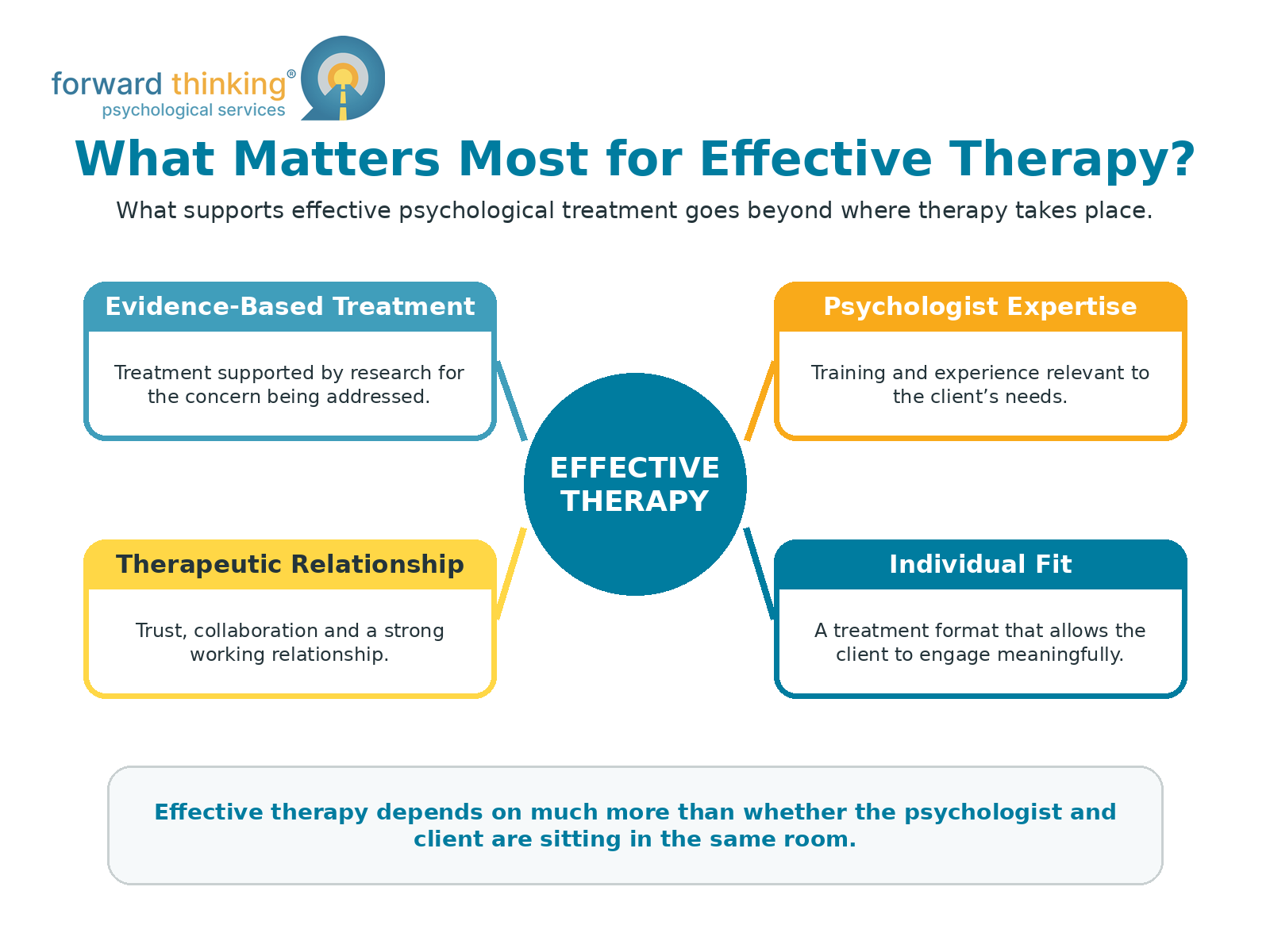
What Matters Most for Effective Therapy?
Whether therapy takes place online or in person, the factors that make psychological treatment effective extend well beyond the physical setting.
The treatment should be appropriate for the concern being addressed and grounded in evidence. The psychologist should have relevant training and experience. The client and psychologist need to develop a collaborative therapeutic relationship, and treatment should be tailored to the individual’s needs.
This is one reason the online-versus-in-person distinction may ultimately be less important than it first appears.
Virtual therapy can make it possible to prioritize these factors by expanding access to psychologists beyond the immediate community. Rather than choosing primarily according to location, clients may have greater opportunity to find a psychologist whose expertise, treatment approach and therapeutic style are a good fit.
Conclusion
Online therapy has fundamentally expanded the ways people can access psychological care.
Research increasingly supports what many psychologists and clients have experienced in practice: effective psychological treatment does not require the psychologist and client to be physically together. Evidence-based interventions can be delivered successfully through videoconferencing, strong therapeutic relationships can develop online, and virtual care can offer opportunities that are difficult to reproduce in an office.
For some people, those advantages are primarily practical. For others, virtual therapy provides access to a psychologist with expertise that may not be available nearby. And for treatments such as CBT, working directly in the environments where difficulties occur can sometimes become part of the therapeutic process itself.
Online and in-person therapy are both legitimate ways of delivering psychological care. The important question is not which format is universally better, but which allows a particular person to access appropriate, evidence-based treatment with a psychologist who is a good fit for their needs.
Online Psychological Treatment at Forward Thinking Psychological Services
Forward Thinking Psychological Services® provides online psychological treatment to adolescents and adults in several Canadian provinces. Our psychologists use evidence-based approaches, including CBT and related treatments, and work with clients experiencing OCD, anxiety disorders, depression, trauma-related concerns and other psychological difficulties.
Virtual treatment allows clients to work with an appropriately matched psychologist without necessarily being limited to clinicians located in their immediate community. This can be particularly valuable when someone is looking for a psychologist with experience in a specific concern or treatment approach.
Because psychologists are regulated provincially, availability depends on where the client is physically located. Our team can help determine whether we provide services in your province and help identify a psychologist whose experience may be a good match for your needs.
Contact us to learn more about online psychological treatment or to explore whether one of our psychologists may be a good fit.
FAQs:
DISCLAIMER: This content is meant for informational and educational purposes only. Only a licensed psychologist or psychiatrist can diagnose a mental health disorder. The content of this website is not meant to be a substitute for therapy. Visiting this website should not be considered to be equivalent to a relationship with FTPS. Mental health concerns should only be discussed in the context of providing professional services after the consent process has been completed with a qualified FTPS associate outside of our website.
Make FTPS a Google Preferred Source
If you found our blog helpful, you can ensure our latest evidence-based mental health insights, tools, and recovery strategies always appear at the top of your Google Search and AI Overviews.