

Relationships naturally involve uncertainty. Even in loving, satisfying partnerships, people sometimes question their feelings, notice differences between themselves and their partners, experience periods of disconnection or wonder what their future together might look like. No relationship is perfect, and occasional doubt does not necessarily mean something is wrong.
For some individuals, however, questions about their relationship become persistent, distressing and difficult to disengage from. Rather than reflecting on a concern and moving forward, they may find themselves repeatedly checking their feelings, reviewing conversations, comparing their partner with others or seeking reassurance that the relationship is right.
These experiences may reflect relationship-themed obsessive-compulsive disorder. Although not a formal diagnostic subtype, it is commonly referred to as relationship OCD or ROCD. We will use those terms throughout this blog.
Understanding the difference between ordinary relationship uncertainty and obsessional doubt is important, particularly because repetitive attempts to find certainty can themselves become part of the problem.

What Is Relationship OCD?
Relationship OCD refers to obsessive-compulsive symptoms that focus on intimate relationships. Individuals may experience recurring doubts about whether they truly love their partner, whether their partner loves them, whether they are compatible or whether they have chosen the right relationship.
These concerns can feel particularly compelling because romantic relationships are often deeply meaningful. Questions about love, commitment and compatibility may seem too important to leave unanswered.
Research has identified two commonly described presentations of relationship OCD:
Relationship-centred obsessions involve doubts about the relationship itself. Someone might repeatedly question whether they are sufficiently in love, whether their partner is right for them or whether the relationship feels the way it should.
Partner-focused obsessions involve persistent preoccupation with perceived flaws in a partner’s appearance, intelligence, personality, social behaviour or other characteristics.
These presentations can overlap. Someone may move between questioning their feelings about the relationship and scrutinizing particular qualities of their partner.
Doron, Derby and Szepsenwol’s (2014) conceptual framework of relationship OCD describes these presentations, along with compulsive checking, comparisons, reassurance seeking and other attempts to neutralize distress. Importantly, relationship OCD is not a separate DSM-5-TR diagnosis. It is a term used to describe OCD symptoms organized around relationship-related concerns.
How Is Relationship OCD Different From Normal Relationship Doubt?
One of the most important distinctions is that experiencing doubt is not evidence of OCD.
Most people experience moments of uncertainty in their relationships. A disagreement may lead someone to question compatibility. Stress, fatigue or competing responsibilities may affect feelings of closeness. People may occasionally notice attractive qualities in someone other than their partner or wonder whether they have made the right long-term decision.
These experiences do not automatically indicate a relationship problem, nor do they suggest a mental health condition.
With ordinary relationship doubts, a person may reflect on their concerns, discuss them with their partner, consider relevant circumstances and make decisions based on their values and experiences. Although questions may sometimes remain unresolved, they do not necessarily dominate everyday life.
However, when experiencing relationship-themed OCD, the process can look quite different.
A passing doubt may become the starting point for prolonged mental analysis. The person may feel compelled to determine exactly what the thought means, whether their emotional response was correct or whether they can be completely certain about the relationship.
Even when reassurance or checking produces temporary relief, another question may soon emerge.
|
Typical Relationship Uncertainty |
Relationship OCD |
|---|---|
|
Doubts arise in response to experiences or changing circumstances. |
Doubts may arise repeatedly, including in the absence of a clear relationship problem. |
|
Reflection may lead to greater understanding or a decision. |
Reflection can become repetitive mental reviewing that rarely feels complete. |
|
Reassurance or discussion may be useful and proportionate. |
Reassurance may be sought repeatedly to reduce obsessional distress. |
|
Some uncertainty can remain without dominating attention. |
Uncertainty may feel intolerable, prompting further checking or analysis. |
|
Concerns are considered alongside the broader relationship context. |
Attention may become narrowly focused on feelings, perceived flaws or signs that the relationship is wrong. |
These differences are not diagnostic rules. Genuine relationship concerns and OCD symptoms can coexist, and persistent doubts may also arise from incompatibility, unmet needs, conflict or unhealthy relationship dynamics.
A careful clinical assessment considers the broader context rather than assuming that recurring relationship questions are necessarily obsessive-compulsive.
For individuals whose doubts have become repetitive and distressing, OCD assessment and evidence-based treatment can help clarify whether an obsessive-compulsive process is contributing to their difficulties. At Forward Thinking Psychological Services® (FTPS), clinicians experienced in OCD can assess these patterns and discuss appropriate treatment options.
What Does Relationship OCD Look Like in Everyday Life?
Relationship-themed OCD does not always involve visible rituals. Many compulsions are mental, making them difficult for others to recognize.
For example, someone may repeatedly ask themselves:
- Do I love my partner enough?
- Should I feel more excited when we’re together?
- What if there’s someone better suited to me?
- Why did I notice that flaw?
- Does this disagreement mean we’re incompatible?
- How can I know whether this relationship is right?
The person may recognize that the questions are repetitive but still feel an urgent need to answer them or confess to their partner that they are having these questions.
Checking Feelings and Attraction
A person may monitor how they feel when their partner enters a room, when they kiss or hug, or when they spend time together.
They may look for what they interpret as a particular sensation of love, attraction or certainty. If the anticipated feeling is absent, they may interpret that absence as evidence of a problem.
The difficulty is that emotions naturally fluctuate during relationship interactions. Deliberately monitoring them can also change the experience itself.
Mental Reviewing and Comparisons
Someone may replay conversations, analyze past moments of affection or compare their relationship with previous relationships.
They might examine other couples and wonder whether those relationships appear more loving, exciting or compatible.
These comparisons can become compulsive when their primary purpose is to settle an obsessional question rather than gain useful perspective and deepen the relationship.
Seeking Reassurance and Confessing Doubts
Reassurance seeking may involve repeatedly asking a partner whether they are loved, whether the relationship is healthy or whether certain feelings are normal.
It can also involve asking friends, family members or therapists for certainty about the relationship.
Other forms may be less obvious, such as searching online for signs of true love, reading relationship advice forums repeatedly or testing a partner’s reactions.
Some individuals also feel compelled to confess every intrusive doubt, fleeting attraction or unwanted thought to their partner. Although openness is generally valuable in relationships, confession can function as a compulsion when its primary purpose is to relieve distress or obtain reassurance.
Reassurance is not inherently problematic. In healthy relationships, people regularly seek comfort, clarification and emotional support. The clinical concern arises when reassurance or confession becomes a repetitive attempt to neutralize obsessional doubt.
Why Does Reassurance Sometimes Make Relationship OCD Worse?
Reassurance can feel helpful in the moment. A partner offers a comforting response, anxiety decreases, and the person briefly feels more certain.
However, when reassurance functions as a compulsion, the relief may be short-lived.
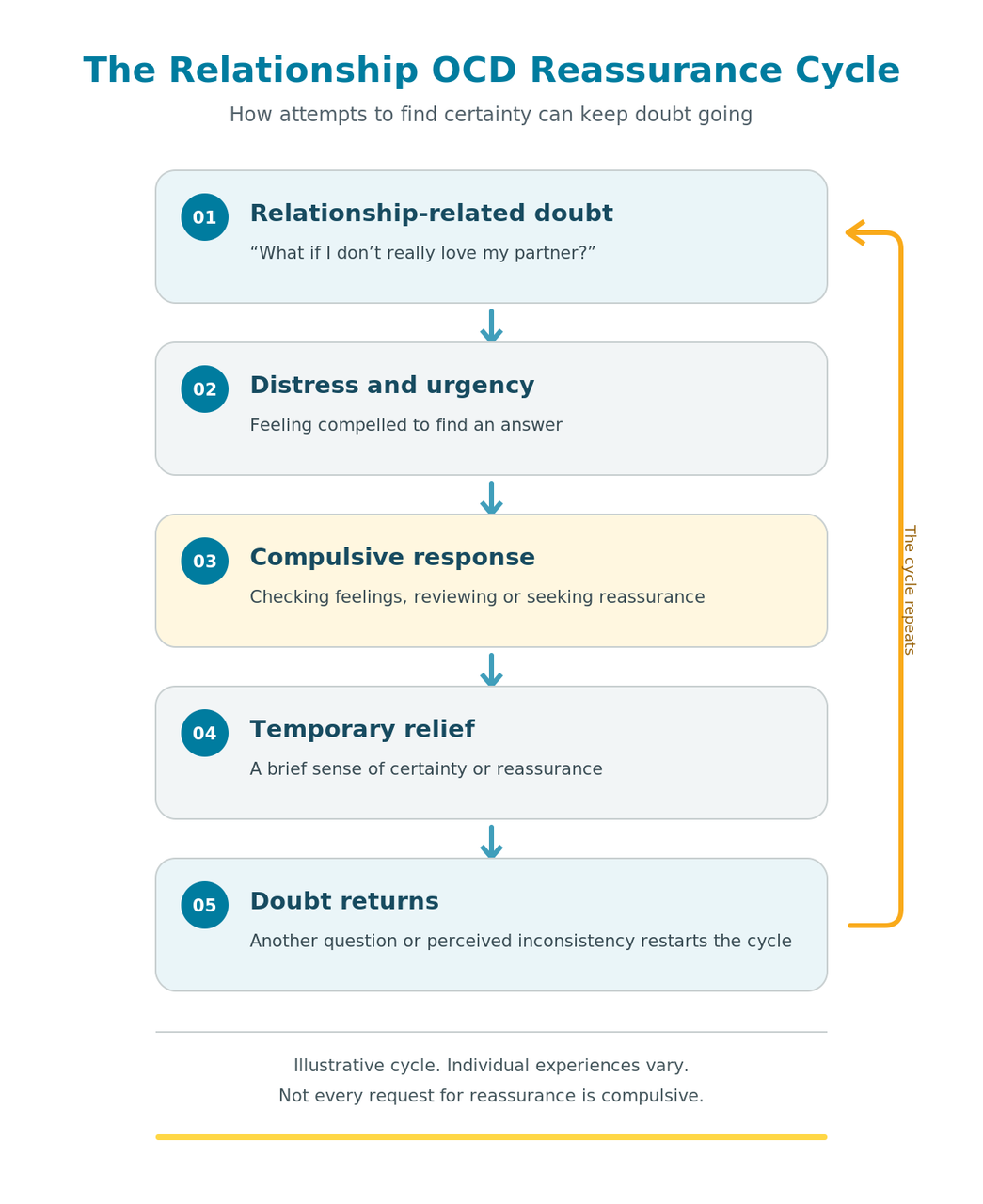
Over time, the person may become increasingly reliant on reassurance to manage uncertainty. Their partner may also feel pressure to provide answers that never seem sufficient. This can cause frustration and distress within the relationship.
Importantly, partners should not be expected to withhold ordinary affection or emotional support. Treatment focuses on identifying specific accommodation patterns and responding to them thoughtfully, rather than treating all reassurance or closeness as problematic.
Can Relationship OCD Affect Both Partners?
Although OCD symptoms are experienced by the individual with OCD, they often unfold within the relationship itself. This can create patterns that affect both partners, even when both are trying to be supportive and maintain their connection.
For example, one partner may repeatedly ask whether the relationship is secure, while the other tries to provide increasingly detailed explanations or reassurance. What begins as a caring response may gradually become an expected ritual. The partner without OCD may feel responsible for preventing distress, while the individual with OCD becomes increasingly dependent on their responses to feel reassured.
Relationship OCD may also affect intimacy and communication. A person who is constantly monitoring their attraction or emotional connection may find it difficult to be present during affectionate moments. Repeated confessions about unwanted thoughts or doubts may leave their partner feeling hurt, confused or uncertain about how to respond.
In other situations, couples may begin avoiding particular conversations, activities or decisions because they anticipate that these situations will trigger obsessive questioning.
These patterns can contribute to frustration, emotional distance and misunderstanding. Importantly, they do not necessarily mean that the relationship itself is fundamentally unhealthy. Rather, OCD may be influencing how the couple interacts.
Research examining accommodation among romantic partners of adults with OCD has found associations between accommodation, OCD symptoms and relationship functioning. This supports the clinical importance of considering partner involvement in treatment, although the research is not specific to relationship OCD alone.
Can Couples Therapy Help When One Partner Has Relationship OCD?
Yes. Couples therapy can be valuable when OCD symptoms are affecting communication, emotional connection, intimacy or the way partners respond to one another.
In some situations, the individual with OCD may benefit primarily from evidence-based OCD treatment, with their partner participating in selected sessions to learn about reassurance, accommodation and ways to provide support without reinforcing compulsions.
In other circumstances, the couple may also benefit from more extensive couples therapy. This can provide opportunities to address relationship difficulties that have developed alongside OCD, improve communication and help both partners understand how symptoms affect their interactions.
These approaches are not mutually exclusive. Individual OCD treatment and couples therapy can complement one another when coordinated appropriately.
It is important, however, that couples therapy does not become another setting in which the therapist repeatedly provides certainty about whether the relationship is right. When OCD is present, treatment needs to recognize and address the obsessive-compulsive processes rather than inadvertently reinforcing them.
For couples navigating both OCD symptoms and relationship difficulties, clinicians who understand these different treatment needs can be particularly helpful.
FTPS offers evidence-based OCD therapy and couples therapy. Depending on the clinical formulation, treatment may focus on individual OCD symptoms, relationship functioning or both. Individuals and couples can contact FTPS for a free Client Consultation Call to explore which service may be most appropriate.
A Clinical Example: When Doubt Becomes an Endless Question
The following example is fictional and illustrates a pattern that may occur in relationship OCD.
Alex is a 34-year-old cisgender man with longstanding symptoms of OCD.
Alex has been in a relationship for four years. He describes the relationship as caring and generally satisfying, although the couple occasionally disagrees about finances, household responsibilities and how they spend their free time.
Following a disagreement, Alex begins wondering whether these differences mean the relationship is fundamentally wrong.
Over the following weeks, he repeatedly reviews the disagreement, compares the relationship with those of friends and checks his feelings of affection during ordinary interactions.
Alex asks his partner whether they seem happy together and searches online for information about compatibility. Reassurance provides temporary relief, but another question quickly follows.
Eventually, Alex finds it difficult to enjoy time with his partner because so much attention is devoted to evaluating the relationship.
In therapy, the focus is not on persuading Alex that the relationship is right or wrong. Instead, assessment explores how obsessional doubt develops, what maintains the repeated questioning and whether compulsive responses are interfering with everyday functioning.
As treatment progresses, Alex and his therapist may also consider whether involving his partner in selected sessions would be helpful, particularly if reassurance seeking has become a recurring source of distress for both of them.
This distinction is essential. Effective OCD treatment does not make relationship decisions for clients or require them to remain in relationships that are genuinely unhealthy or unsuitable.
What Treatment Helps With Relationship OCD?
Relationship OCD therapy focuses on addressing the obsessive-compulsive processes that maintain distress and interfere with functioning. Effective treatment does not aim to eliminate every relationship doubt, but to help individuals respond differently to the thoughts and concerns that have become consuming.
Two evidence-based approaches used in OCD treatment are exposure and response prevention (ERP) and inference-based cognitive behavioural therapy (I-CBT). They differ in how they conceptualize and address obsessional doubt.
Exposure and Response Prevention (ERP)
ERP is a well-established psychological treatment for OCD.
In relationship OCD, ERP may involve helping individuals encounter situations or thoughts that trigger obsessional concerns while reducing compulsive responses.
For example, treatment may address repeated checking of feelings, mental reviewing, reassurance seeking or comparisons. An individual may practise spending time with their partner without repeatedly evaluating their emotional reactions or seeking certainty about what those reactions mean.
The goal is not to prove that a relationship is perfect or guarantee that it will last. Rather, ERP helps individuals change their responses to fear, uncertainty and distress while reducing reliance on compulsions.
Exposure exercises should be individualized, clinically appropriate and consistent with the person’s circumstances and treatment goals.
For individuals seeking ERP therapy for OCD, it is important to work with a clinician experienced in recognizing both visible and mental compulsions, particularly when symptoms are focused on romantic relationships.
Inference-Based Cognitive Behavioural Therapy (I-CBT)
I-CBT approaches OCD by focusing on how obsessional doubt is constructed.
From this perspective, OCD may involve giving imagined possibilities greater weight than information available through direct experience and ordinary reasoning. This process is described as inferential confusion.
For someone experiencing relationship OCD, treatment may explore how an ordinary experience, such as noticing a partner’s imperfection or having a moment of emotional distance, becomes the basis for an increasingly elaborate obsessional story.
I-CBT helps individuals identify when they have moved away from the reality of their experience into hypothetical possibilities and develop greater confidence in reality-based reasoning.
Rather than introducing exposure exercises, I-CBT focuses on the reasoning processes that generate obsessional doubt.
A multisite randomized trial found improvements in OCD symptoms with both I-CBT and ERP-based CBT. Although the trial did not establish I-CBT’s statistical non-inferiority, it contributes to a growing evidence base for this approach. Research specific to relationship OCD remains more limited.
For individuals considering I-CBT for OCD, treatment involves understanding how obsessional doubts develop and learning to recognize when imagined possibilities are being treated as credible despite lacking a basis in present reality.
How Do ERP and I-CBT Differ?
|
ERP |
I-CBT |
|---|---|
|
Focuses on changing responses to obsessional triggers, distress and uncertainty. |
Focuses on how obsessional doubt is generated through inferential confusion. |
|
Helps reduce compulsions through exposure and response prevention. |
Helps identify inferential confusion and return to reality-based reasoning. |
|
Does not require proving whether a feared possibility is true or false. |
Examines the reasoning that makes an imagined possibility appear credible. |
|
Has an extensive OCD treatment evidence base. |
Has a smaller but growing OCD treatment evidence base. |
Neither approach is intended to tell someone whether they should stay in or leave a relationship. Treatment is directed toward reducing OCD symptoms and supporting clearer, less compulsively driven decision-making.
Working with a clinician who provides evidence-based OCD therapy can help individuals understand their symptoms and determine which treatment approach is appropriate.
How Can Forward Thinking Psychological Services® Help With Relationship OCD?
At Forward Thinking Psychological Services®, our clinicians provide evidence-based OCD treatment for individuals experiencing intrusive thoughts, obsessional doubts and compulsive behaviours, including symptoms focused on romantic relationships.
Our approach begins with understanding the individual’s experiences, including the nature of their doubts, the compulsive responses that may maintain them and the impact on personal well-being and relationship functioning.
Depending on the individual’s needs and clinical formulation, treatment may involve ERP or I-CBT, with attention to the particular ways obsessional doubt appears in relationships.
For individuals whose partners have become involved in reassurance seeking or accommodation, treatment may include partner participation when appropriate. This can help couples understand how OCD affects their interactions and develop more helpful ways of responding to symptoms.
FTPS also offers couples therapy for partners experiencing communication difficulties, relationship stress or other concerns. When OCD is part of the picture, individual and couples work may address different but complementary treatment goals.
Our virtual practice provides access to online OCD therapy for adults, allowing individuals to participate in treatment from their own environments. Online couples therapy is also available where clinically appropriate.
If you’re looking for a relationship OCD therapist, seeking OCD therapy for relationship doubts, or are uncertain whether individual OCD treatment, couples therapy or a combination of services would be most appropriate, our intake team can help you explore the available options.
You can book a free Client Consultation Call or complete our secure consultation form to get started.
When Should Someone Seek Professional Support?
Professional support may be helpful when relationship-related doubts become persistent, distressing or difficult to disengage from.
Some signs include:
- Spending substantial time analyzing feelings, compatibility or perceived partner flaws.
- Repeatedly seeking reassurance but feeling uncertain again soon afterward.
- Avoiding relationship decisions or meaningful activities because of obsessional doubt.
- Feeling compelled to compare a partner or relationship with others.
- Experiencing significant distress or interference with work, sleep, relationships or daily life.
- Finding that attempts to resolve uncertainty have become increasingly repetitive or exhausting.
A relationship OCD assessment may help clarify whether these experiences reflect OCD, another mental health concern or relationship difficulties that would benefit from a different approach.
It is equally important to consider genuine relationship concerns. Conflict, incompatibility, coercion, emotional abuse or other safety issues should not be dismissed as manifestations of OCD.
Seeking relationship OCD therapy can be an important step toward understanding these patterns and developing an individualized treatment plan. Couples who are also experiencing relationship difficulties may benefit from discussing whether couples therapy would be helpful alongside individual treatment.
The clinical distinction is not simply whether a person has relationship doubts or whether those doubts are accurate. Assessment considers the nature of the doubt, how it develops, the responses that follow and the degree to which these patterns interfere with functioning. Understanding the relationship context is essential, but so is identifying whether compulsive attempts to obtain certainty are maintaining distress.
Moving Forward: Relationships Do Not Require Perfect Certainty
No relationship is free from uncertainty. Feelings fluctuate, partners have differences, and important decisions sometimes require thoughtful reflection.
For individuals experiencing relationship OCD, however, the pursuit of certainty can become increasingly consuming. Repeatedly checking feelings, analyzing interactions or seeking reassurance may make it harder to engage with the relationship as it is actually experienced.
Effective treatment focuses on addressing these obsessive-compulsive processes while respecting the person’s autonomy, values and genuine relationship circumstances.
At Forward Thinking Psychological Services®, we offer evidence-based OCD treatment for adults and support for couples experiencing difficulties related to intrusive doubts and compulsive behaviours, including concerns focused on romantic relationships.
If relationship-related doubts are interfering with your well-being or everyday life, you can book a free Client Consultation Call or complete our secure consultation form to learn more about our therapy services.

FAQs:
References
Boeding, S. E., Paprocki, C. M., Baucom, D. H., Abramowitz, J. S., Wheaton, M. G., Fabricant, L. E., & Fischer, M. S. (2013). Let me check that for you: Symptom accommodation in romantic partners of adults with obsessive-compulsive disorder. Behaviour Research and Therapy, 51(6), 316–322. https://doi.org/10.1016/j.brat.2013.03.002
Doron, G., Derby, D. S., & Szepsenwol, O. (2014). Relationship obsessive compulsive disorder (ROCD): A conceptual framework. Journal of Obsessive-Compulsive and Related Disorders, 3(2), 169–180. https://doi.org/10.1016/j.jocrd.2013.12.005
Wolf, N., et al. (2024). Inference-based cognitive behavioral therapy versus cognitive behavioral therapy for obsessive-compulsive disorder: A multisite randomized controlled non-inferiority trial. Psychotherapy and Psychosomatics, 93(6), 397–411. https://doi.org/10.1159/000541508
DISCLAIMER: This content is meant for informational and educational purposes only. Only a licensed psychologist or psychiatrist can diagnose a mental health disorder. The content of this website is not meant to be a substitute for therapy. Visiting this website should not be considered to be equivalent to a relationship with FTPS. Mental health concerns should only be discussed in the context of providing professional services after the consent process has been completed with a qualified FTPS associate outside of our website.
Make FTPS a Google Preferred Source
If you found our blog helpful, you can ensure our latest evidence-based mental health insights, tools, and recovery strategies always appear at the top of your Google Search and AI Overviews.