

Ontario has introduced new attendance and participation requirements for secondary school students beginning in the 2026–27 school year.
For parents of a teenager whose anxiety already affects school attendance, these changes may understandably raise questions. What happens when anxiety makes it difficult for a teenager to get to school? How should parents respond when their teen is genuinely struggling? And how do families balance supporting a teenager’s mental health with attending school when the latter can exacerbate existing difficulties?
This article is not intended to interpret Ministry of Education policy or advise families about how particular absences will be classified. Instead, it looks at an important clinical question that the new policy may bring to the forefront: how can parents support a teenager when anxiety is interfering with school attendance?
Because these requirements are new for the 2026–27 school year, families may also encounter differences in how individual schools and school boards implement them. Parents with questions about how the policy applies to their teenager should speak directly with their school or school board and consult the current Ontario Ministry of Education guidance.

What Changed With Ontario’s School Attendance Rules in 2026–27?
Beginning in the 2026–27 school year, Ontario has changed the way final grades are calculated for secondary school students.
According to the Ontario Ministry of Education, attendance and participation now account for:
of the final grade in
Grades 9 and 10
of the final grade in
Grades 11 and 12
For families already dealing with school attendance difficulties, the introduction of an attendance and participation component may compound a problem that was already complicated.
A teenager who is struggling to attend school is rarely just a number on an attendance record. There may be important questions about mental health, functioning, the school environment and what is preventing the young person from attending consistently.
The new requirements therefore provide an important opportunity to think about school attendance not only as an educational issue, but also, in some cases, as a potential indicator that a teenager may need additional support.
The Ministry provides the details of the new requirements in its current student assessment, evaluations and report cards guidance.
What Does Ontario Say About Mental-Health-Related Absences?
Ontario’s student mental-health policy, Policy/Program Memorandum 169 (PPM 169), specifically addresses mental-health-related absences.
The policy states:
“If students are unable to attend school due to a mental health concern, their absence must be excused…”
PPM 169 contains additional information about attendance and circumstances in which supporting documentation may not be available.
Parents can review the Ministry’s Policy/Program Memorandum 169 on Student Mental Health directly for the current provincial guidance and speak with their school in order to fully understand how these new regulations will be implemented for their child.
From a clinical perspective, the question of whether an absence is permitted or excused is separate from the question of how best to help a teenager whose anxiety is interfering with attendance.
A teenager may sometimes be unable to attend school because of a significant mental-health concern.
However, repeatedly avoiding school whenever anxiety becomes uncomfortable may inadvertently strengthen the cycle that is maintaining the anxiety.
Understanding the difference requires looking at the individual teenager and what is contributing to the attendance difficulty.
How Can Anxiety Contribute to School Avoidance?
Anxiety often encourages avoidance.
A teenager who is afraid of having a panic attack at school may feel immediate relief when allowed to stay home. A teen with social anxiety may experience the same relief after avoiding a presentation they were asked to do. A young person overwhelmed by fear of failure may feel considerably better once they know they do not have to face a test that day if they opt to miss class.
That relief is understandable.
But it can also teach the brain something important:
I felt safer because I avoided the situation.
Over time, that learning can strengthen anxiety and make returning to the feared situation more difficult. The teenager also has fewer opportunities to learn that they can experience anxiety and still cope with the situation.
This is one of the reasons evidence-based treatments for anxiety frequently involve gradually approaching feared situations rather than organizing life around avoiding them.
Current School Mental Health Ontario guidance recommends supporting young people experiencing school-related anxiety in taking small steps toward attendance and emphasizes working with the school when additional support is needed.
This does not mean forcing every anxious teenager through a full school day regardless of their level of distress or circumstances. It also does not mean that every absence represents avoidance.
It means that the response should be guided by an understanding of why the teenager is not attending.
Not Every Teen Who Misses School Is Avoiding Anxiety
This distinction matters.
A teenager may be struggling to attend because of:
- anxiety or panic
- depression
- OCD
- bullying, discrimination or other difficulties with peers
- autism-related sensory or social demands
- ADHD or executive-functioning difficulties
- learning difficulties
- physical illness
- sleep difficulties
- trauma
- family circumstances
- problems within the school environment
- several factors occurring together
Two teenagers can therefore both have difficulty getting to school for very different reasons. It is important to understand these reasons in order to facilitate a safe return to school.
For example, if a teenager is avoiding school because they are being bullied, the problem is not simply that they need to become more comfortable with attending. The circumstances making school feel unsafe need to be addressed.
Alternatively, consider a teenager who has begun avoiding school because they fear having a panic attack in class. Staying home may reduce their anxiety immediately, but over time it may reinforce the belief that school is dangerous or that they cannot cope with anxiety if it occurs there. In that situation, treatment may involve helping the teenager gradually return to the school environment while learning that anxiety can be experienced and managed without escaping from it.
School Mental Health Ontario similarly identifies a range of factors that can contribute to school avoidance, including peer difficulties, discrimination and bullying.
This is why identifying what is getting in the way of attendance matters more than applying the same return-to-school strategy for every teenager who is missing school. A deeper understanding is needed to determine what will support an appropriate return.
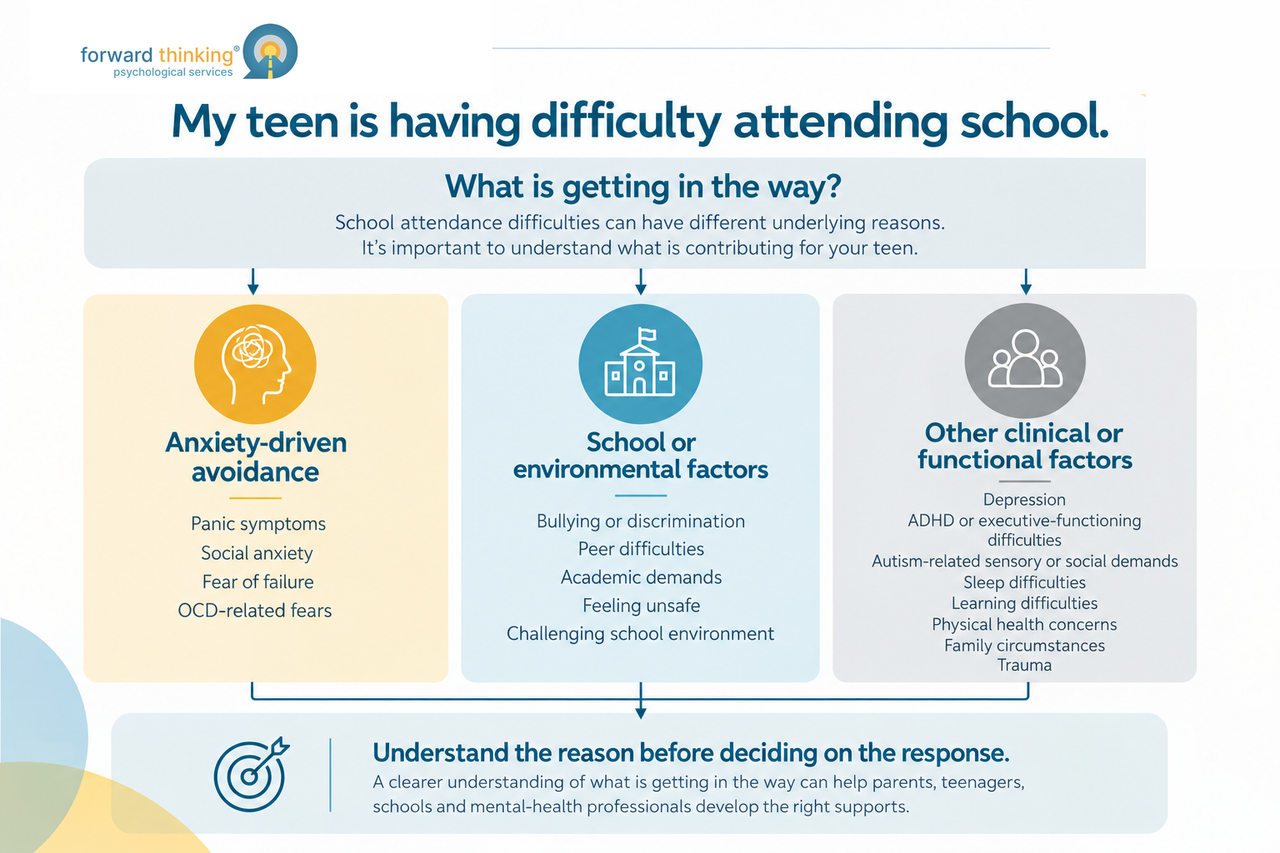
School attendance difficulties can have many underlying causes. Understanding what is contributing to the problem can help determine the most appropriate supports.
What Should Parents Look for When Anxiety Is Affecting School Attendance?
If anxiety is beginning to interfere with attendance, addressing the problem early can help prevent the pattern from becoming more established.
Parents can begin by noticing patterns around what happens before, during and after the difficulty attending school. Questions to consider include:
- Is your teenager afraid of something specific?
- Are mornings particularly difficult?
- Are there panic symptoms? When do they occur?
- Are they worried about being evaluated or embarrassed?
- Is there a particular class, teacher, peer interaction or academic demand involved?
- Do they feel overwhelmed throughout the entire school day, or is one part of the day particularly difficult?
- What happens to their anxiety once they know they can stay home?
The answers can help distinguish between different problems that may look very similar from the outside.
Our earlier article, When School Refusal Isn’t About Laziness: Recognizing Anxiety in Teens, explores these patterns in more detail, including physical symptoms, avoidance and approaches to treatment.
Another important step is to let the school know what is happening.
How Can Parents Work With the School?
School attendance difficulties are usually easier to address when parents, the teenager and the school are communicating and collaborating rather than working separately.
Depending on the circumstances, it may be helpful to speak with the teenager’s teacher, guidance counsellor, school mental-health professional, special-education staff or administration.
Useful questions might include:
- What patterns are school staff noticing? Are these patterns new?
- Are there particular classes, activities or times of day when the difficulty seems greater?
- What does the school observe when my teen does attend?
- Are there supports that might make attendance more manageable?
- Who should be involved if we need to develop a plan for increasing attendance?
- How can we communicate consistently without putting the teenager in the middle?
- What can parents do at home to help with a return-to-school plan?
If parents have questions about the new attendance and participation requirements, they can also ask the school how the policy is being implemented and how it applies to their teen’s circumstances.
School Mental Health Ontario identifies a number of ways school staff may be able to support students experiencing school-related anxiety, including assistance with transitions, coping strategies and graduated-entry planning when appropriate.
Exactly what is available and appropriate will depend on the individual student and school.
What If My Teen Can’t Return to School Full-Time Right Away?
For some teenagers, returning to a full school day immediately may not be realistic or clinically appropriate.
A carefully planned, gradual return may sometimes be considered.
Depending on the teenager and the circumstances, this might involve beginning with particular parts of the school day or gradually increasing time at school. Depending on the student and school, other supports may also be considered, such as beginning in a resource centre or incorporating planned breaks. These possibilities are important to discuss with parents, teens and the school.
The purpose of a gradual approach is not simply to make it easier to avoid school.
Ideally, it provides enough support for the teenager to begin approaching what has become difficult, while building their ability to remain in the school environment over time.
School Mental Health Ontario includes graduated-entry planning among the approaches that may be considered for students experiencing school-related anxiety.
What that looks like should be individualized and developed with the appropriate school personnel.
A teenager with panic disorder, a teen experiencing bullying, and an autistic teenager overwhelmed by the sensory demands of school may all have difficulty attending, so they may need very different forms of support for their successful return.
When Should Parents Seek Professional Help?
Consider seeking professional support when anxiety is:
- repeatedly interfering with school attendance
- producing significant distress before or during school
- leading to increasing avoidance
- affecting sleep, friendships, family functioning or other activities
- associated with frequent panic attacks or physical complaints
- making it difficult for the teenager to complete schoolwork or participate in class activities
- becoming difficult for the family and school to manage
- not improving despite reasonable school-based supports
Assessment can help clarify what is driving the attendance problem.
For anxiety-related avoidance, cognitive behavioural approaches may involve helping the young person understand their anxiety, develop appropriate coping strategies and gradually approach rather than continually avoid feared situations.
Collaboration among the teenager, family, school and mental-health professionals can also be important when school attendance has become significantly disrupted.
Support for Teen Mental Health at Forward Thinking Psychological Services®
At Forward Thinking Psychological Services®, our clinicians work with teenagers experiencing a range of mental-health and neurodevelopmental concerns, including anxiety, OCD, depression, ADHD and autism. These concerns can affect school attendance and functioning in different ways.
Treatment begins with understanding what is contributing to the difficulty rather than assuming that every teenager who struggles to attend school is experiencing the same problem.
For anxiety-related school avoidance, treatment may include cognitive behavioural therapy (CBT), gradual exposure to feared situations, strategies for responding differently to anxiety and collaboration with parents when appropriate.
Where other concerns are contributing to school difficulties, assessment may also help clarify the clinical picture and guide recommendations.
Services are available virtually in Ontario and in several other Canadian provinces.
Conclusion
Ontario’s new attendance and participation requirements may bring additional attention to school attendance for families of secondary school students this year.
For parents of teenagers experiencing anxiety, however, the most important clinical question remains highly individualized:
What is making it difficult for this teenager to attend school, and what will help them move forward?
Sometimes a teenager may be unable to attend because of a significant mental-health concern. At other times, repeated avoidance may become part of the cycle that keeps anxiety going. Difficulties with attendance can also reflect problems other than anxiety that require a different response altogether.
Ontario provides specific guidance regarding attendance and mental-health-related absences. Families who need to know how those requirements apply to their teenager should consult the current Ministry guidance and speak directly with their school.
From a mental-health perspective, parents can focus on understanding what is driving the difficulty, communicating with the school and seeking appropriate professional support when anxiety is significantly interfering with their teenager’s functioning.

FAQs:
DISCLAIMER: This content is meant for informational and educational purposes only. Only a licensed psychologist or psychiatrist can diagnose a mental health disorder. The content of this website is not meant to be a substitute for therapy. Visiting this website should not be considered to be equivalent to a relationship with FTPS. Mental health concerns should only be discussed in the context of providing professional services after the consent process has been completed with a qualified FTPS associate outside of our website.
Make FTPS a Google Preferred Source
If you found our blog helpful, you can ensure our latest evidence-based mental health insights, tools, and recovery strategies always appear at the top of your Google Search and AI Overviews.