

Hair pulling, also known as trichotillomania, is often misunderstood. Many people assume it is simply a bad habit, a sign of stress, or something that should be possible to stop with enough willpower. Individuals living with trichotillomania often believe the same thing. They may promise themselves that today will be different, only to find themselves pulling again hours later despite their best intentions.
Trichotillomania is one of several body-focused repetitive behaviours (BFRBs), a group of conditions that also includes behaviours such as repetitive skin picking (excoriation disorder). Although these behaviours can look very different on the surface, they often share similar learning processes and are maintained by a combination of behavioural, sensory, emotional, cognitive, and environmental factors. This article focuses specifically on trichotillomania, or recurrent hair pulling.
This cycle can be frustrating, confusing, and discouraging. Many people experience shame about their hair pulling and wonder why something that seems so simple to stop actually feels so difficult to control.
The answer is that stopping the behaviours associated with trichotillomania is far more complex than simply encouraging an individual to “try harder.”
Many people searching for “how to stop pulling out your hair” hope there is a single strategy that works for everyone. However, a hair pulling disorder is maintained by a combination of behavioural, sensory, emotional, cognitive, and environmental factors that differ from one person to the next. Understanding these factors is one of the reasons why evidence-based psychological treatments can be so effective. Rather than focusing only on stopping the behaviour, psychologists work to understand what keeps the behaviour going in the first place.
In recent years, our understanding of trichotillomania has advanced considerably. Treatments such as Habit Reversal Training (HRT) and the Comprehensive Behavioral (ComB) Model have helped psychologists move beyond one-size-fits-all approaches toward highly individualized treatment plans that target the specific factors maintaining each person’s hair pulling.
This article explains why hair pulling can be so difficult to stop, what current research tells us about effective treatment, and how psychologists help individuals develop practical strategies for long-term change.

Why Is Hair Pulling So Difficult to Stop?
One of the most common questions people ask is:
“If I know I don’t want to pull my hair, why can’t I just stop?”
It is a reasonable question, but one that assumes hair pulling is primarily controlled by willpower. Research suggests that this is rarely the case.
Trichotillomania is classified in the DSM-5-TR as an obsessive-compulsive and related disorder. Although every person’s experience is unique, hair pulling often becomes a learned behavioural pattern that is reinforced over time. The behaviour may temporarily reduce uncomfortable feelings, satisfy sensory urges, increase feelings of completeness, or occur so automatically that the individual does not immediately realize they are pulling.
Over time, these repeated experiences strengthen the pulling behaviour. This helps explain why simply deciding to stop is often unsuccessful, even when someone is highly motivated to change.
Importantly, hair pulling does not always occur for the same reason. One individual may notice that they pull primarily while studying or watching television. Another may pull when feeling anxious or overwhelmed. Someone else may find themselves searching for hairs that feel coarse or different from the surrounding hair. Others describe pulling with very little awareness until they notice hair on their clothing or the floor.
These differences are important because they suggest that effective treatment should not begin with the question, “How do we stop the pulling?”
Instead, psychologists often begin by asking:
“What function is the pulling serving for this individual?”
Understanding that answer frequently provides the roadmap for treatment.
People often assume that hair pulling continues because of a lack of motivation or self-control. In clinical practice, psychologists are usually asking a different question:
What is reinforcing the behaviour, and what function is it serving?
Answering that question often provides the foundation for effective treatment.
Why Doesn’t Willpower Work?
Many people living with trichotillomania have tried countless times to stop pulling through determination alone.
They may promise themselves they will not pull today, use barriers to pulling inconsistently, become frustrated after a lapse, and then conclude that they simply lack enough self-control.
Unfortunately, this way of trying to modify hair pulling often increases shame while doing little to change the behaviour itself.
Psychologists understand habits somewhat differently.
Many behaviours become repeated because they continue to serve a purpose, even when they also create distress. Hair pulling is no exception. Over time, the behaviour often becomes linked to specific internal experiences or external situations. For some individuals, pulling occurs almost automatically with very little awareness. For others, it becomes a familiar response to particular emotions, sensory experiences, or environmental cues. These learned patterns can become deeply ingrained, making the behaviour difficult to interrupt through willpower alone.
Importantly, the consequences of pulling are often immediate, even if they are short-lived. Pulling may briefly change how a person feels, whether by reducing tension, satisfying a sensory urge, increasing a sense of completeness, or providing temporary relief from discomfort. Although these experiences are temporary, they reinforce the behaviour, making it more likely to occur again in similar situations.
This does not mean that hair pulling is intentional or that someone wants to continue pulling. Rather, it highlights why evidence-based behavioural treatments focus on understanding and changing the factors that maintain the behaviour instead of relying exclusively on motivation or willpower.
Understanding this distinction can be enormously validating for many individuals. Instead of viewing repeated pulling as a personal failure, they begin to recognize it as a learned behavioural pattern that can be understood, assessed, and changed using evidence-based psychological strategies.
What Is the Most Effective Treatment for Trichotillomania?
One of the most encouraging findings from research over the past several decades is that effective psychological treatments for trichotillomania do exist. While hair pulling can become a deeply ingrained behaviour, evidence suggests that many people experience meaningful improvement when treatment focuses on understanding and changing the factors maintaining the behaviour rather than simply trying to suppress the urges.
Among the available psychological approaches, Habit Reversal Training (HRT) is considered one of the most extensively researched and well-established treatments for trichotillomania. HRT has consistently been shown to reduce hair pulling across children, adolescents, and adults and remains a core component of evidence-based care.
Over time, clinicians and researchers also recognized that hair pulling rarely looks exactly the same from one individual to another. While HRT provides a strong behavioural foundation, many psychologists now integrate the Comprehensive Behavioral (ComB) Model, which builds on HRT by helping identify the unique combination of factors contributing to and maintaining hair pulling for each person.
Rather than viewing these approaches as competing treatments, many psychologists see them as complementary. HRT provides practical behavioural strategies for changing pulling patterns, while ComB helps ensure that those strategies are tailored to the individual’s unique presentation.
The goal is not simply to reduce hair pulling. It is to understand the processes contributing to and maintaining the behaviour so that treatment can be individualized.
Effective treatment does not begin with a single strategy that is applied to everyone. Instead, psychologists first seek to understand the individual’s unique pulling pattern and then select interventions that best address the factors maintaining that behaviour.
What Is Habit Reversal Training (HRT)?
Habit Reversal Training (HRT) was one of the first psychological treatments shown to be consistently effective for trichotillomania and remains a cornerstone of evidence-based care today. Although the name may sound technical, the underlying idea is relatively straightforward: before a behaviour can change, individuals first need to become aware of when, where, and how the pulling occurs.
HRT is based on the understanding that many episodes of hair pulling occur with limited awareness or have become highly automatic over time. Treatment, therefore, begins by helping individuals recognize their own pulling patterns more clearly. As awareness increases, it becomes easier to interrupt the behaviour before or while it is occurring.
Although HRT can be adapted to meet individual needs, it often includes several core components:
- Awareness training: Learning to recognize urges, early pulling behaviours, and the situations in which pulling is most likely to occur.
- Competing responses: Practising an alternative behaviour that is physically incompatible with pulling until the urge begins to decrease.
- Stimulus control: Making practical changes to the environment to reduce opportunities for pulling or make pulling more difficult.
- Generalization and maintenance: Applying these skills across different situations and maintaining gains over time.
HRT has helped many individuals significantly reduce hair pulling. However, psychologists also recognize that the same behavioural strategies may not work equally well for everyone. Two people may both pull their hair, but the aspects contributing to and maintaining the behaviour can be quite different. This realization helped pave the way for the development of the Comprehensive Behavioral (ComB) Model, which builds upon the behavioural principles of HRT while placing greater emphasis on individualized case formulation.
What Is the Comprehensive Behavioral (ComB) Model?
As psychologists gained more experience treating trichotillomania, it became increasingly clear that hair pulling is rarely maintained by a single factor. Two people may have very similar hair pulling behaviours while experiencing very different urges, emotions, sensory experiences, thoughts, or environmental triggers. As a result, researchers developed the Comprehensive Behavioral (ComB) Model, a treatment approach that builds upon Habit Reversal Training while placing greater emphasis on individualized behavioural formulation.
Rather than assuming everyone pulls for the same combination of reasons, ComB begins with a careful assessment of the factors contributing to and maintaining hair pulling. This individualized understanding helps psychologists select interventions that are most likely to be effective for that particular person.
The ComB Model organizes these contributing factors into five domains. Although these domains are described separately, they often interact. For many individuals, hair pulling is maintained by several domains operating together rather than a single contributing factor.
The infographic gives readers a quick visual overview of the five domains before they read about each one in detail.
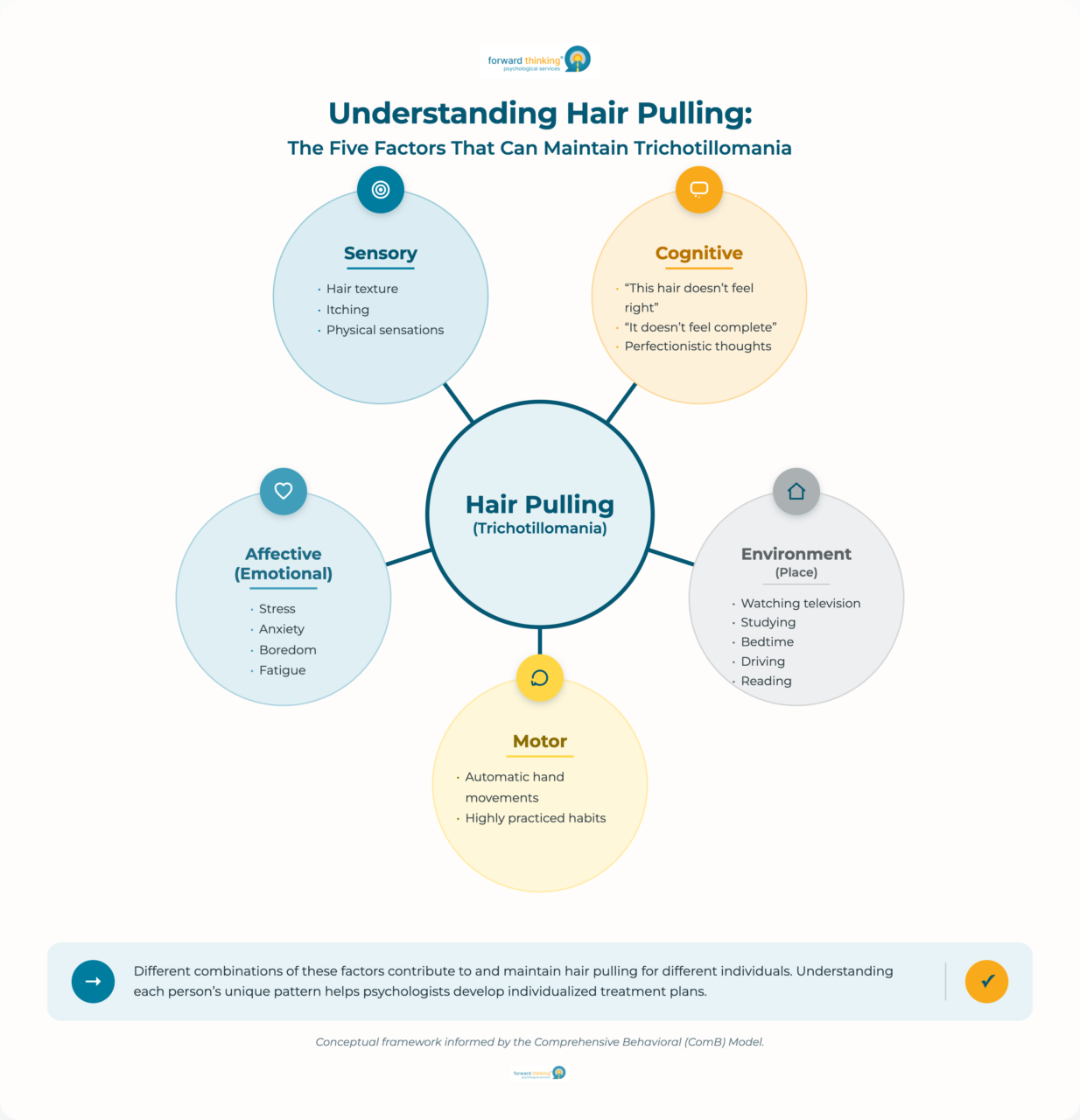
Sensory Factors
Many individuals describe particular sensory experiences that contribute to pulling. Some notice an urge to remove hairs that feel coarse, uneven, or “different.” Others describe satisfaction from manipulating, examining, or pulling certain hairs. For some, hair pulling temporarily relieves uncomfortable physical sensations such as itching or tension.
Cognitive Factors
A person’s thoughts can also influence hair pulling behaviour. For example, some individuals notice perfectionistic thoughts about particular hairs that “do not feel right,” while others become absorbed in examining hairs or experience strong urges to make something feel complete or “just right.” These cognitive experiences can increase the likelihood of pulling in certain situations.
Affective (Emotional) Factors
Hair pulling may occur alongside a variety of emotional experiences. Some people notice increased pulling during periods of stress, anxiety, frustration, boredom, loneliness, or fatigue. Others may pull during quieter moments when they are attempting to relax. Importantly, emotions are rarely the sole explanation for hair pulling, but they often represent one piece of a much larger pattern.
Motor Factors
For some individuals, pulling becomes a highly practiced motor habit. Their hands may move toward the hair with very little conscious awareness, particularly during activities such as reading, watching television, studying, or working on a computer. These automatic movements often occur during sedentary activities or periods of boredom. Over time, these repeated motor patterns can become increasingly automatic.
Place (Environmental) Factors
The physical environment also plays an important role. Many individuals notice that pulling occurs in specific locations or during particular routines, such as sitting on the couch in the evening, driving, lying in bed, or working at a desk. Identifying these environmental patterns often creates opportunities to modify situations that increase the likelihood of pulling.
Although these five domains are described separately, they rarely operate independently. Hair pulling is often maintained by several interacting factors that vary from person to person. This is one of the reasons psychologists conduct a comprehensive assessment before developing a treatment plan.
Habit Reversal Training (HRT) remains the foundation of evidence-based treatment for trichotillomania. The Comprehensive Behavioral (ComB) Model builds upon that foundation by helping psychologists understand the unique combination of factors contributing to and maintaining each individual’s hair pulling. This comparison table below highlights some of the key differences:
|
Habit Reversal Training |
ComB |
|---|---|
|
Strong behavioural foundation |
Builds upon HRT |
|
Focuses on changing pulling behaviours |
Individualizes treatment based on the person’s maintaining factors |
|
Behavioural skills taught to all clients |
Behavioural skills selected based on individualized formulation |
|
Awareness, competing responses, stimulus control |
Sensory, cognitive, affective, motor and place domains guide treatment |
|
Strong evidence base |
Extends HRT through individualized behavioural formulation |
Two people may both pull their hair but require different treatment strategies. Rather than searching for a single hidden cause of hair pulling, psychologists work collaboratively with clients to identify the combination of factors contributing to and maintaining the behaviour. This individualized understanding helps guide treatment planning and the selection of interventions that are most likely to be effective.
Why Understanding Your Pulling Pattern Matters
One of the most reassuring aspects of treatment is learning that hair pulling is often understandable once patterns begin to emerge and are brought into one’s awareness.
For example, one individual may discover that most pulling occurs while studying late at night when they are mentally fatigued. Another may notice that urges increase while watching television because one hand is unoccupied. Someone else may find that they primarily pull hairs that feel coarse or uneven. Although all three people meet criteria for trichotillomania, the processes contributing to and maintaining their pulling are quite different.
This is why treatment is rarely about applying the same strategy to everyone. Instead, psychologists work collaboratively with clients to understand the specific situations, thoughts, emotions, sensory experiences, motor habits, and environmental factors associated with their pulling. Once these patterns become clearer, treatment can be tailored to address the individual’s unique presentation.
Understanding these patterns is often empowering. Rather than viewing hair pulling as random or unpredictable, many people begin to recognize that it follows identifiable patterns that can be understood and modified over time.
One of the goals of treatment is to help individuals become curious about these patterns rather than frustrated by them. As people begin to recognize when pulling occurs and what factors are contributing to it, the behaviour often starts to feel less unpredictable and more understandable. This increased awareness creates opportunities to interrupt the pulling cycle in ways that are both practical and individualized.
Can Trichotillomania Improve?
One of the most common questions people ask after receiving a diagnosis is whether trichotillomania can actually improve.
The answer is encouraging. Research suggests that many individuals experience meaningful reductions in hair pulling when they receive evidence-based psychological treatment. Although progress often takes time and requires consistent practice, many people develop a much better understanding of their pulling patterns, learn effective strategies to manage urges, and significantly reduce the frequency and impact of hair pulling.
It is important to recognize that progress is not always linear. Most people experience periods when pulling becomes easier to manage as well as times when urges temporarily increase, particularly during periods of stress, illness, major life transitions, or changes in routine. These experiences do not necessarily mean that treatment has failed. Instead, they often provide valuable information about situations in which additional planning or different strategies may be helpful.
Rather than viewing occasional lapses as failures, psychologists encourage individuals to approach them with curiosity. Understanding what contributed to the pulling episode often provides important information that can strengthen future treatment planning.
For many individuals, treatment is not simply about reducing hair pulling. It is also about reducing shame, increasing self-understanding, improving quality of life, and developing greater confidence in managing urges over time.
Progress is rarely measured by whether someone never pulls again. Instead, psychologists often look for meaningful changes such as increased awareness, greater ability to interrupt pulling, reduced frequency or intensity of urges, improved confidence in managing difficult situations, and less interference in everyday life.
How Do Psychologists Assess Trichotillomania?
A comprehensive psychological assessment involves much more than determining whether someone meets diagnostic criteria for trichotillomania.
Psychologists also work collaboratively with clients to understand how hair pulling occurs in everyday life and what factors appear to contribute to and maintain the behaviour. This individualized assessment helps guide treatment planning and ensures that interventions are tailored to the person’s unique presentation rather than relying on a one-size-fits-all approach.
During an assessment, psychologists may explore questions such as:
- When is hair pulling most likely to occur?
- Are there particular situations, locations, or routines in which pulling is more common?
- What thoughts, emotions, physical sensations, or urges tend to occur before pulling?
- Is the pulling largely automatic, more deliberate, or both?
- Are there sensory experiences that appear to contribute to pulling?
- What happens immediately after pulling?
- Which situations seem to increase or decrease the likelihood of pulling?
Rather than searching for a single hidden cause of hair pulling, psychologists work collaboratively with clients to identify the combination of sensory, cognitive, emotional, motor, and environmental factors contributing to and maintaining the behaviour. This individualized understanding helps guide treatment planning and the selection of interventions that are most likely to be effective.
For some individuals, hair pulling occurs alongside other conditions, such as anxiety disorders, obsessive-compulsive disorder (OCD), depression, attention-deficit/hyperactivity disorder (ADHD), or other body-focused repetitive behaviours. A comprehensive assessment helps determine whether additional concerns should also be addressed as part of treatment planning.
Conclusion
Hair pulling can be confusing, frustrating, and isolating, particularly for individuals who have spent years believing they simply lacked enough willpower to stop.
Research tells us a different story.
Trichotillomania is a complex body-focused repetitive behaviour that is influenced by a combination of behavioural, sensory, emotional, cognitive, and environmental factors. Effective treatment is not about trying harder. It is about understanding the unique patterns contributing to and maintaining the behaviour so that practical, evidence-based interventions can be selected.
Approaches such as Habit Reversal Training (HRT) and the Comprehensive Behavioral (ComB) Model have significantly improved psychologists’ understanding of trichotillomania and provide structured, individualized approaches to treatment.
With greater awareness, individualized assessment, and evidence-based intervention, many people experience meaningful improvements in their symptoms and quality of life.
Psychological Assessment for Trichotillomania
If you have been struggling with recurrent hair pulling, a comprehensive psychological assessment can help clarify whether trichotillomania or another body-focused repetitive behaviour may be contributing to your experiences. An assessment also provides an opportunity to better understand the unique factors maintaining your hair pulling and to develop individualized treatment recommendations.
At Forward Thinking Psychological Services®, our team provide evidence-based assessment and treatment for trichotillomania and other body-focused repetitive behaviours using approaches informed by current research, including Habit Reversal Training (HRT), the Comprehensive Behavioral (ComB) Model, and cognitive behavioural therapies.
If you would like to learn more about psychological assessment or treatment for trichotillomania, Forward Thinking Psychological Services® offers virtual services across several Canadian provinces.
Contact us today to learn more about our evidence-based assessment and treatment services.

FAQs:
DISCLAIMER: This content is meant for informational and educational purposes only. Only a licensed psychologist or psychiatrist can diagnose a mental health disorder. The content of this website is not meant to be a substitute for therapy. Visiting this website should not be considered to be equivalent to a relationship with FTPS. Mental health concerns should only be discussed in the context of providing professional services after the consent process has been completed with a qualified FTPS associate outside of our website.
Make FTPS a Google Preferred Source
If you found our blog helpful, you can ensure our latest evidence-based mental health insights, tools, and recovery strategies always appear at the top of your Google Search and AI Overviews.